AI solutions
What we do
Services
Experts in
How we work


Choosing a SaaS development company is not the same as hiring a team for a standard website or traditional business application. A SaaS partner must understand recurring revenue models, cloud infrastructure, multi-tenant architecture, subscription billing, security, product analytics, and continuous development.
A team with the wrong skill set and experience can affect the product long after its first release. Poor discovery can lead to features customers do not need. Weak architecture decisions may require an expensive rewrite. An unstable team can delay the launch and leave critical product knowledge with people who are no longer available.
This guide explains how to choose a SaaS development company based on evidence rather than sales claims. It is intended for founders, product leaders, and established businesses preparing to build an MVP, replace legacy software, or scale an existing SaaS platform.
You will learn how to evaluate:
The recommendations are based on our experience across more than 200 software projects, including 25+ SaaS products. Since 2014, our teams have worked on product discovery, technical planning, MVP development, legacy modernization, and post-launch scaling.
A SaaS vendor influences product decisions that may remain in the platform for years. The team defines how customer data is separated, how permissions work, how new features are released, and how the product responds to growth.
These decisions affect development speed, security, operating costs, and the ability to transfer the product to another team. A partner that appears suitable for the first release can become a constraint once the platform gains users or enters a more demanding market.
SaaS products introduce requirements that may not exist in traditional software:
A general software vendor may understand web development but lack experience with tenant isolation, recurring billing, high-load infrastructure, or continuous delivery. Before hiring a SaaS software development company, confirm they know and can make SaaS-specific technical decisions.
The team should also understand how commercial and technical decisions affect one another. A tenancy model influences infrastructure costs. Billing architecture can limit future pricing plans. A weak permission system can block enterprise sales. These are product decisions as much as engineering decisions.
The consequences of a poor vendor decision may not appear during the first sprint. The product can look functional while structural problems grow underneath it.
Common outcomes include:
Replacing the team does not instantly remove these problems — a fix will take time. A new SaaS development partner must first understand the existing code, infrastructure, product logic, and unresolved defects. If documentation is incomplete, the transition may take months before meaningful development resumes.
An architecture rewrite creates an even larger impact. The company may need to maintain the current platform while rebuilding core components, migrating data, and protecting active customers. This consumes budget without producing visible new features.
A capable SaaS development firm reduces these risks through structured discovery, documented architecture decisions, clear acceptance criteria, shared repositories, automated testing, and continuous knowledge transfer.
A low estimate may be valid for a narrow scope. But it may also exclude work required for a production SaaS product.
Before comparing proposals, check whether each one includes:
One SaaS development agency may estimate only feature implementation. Another may include testing, infrastructure, deployment, and release preparation. Their totals are not comparable because they cover different outcomes.
Team seniority also matters. A junior-heavy team may charge less per hour but require more time and supervision. Senior engineers cost more per hour but can reduce architecture mistakes and rework.
A professional proposal should explain why the estimate has a particular range. It should list assumptions, exclusions, dependencies, team composition, and major risks. It should also describe how scope changes affect the budget.
The objective is not to select the most expensive vendor. It is to understand the total cost of reaching a stable production release. A cheap initial build becomes expensive when the product must be repaired, rewritten, or transferred to another team.
You do not need a complete technical specification before contacting vendors. But you should have enough context to explain the product, compare proposals, and recognize whether a potential partner understands the problem.
If every company receives different information, each will estimate a different SaaS development project. A shared product brief creates a consistent basis for evaluation.
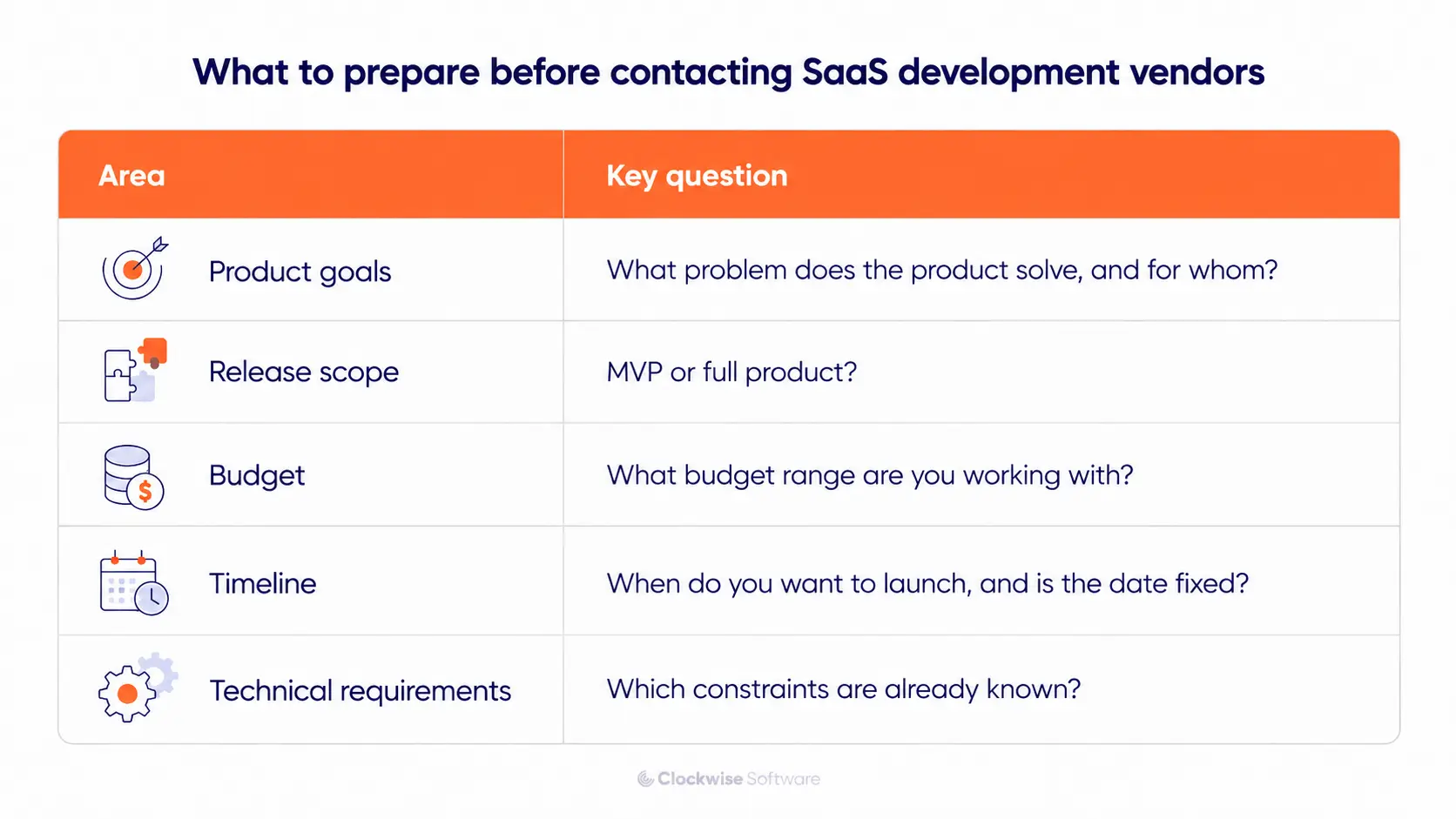
Start with the business result rather than the feature list. Explain why the product should exist and which problem it must solve.
Define:
“Build a project management platform” is too broad. “Help small construction companies track subcontractor work and approve completed jobs from one dashboard” gives the team a clearer audience, workflow, and outcome.
A strong SaaS development company will challenge unclear assumptions. A vendor that accepts every feature without asking about customers, value, or business priorities may be estimating tasks rather than understanding the product.
Clarify whether the immediate goal is to validate an idea, launch a commercial product, replace an existing system, or scale a proven platform.
An MVP should contain the smallest complete experience that delivers value and tests the main assumptions. It still needs appropriate security, reliable infrastructure, monitoring, and enough quality assurance for real users.
A broader first release may be justified when the product replaces an operational system, supports signed contracts, or serves a regulated market. Tell potential development partners which functions are essential for launch and which belong to the longer roadmap.
This helps the vendor propose a realistic release sequence instead of estimating the entire product vision as one project.
Providing a budget range helps the vendor recommend a scope and delivery model that fit the available investment.
Clarify whether the budget should cover:
The partner should explain what can realistically be delivered within the available range. If the complete scope does not fit, the team should help prioritize it rather than hide the gap behind an optimistic estimate.
State the preferred release date and explain why it matters. A deadline tied to funding, regulation, or a customer contract has different implications from an internal target.
Also clarify whether the date is fixed, how quickly stakeholders can approve decisions, and whether phased delivery is acceptable.
A shorter timeline may require a narrower scope or a larger team. Adding developers does not always make delivery faster because architecture, design, integrations, and approvals contain sequential work.
Document the technical constraints already known to the business. Useful information includes:
A specialized SaaS development firm should use this information to evaluate architecture options. Be cautious when a vendor recommends a technology stack before understanding the product.
Prepare the following information:
The brief does not need to answer every technical question. Its purpose is to give each potential vendor the same context and reveal how the team handles uncertainty.
The strongest candidates will not only quote the requested scope. They will identify missing decisions, explain which assumptions require discovery, and propose a practical route from the current product stage to a production release.
A polished proposal does not prove that a vendor can build and support a SaaS product. The evaluation should focus on relevant evidence, delivery processes, technical ownership, and the team that will perform the work.
Use the following criteria to compare potential partners on the same basis.
SaaS experience matters because subscription products have recurring technical and operational requirements. The team must understand multitenancy, permissions, billing, cloud infrastructure, product analytics, continuous releases, and post-launch support.
Do not rely only on the number of years the vendor has operated. Ask how many SaaS products the company has delivered and which lifecycle stages it covered.
Verify:
Request a list of relevant projects and a clear description of the vendor’s contribution. A SaaS development firm should distinguish between work it led and work completed by the client or another vendor.
A large portfolio may still contain little evidence related to your project. Look for cases with similar complexity, workflows, users, integrations, or regulatory requirements.
A useful case study should explain:
Ask whether the people responsible for the case are still with the company and available to support your project.
Where possible, request a client reference. Ask the client how the vendor handled changes, difficult decisions, budget pressure, missed assumptions, and post-launch issues. Positive results matter, but behavior under pressure reveals more about a long-term partner.
A development company should not begin with a feature estimate before understanding the product.
Discovery clarifies the business goal, target users, workflows, scope, risks, and assumptions. It creates the information needed for architecture, design, and a realistic estimate.
Ask the vendor to explain:
Typical deliverables include product requirements, user flows, architecture decisions, a prioritized backlog, a roadmap, a risk register, and estimate assumptions.
A mature SaaS development agency should also know when discovery can be shortened. A company replacing a documented internal platform may need a different process from a founder validating an early product idea.
Architecture determines how the product manages data, permissions, integrations, security, deployment, and growth.
During vendor evaluation, ask a senior technical specialist to discuss your main constraints. Do not limit technical communication to an account manager.
A qualified architect should be able to explain:
Request an anonymized architecture diagram, architecture decision record, or technical discovery deliverable from a previous project.
Be cautious when a SaaS software development company recommends microservices, a specific cloud provider, or a complex stack before understanding the requirements. Technology should support the product, not define it.
Multi-tenancy is one of the main differences between SaaS and ordinary custom software. It determines how customers share application resources while keeping their data and settings isolated.
Ask how the vendor has implemented:
The team should explain how isolation is enforced across databases, APIs, caching, file storage, background jobs, logs, and analytics.
Request a technical explanation from an architect or senior engineer. A generic statement that the team “uses secure multitenancy” is not enough.
The right approach depends on customer size, data sensitivity, compliance, infrastructure cost, and customization needs. A strong partner should discuss these trade-offs rather than present one model as suitable for every product.
Read also: Multi-Tenant Architecture for SaaS: From Fundamentals to Migration
A production SaaS product needs more than a successful deployment. It requires repeatable releases, monitoring, backups, controlled access, and recovery procedures.
Verify whether the vendor can manage:
Ask which cloud accounts will be used and who will own them. The client should retain access and control over production infrastructure.
Request an anonymized infrastructure diagram, deployment workflow, release checklist, or incident-response procedure. These documents show whether DevOps is part of the delivery process or an afterthought.
A SaaS development partner should also explain how infrastructure decisions affect recurring operating costs.
Security must be integrated into architecture and development. Signing an NDA is not a security process.
Ask how the company handles:
If the product operates in healthcare, finance, education, or another regulated industry, confirm experience with relevant requirements. These may include HIPAA, SOC 2, PCI DSS, GDPR, or customer-specific controls.
Request security policies, development checklists, access-control procedures, or evidence from a comparable project. Formal certification can support the evaluation, but it does not replace product-specific security competence.
The company’s portfolio does not build your product. The proposed team does.
Request the names, roles, seniority, availability, and expected involvement of key specialists. Clarify whether the vendor plans to use employees, contractors, or subcontractors.
A typical SaaS product team may include:
Not every role needs to be full-time. But ownership must be clear.
Ask who makes architecture decisions, who reviews code, who controls quality, and who communicates with the client. Also ask how the company replaces a specialist without losing product knowledge.
A professional SaaS development firm should provide access to key team members before the contract is signed.
Communication quality affects every part of delivery. The client needs early visibility into progress, risks, budget, and decisions.
Verify:
Request an anonymized status report, sprint summary, project dashboard, or change request. These materials show how the company communicates when work is in progress.
Weekly demonstrations are particularly useful. They allow stakeholders to review working functionality rather than rely on activity reports.
Transparency does not mean that every project will follow the original plan exactly. It means the client understands why conditions changed and can approve the response.
A SaaS product needs continued technical and product work after release.
Ask whether the vendor provides:
Clarify support hours, severity levels, response expectations, and how unplanned work affects the roadmap.
The company should also explain how knowledge is maintained and transferred. Documentation, accessible repositories, client-owned cloud accounts, and regular handover reduce vendor dependency.
A SaaS development company that only plans for launch may leave the client without the team or operational process needed to support real customers.
Use this SaaS development company checklist after reviewing the proposal and speaking with the proposed team. A missing item is not always a reason to reject a vendor, but it should lead to a direct question.
Contract terms deserve their own review. Further in this article, we’ll talk about what you should clarify before signing a contract and what terms to watch for. But first, let’s us share some points on what to take into account when you compare several vendors.
Sales presentations can make several vendors look equally capable. The criteria above tell you what to evaluate. A structured comparison helps you apply them consistently and separate a strong SaaS development partner from a company that simply presents itself well.
Start by giving every vendor the same input: identical product requirements, expected deliverables, and commercial assumptions. Otherwise, one company may estimate a validated MVP while another includes architecture preparation, security work, production infrastructure, and post-launch support. The prices will differ, but the proposals will not be directly comparable.
Two proposals with similar totals can describe very different projects. Before comparing amounts, review what each price is based on:
If a vendor cannot clearly explain these assumptions, the estimate is harder to trust, regardless of the number.
The pricing model also affects how risk is shared. A fixed-price proposal can provide predictability when the scope is stable. Time and materials usually fits better when the product will evolve through validation and user feedback. A dedicated-team model works well for long-term development with a changing roadmap.
No pricing model removes uncertainty. The important question is how the SaaS development company identifies, communicates, and controls it.
A scorecard keeps the final decision tied to evidence rather than impressions. The categories below consolidate the 10 criteria: architecture, multi-tenancy, cloud and DevOps, and security are grouped under technical expertise, and pricing clarity is added as a separate category.
| Evaluation criterion | Weight | Vendor score | Weighted score |
| Relevant SaaS experience | 20% | 1–5 | Weight × score |
| Technical and architecture expertise | 20% | 1–5 | Weight × score |
| Discovery quality | 15% | 1–5 | Weight × score |
| Proposed team | 15% | 1–5 | Weight × score |
| Communication and transparency | 10% | 1–5 | Weight × score |
| Pricing clarity | 10% | 1–5 | Weight × score |
| Post-launch capabilities | 10% | 1–5 | Weight × score |
Adjust the weights to your situation. A product in a regulated industry may need more weight on technical expertise, while an early MVP may prioritize discovery quality.
Record evidence beside every score. A five should be supported by a relevant case study, a clear process, or a conversation with the proposed specialists. This prevents brand recognition, price, or sales chemistry from dominating the decision.
The best candidate is not necessarily the largest SaaS development firm or the vendor with the lowest quote. It is the company that provides the strongest evidence, makes its assumptions visible, and offers a process suited to your product's risks. If important answers remain unclear after technical discussions and contract review, continue the evaluation before committing the budget.
Now, let’s talk about contract terms and questions to ask before signing it.
The right questions expose unclear responsibilities before they become delivery problems. Ask the same core questions to every shortlisted vendor so their answers can be compared.
The answers should connect discovery to concrete decisions. Be cautious if the process produces only a presentation without a defined scope, roadmap, risks, and estimated assumptions.
The vendor should discuss trade-offs. Immediate certainty without enough product context is a warning sign.
Ask for the proposed team, not a sample team. Confirm that the specialists presented during sales will participate in delivery.
A mature process should make the impact of changes visible before work begins. The client should not discover their financial effect at the end of a billing period.
Read also: SaaS Product Development Process
Contract language and practical access should match. A client can legally own the code while lacking the credentials required to operate it.
Support should be connected to product risk. A business-critical platform needs a different model from a limited pilot.
These questions help you choose a SaaS development company based on how the team will operate, not how well it performs during a sales call.
Document the answers and include important commitments in the contract, statement of work, or delivery plan.
One concern may require clarification. Several unresolved concerns usually indicate that the vendor is not ready to own a complex SaaS product.
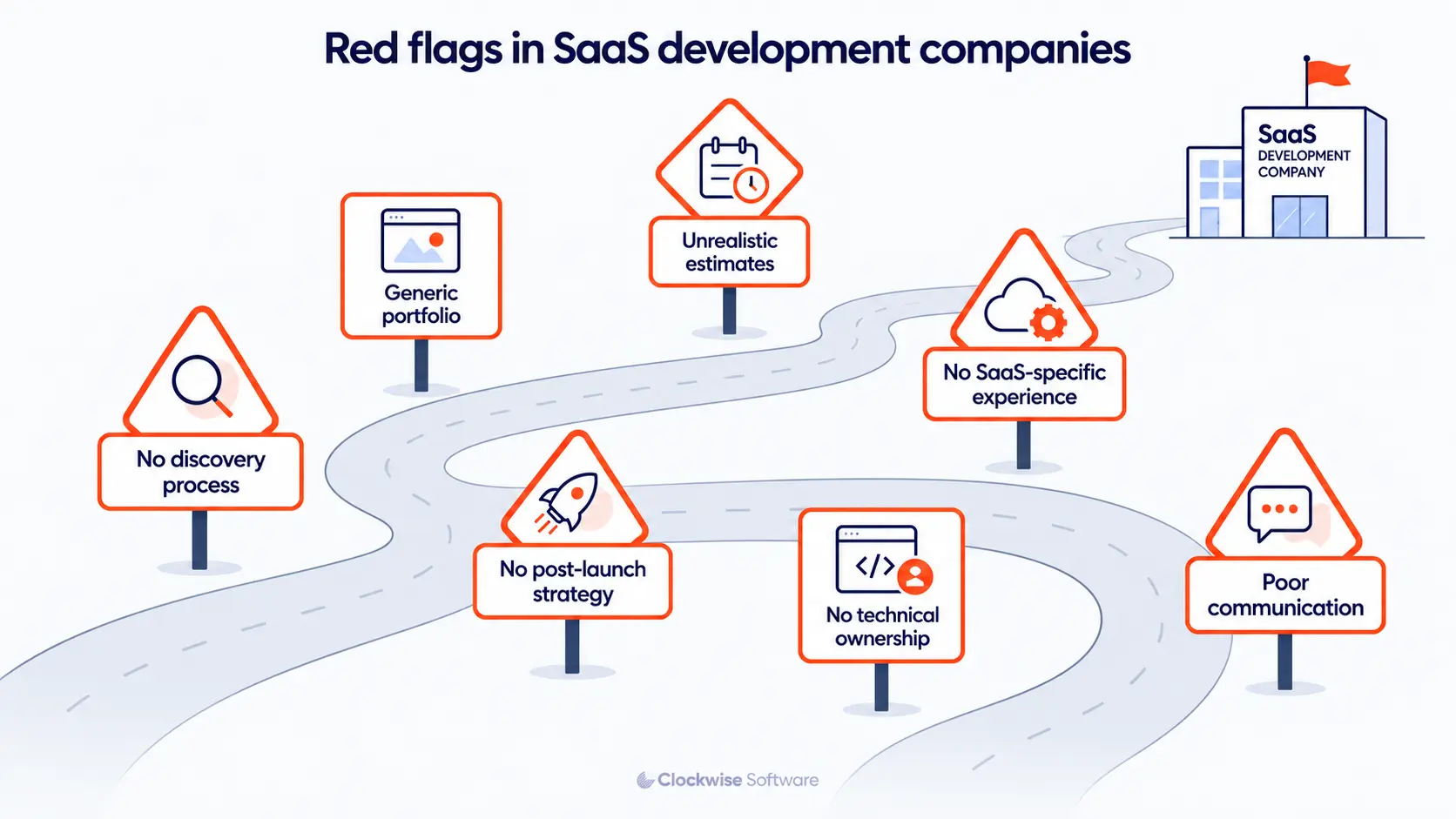
A vendor that provides a precise estimate after a short introductory call is likely estimating assumptions rather than a defined product.
Without discovery, important decisions move into development. Scope changes increase, architecture is selected with limited context, and the budget becomes difficult to control.
A shorter discovery process may be appropriate when requirements are already documented. But the company should still review the scope, risks, integrations, and architecture before committing to a final plan.
A portfolio full of attractive interfaces does not prove SaaS competence.
Red flags include case studies that do not explain the vendor’s role, team, architecture, challenges, or outcomes. The company may have completed a small part of the work while presenting the entire product as its own.
Ask for cases that match your product’s complexity and lifecycle stage. Request technical context and a client reference where possible.
A SaaS development agency should be able to explain what it delivered and how its decisions affected the result.
An unrealistically low estimate may omit discovery, design, QA, DevOps, security, or project management. An unusually short timeline may assume immediate decisions, perfect integrations, and no changes.
Review whether the estimate includes:
A trustworthy SaaS development firm explains uncertainty instead of hiding it inside one attractive number.
General web experience does not automatically cover multitenancy, subscriptions, tenant permissions, cloud economics, or continuous product operations.
If the team cannot explain its experience with tenant isolation, billing, monitoring, scaling, and post-launch development, the client may pay for its learning during the project.
This risk is higher when the product handles regulated data, complex integrations, or enterprise customers.
A vendor focused only on feature completion may treat deployment as the end of the project.
Before launch, the product needs monitoring, backups, analytics, rollback procedures, support ownership, and incident response. After launch, it needs maintenance, security updates, and roadmap work based on customer evidence.
Without this plan, the client may have a working application but no reliable way to operate it.
Technical ownership is unclear when no one is responsible for architecture, code quality, infrastructure, or documentation.
Warning signs include:
This creates vendor dependency and makes future transfer expensive. The client should have access to the code, environments, and documentation throughout delivery.
Slow or unclear communication before signing usually becomes worse after development starts.
Watch for unanswered technical questions, inconsistent estimates, unclear responsibilities, and reluctance to involve delivery specialists.
A vendor should be able to explain its process in plain language. It should also identify risks and challenge unrealistic expectations.
Good communication does not mean agreeing with every request. A capable SaaS development company explains trade-offs and protects the product from decisions that would harm its budget, timeline, or architecture.
If the vendor avoids difficult discussions during evaluation, it is unlikely to handle them well after the contract is signed.
At Clockwise Software, we start by reducing uncertainty. Our process has been shaped by experience delivering more than 200 software projects since 2014, including over 25 SaaS products. The exact workflow changes with the product stage, but the core principle remains the same: every technical decision should support a clear product or business goal.
We begin by examining the product idea, target users, business model, current evidence, and delivery constraints. The team identifies open questions before turning assumptions into requirements.
Depending on the project, Discovery may include stakeholder workshops, market and competitor research, user-flow definition, feature prioritization, technical investigation, and integration analysis. The output is not a generic requirements document. It is an actionable plan that defines what should be built, why it matters, what could go wrong, and what the first release should prove.
A SaaS development company should not treat every requested feature as a fixed instruction. Features consume budget and create long-term maintenance obligations. They need a reason to exist.
Our product and engineering specialists examine the user problem behind each requirement. We help distinguish essential workflows from assumptions that can be tested more cheaply. This keeps the first release focused while preserving a roadmap for later development.
The goal is not to reduce scope at any cost. It is to invest the budget in functionality that supports adoption, revenue, operational efficiency, or another defined product outcome.
Architecture decisions are reviewed against the actual requirements for tenancy, security, integrations, expected load, data volume, and future growth. We avoid adding distributed infrastructure or complex cloud services simply because they may be useful later.
At the same time, we identify decisions that would be expensive to reverse. These may include tenant isolation, data models, identity management, access control, integration boundaries, and deployment strategy. Architecture validation gives the team a technical foundation without turning early development into an infrastructure project.
Our estimates are connected to scope and delivery assumptions. The team breaks the product into manageable components, identifies dependencies, and considers technical and business risks. Where uncertainty is material, we state it instead of hiding it inside a single confident number.
We use work breakdown structures and review realistic and pessimistic scenarios. During development, cost and schedule performance can be tracked through CPI and SPI indicators. This gives stakeholders early warning when delivery differs from the plan and supports informed decisions about scope, resources, or timing.
The project team is selected around the required work. It may include a business analyst, solution architect, UX/UI designer, frontend and backend engineers, QA specialists, DevOps expertise, and a project manager.
Clients communicate with the specialists responsible for the product rather than passing every technical question through a sales layer. Regular planning sessions and weekly demonstrations keep the work visible. Each demonstration connects completed functionality with acceptance criteria and the current product goal.
Our engineers can use AI-assisted development tools where they improve speed or consistency, but generated output remains subject to engineering review, testing, security practices, and the project’s quality standards.
SaaS development services do not end when the first production version is deployed. After launch, the team can support monitoring, incident response, product analytics, improvements, infrastructure changes, and roadmap delivery.
The process also includes documentation and knowledge sharing. The client should retain control of the product, source code, infrastructure access, and technical information. This allows the SaaS development agency to remain a useful long-term partner without making the client dependent on it.
The best candidate is not necessarily the largest SaaS development firm or the vendor with the lowest quote. It is the company that provides the strongest evidence, makes its assumptions visible, and offers a process suited to your product’s risks. If important answers remain unclear after technical discussions and contract review, continue the evaluation before committing the budget.
Choosing a SaaS development company is a decision that outlasts the contract. The team you select will influence your architecture, release pace, operating costs, and how easily the product can change direction after launch.
That's why the evaluation should rely on evidence rather than presentations. Use the criteria to understand what to look for, the checklist to verify each vendor, and the scorecard to compare candidates on the same basis. Before signing, review the contract terms with the same attention you gave to the technical discussions.
If you're starting your search, you can begin with us. We'll show SaaS projects similar to yours, introduce the specialists who would work on your product, and explain how we would approach discovery and delivery.