AI solutions
What we do
Services
Experts in
How we work


How much does it cost to build a SaaS platform? Short answer: somewhere between $12,000 for a discovery phase and $300,000+ for a full enterprise build. On its own, that range is almost useless, so let’s fix it.
Our SaaS development services are built around a more practical question: what does your budget actually buy? Since 2014, our teams have worked on 25+ SaaS products at different stages, from early discovery to enterprise-scale delivery.
In this article, we'll cover what each tier ($25K, $80K, $150K, $300K+) gets you in a real product, the factors that push the number up or down, how the budget splits across discovery, design, development, and the costs nobody warns you about, and how we keep estimates within 10% of the final invoice. Every figure here matches what we quote on live projects. No padding, no "it depends" exits. Let's get into it.
Based on the SaaS projects we’ve worked on over the past three years, budgets usually run from $15,000 for discovery to $300,000+ for an enterprise-grade platform. A focused MVP with one core workflow runs $50,000–$100,000. A market-ready SaaS with multiple integrations and polished UX lands at $100,000–$250,000+. Final cost depends on scope and architecture.
| Budget | What it gets you | Timeline |
| $15K–$25K | Discovery & planning — specs, architecture, roadmap, estimate | 3–8 weeks |
| $50K–$100K | Focused MVP — one core workflow, essential integrations | 3–6 months |
| $100K–$250K+ | Market-ready SaaS — multi-role access, several integrations, refined UX | 6–10 months |
| $250K–$500K+ | Enterprise-grade platform — high load, compliance, multiple modules | 10+ months |
One caveat worth stating up front: except for discovery, these ranges assume production-ready quality. Not clickable prototypes, not weekend experiments. A SaaS product that real users log into has to be stable, secure, and ready to scale, and that’s what these budgets pay for.
The wider your scope, the more your architecture decisions start to drive the bill. We'll show you exactly where that happens next.
Six things move a SaaS budget more than anything else: scope, your tenancy model, UI/UX depth, technical complexity, AI and LLM features, and who builds it. Get these right early and your estimate holds. Get them wrong and you may be paying to rebuild in month six.
Scope is the number of features, user roles, and workflows your product has to support. It's the single biggest lever on cost, because everything else scales with it.
A SaaS with one user type and one core workflow is a different animal from one with admins, end users, team managers, and a billing portal, each with its own permissions and screens. More roles mean more logic, more testing, more edge cases.
The fix is figuring out what’s actually essential to your product and building that first. That’s what a discovery phase is for, and it’s why we’ll keep coming back to it.
Multi-tenancy is where SaaS cost gets specifically SaaS. It's the choice of how your customers share (or don't share) the same infrastructure and data.
A single-tenant setup gives each customer their own isolated instance: cleaner separation, higher running costs. A multi-tenant setup serves everyone from shared infrastructure with logical data isolation: cheaper to run, harder to get right. You can read our SaaS architecture guide for more details.
This decision sits underneath everything: security, scaling, per-customer customization, even your pricing model. Change it after launch and you're not editing code, you're re-pouring the foundation. We make this call during discovery, on purpose, before a line of production code exists.
UI/UX cost tracks the number of unique screens, the depth of each one, and how much of it is custom versus standard.
SaaS products are dashboard-heavy by nature. Data tables, filters, charts, settings panels, onboarding flows, each one is a design and a build. A product with 12 thoughtfully designed screens costs less than one with 40, and a custom design system costs more than a component library. Both can be the right call, depending on who you're selling to.
In the SaaS business model, design matters in different ways depending on the product. For a marketplace, consumer platform, or entertainment app, a distinctive visual identity can be part of the value. The product has to feel memorable, trustworthy, and different from the alternatives, which usually means more custom design work.
For many B2B SaaS products, the priority is different. Users care less about novelty and more about getting routine work done quickly, without confusion. In those cases, standard components can work perfectly well without hurting quality, as long as the flows are clear, the interface is consistent, and the product is easy to learn. Custom design is still useful where it improves the core workflow, but not every screen needs to reinvent the pattern.
Not all features cost the same. Some are quick to build. Others quietly eat weeks.
The expensive ones in SaaS are predictable: subscription billing with tiers and proration, real-time collaboration, role-based access control, white-labeling, and anything touching third-party APIs you don't control. A "simple" Stripe integration is simple until you add trials, upgrades, dunning, and tax.
When we estimate, we break each feature into tasks and give a realistic and a pessimistic number for each. That's how the final bill stays close to the quote instead of drifting, trying to follow SaaS development trends.
AI is now a real cost driver in SaaS, and the build is only part of it, the architecture matters just as much.
The model choice matters more than people expect. On a Releasd, our recent MarTech project, routing everything through one large model looked simplest, but a two-model setup, a small model for classification, a larger one for generation, cut inference costs by ~62% and halved latency. Same output, very different monthly bill.
Budget for three things with AI SaaS development cost: the integration work, the infrastructure, and the ongoing usage costs that scale with your users.
The hourly rate only tells you part of the story.
Cheaper, junior-heavy teams look attractive on the quote and expensive on the rebuild. Top SaaS companies with senior teams cost more per hour and usually less per project, because they make fewer architectural mistakes and need less rework.
On our projects, we usually build a mixed team rather than putting senior engineers on every task. Seniors own the architecture, review critical decisions, and handle the hardest parts. Mid-level and junior developers take on well-defined implementation work under their guidance. That way, you get senior-level technical oversight without paying senior rates for every hour of development.
Geography plays in too: a US in-house rate and an Eastern European senior rate buy very different amounts of product for the same dollar.
We'll break down the team and cooperation question properly in the next section, because it deserves more than a line.
Who builds your product shapes custom SaaS development cost as much as what you build. You've got three realistic models: an in-house team, an outsourced partner, or a hybrid of both. Each fits a different stage and a different budget.
| Model | Best for | Trade-off |
| In-house | Long-term products with a stable roadmap | Highest fixed cost, slowest to start |
| Outsourced | MVPs, long-term development, flexible scaling, and teams without full in-house expertise | Less day-to-day control, partner-dependent |
| Hybrid | Scaling teams that own the core, rent the surge | Coordination overhead |
In-house buys you control and continuity. Outsourcing buys you speed and senior talent without the hiring marathon.
| In-house | Outsourced | |
| Time to start | Months (hire, onboard, ramp) | Days to weeks |
| Cost structure | Fixed — salaries, benefits, overhead | Project- or sprint-based |
| Talent depth | Limited to who you can hire | Senior teams ready on day one |
| Best moment | Once the product and roadmap are proven | Early stages, first release, rapid scaling |
A simple rule: if you don't yet know exactly what you're building or how big it'll get, SaaS outsourcing keeps you flexible. Once the product is validated and the roadmap is steady, an in-house core starts to pay off.
In-house looks cheaper on paper and rarely is. The salary is just the visible part.
The full cost includes recruiting, benefits, equipment, and management time. The bigger challenge is not getting one new hire to start coding. It’s building the full mix of skills a SaaS product needs: product, cloud architecture, frontend, backend, QA, and DevOps. An outsourced partner can often bring that team in at once, while hiring it in-house takes longer and creates more fixed cost.
Heads Up, a US digital health platform, hit exactly this decision after securing investment. The team needed to move fast (migrate off a legacy jQuery stack, finish the healthcare-provider portal, and rebuild the mobile app) without spending months recruiting a full in-house spread of frontend, mobile, backend, and QA talent. Instead of staffing up, they brought in a dedicated Clockwise team covering all four and kept shipping, HIPAA compliance included. The platform now serves 50,000+ users worldwide and raised Series A funding in 2024.
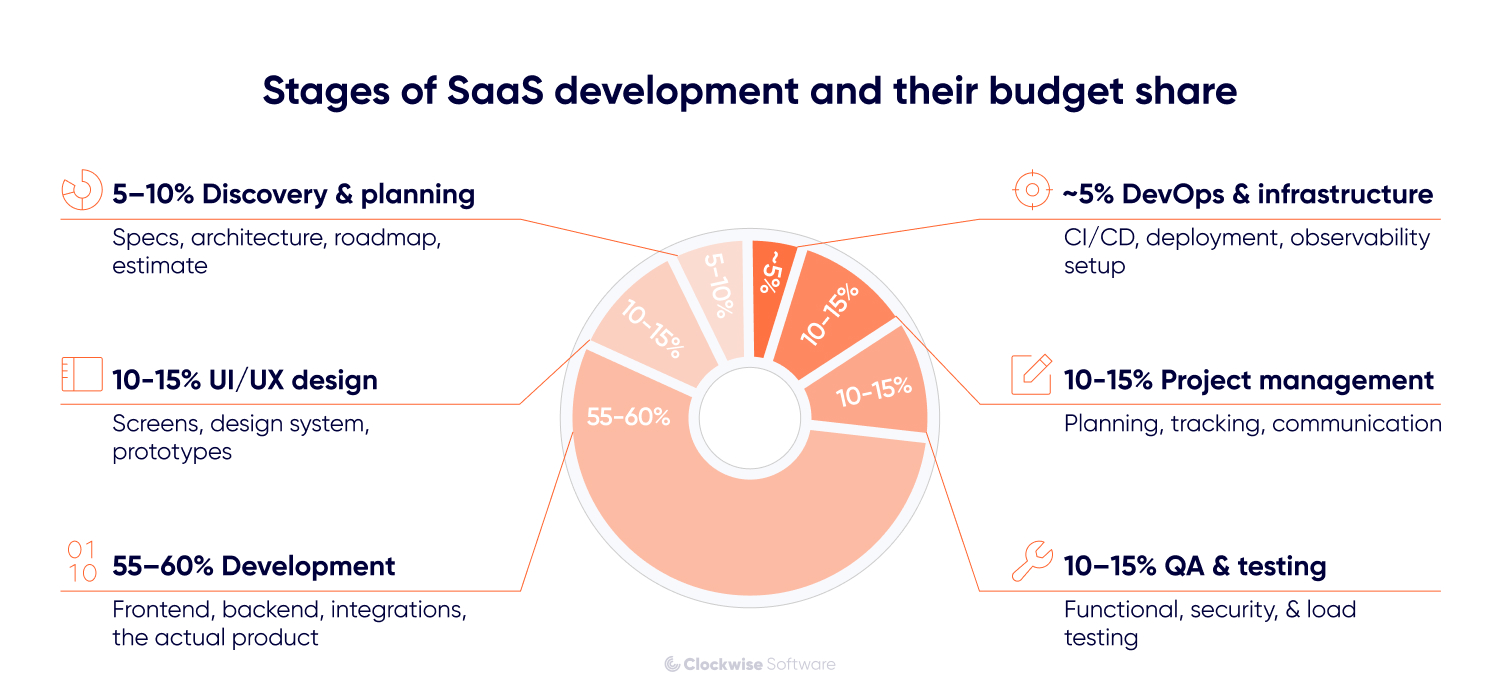
Most of a SaaS budget goes to one thing: development. But the stages around it (discovery, design, QA, and infrastructure) are equally important.
Here's how a SaaS budget typically splits. Percentages are illustrative; the exact mix shifts with scope.
A few of these deserve a closer look, starting with the one founders are most tempted to skip.
Discovery is the smallest line item with the biggest leverage. It's the 5–10% that makes the other 90% predictable.
During discovery, we turn a rough idea into specs, an architecture decision, a prioritized feature list, and an accurate estimate. That's what lets us hold cost and schedule variance under 10% for the rest of the build and create a strong SaaS backup strategy for each project we work on. Skip it, and those decisions still get made — just later, in the middle of the build, where they cost far more to change.
A discovery phase usually runs 4–8 weeks and involves a small senior crew: a business analyst, a software architect, and a UI/UX designer, brought in part-time. You're not paying for a big team here.
How discovery shaped SmartSkip

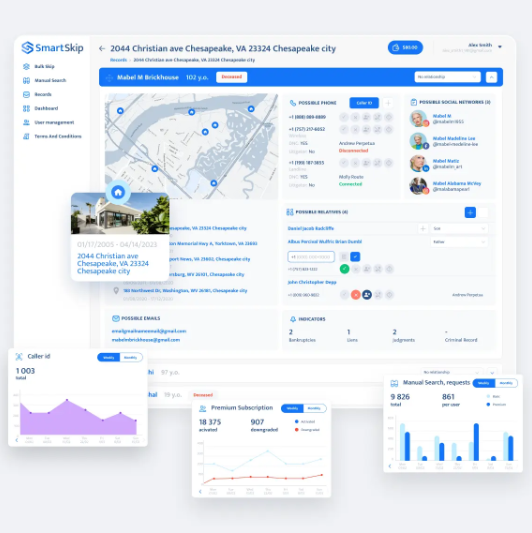
With SmartSkip, a skip tracing platform, the founders already knew the problem (they were their own users), so a lot of discovery was just getting that knowledge out of their heads and into a functional decomposition doc. We ran elicitation sessions three times a week for about two months, then cut the whole thing down to what we called the Minimum Sellable Product. That's what let us give them a realistic build estimate instead of a range.
Design is roughly a tenth of the budget, and in SaaS it earns its keep.
This covers user flows, wireframes, a UI kit or design system, and a clickable prototype before development starts. The prototype matters more than it sounds: it catches confusing flows while they're cheap to fix. For dashboard-heavy SaaS, clean design is the difference between a daily-use tool and an abandoned one.
This is the bulk of the bill, and it's where scope turns into product.
Development covers frontend, backend, database, integrations, and the SaaS-specific plumbing: multi-tenancy, role-based access, subscription billing. We ship in two-week cycles with a demo at the end of each, so you see the product grow and can adjust scope while it's still cheap to adjust. A typical SaaS build team is one PM, one designer, three to five engineers, and a QA specialist, with a part-time DevOps engineer in the first weeks to set up the pipeline.
The last quarter of the budget is what keeps the product stable and on track.
QA runs alongside development. Project management keeps scope, timeline, and communication aligned. DevOps sets up deployment and monitoring in the first weeks. Teams that defer these always rebuild them in production at higher cost.
The build is the visible cost. Running the product is the one that surprises people. Budget for these early:
None of these are optional once you have real customers. Planning for them upfront keeps your runway honest.
At this budget, you don't get a product yet. You get the thing that makes the product predictable — a discovery phase.
For $12K–$25K you walk away with:
The engine under all of this is a work breakdown structure: we split the project into small tasks, then estimate each one twice: a realistic number and a pessimistic one. That's how you see exactly where every dollar goes before you commit to building.
Look at how we ran this for a cloud-based cost-estimation platform that needed a SaaS architecture designed from scratch. A three-month discovery with five part-time specialists produced 11 deliverables: specs, architecture, security checklist, prototype, and an investor-ready pitch package. The client moved from "I have an idea" to "I have a fundable plan" without spending a cent on production code.
If you're at the idea stage, start here — that's exactly what our discovery phase is built to do.
This budget builds a real, usable MVP with one core workflow, the essential integrations, nothing you don't need yet.
The scope at this tier:
The discipline here is prioritization. You're not building the whole vision; you're building the part that proves it.
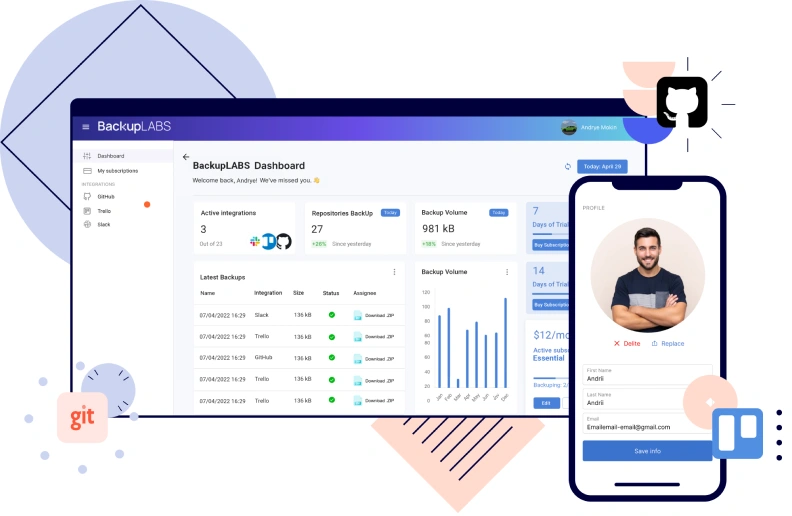
BackupLABS, a data backup platform, is the model. We started with a proof of concept that became the MVP foundation, then built out the integrations that delivered the strongest value first, the ones that could anchor future modules. That focus paid off: the platform now protects 4.5M+ assets for 1,000+ corporate clients. A product in this budget usually needs exactly that kind of prioritization. Start with the integrations that matter most and let them carry the next phase.
At this level, you're not validating anymore, but launching something people pay for. A full product with several integrations, polished UX, and a foundation built to scale.
What changes from the MVP tier is depth on every front: more integrations, richer workflows, broader role and permission logic, and stronger foundations for scaling, onboarding, and continued product growth.
This tier usually folds in everything (discovery, MVP, and the first scaling push) under one plan.
A project that we mentioned earlier, SmartSkip, is the proof. It launched as a complete, sales-ready product and reached ~2,000 paying users in its first year in a highly specific niche, with a compressed discovery feeding straight into a focused build. Push toward the top of this range (and past it) and you get something like the SMM platform we built for an Australian client — four social-network integrations, complex approval workflows, and cross-channel analytics, on a $200K+ budget.
At the top of the range, you're building enterprise infrastructure: large scope, many users, high-load capacity, and the strictest security and compliance.
At this budget, you're supporting many modules and complex, interconnected workflows, on a high-load architecture built for rapid growth. Enterprise security and compliance come into play (SOC 2, HIPAA, GDPR where relevant) alongside deep integrations and migration from legacy systems.
We built a platform like this for an international cultural-exchange organization operating in 100+ countries and onboarding over 25,000 participants a year. It replaced a 10-year-old Salesforce-based system and centralized program setup, candidate matching, visa workflows, and more. The result set the client up for long-term growth and lower operating costs — the kind of foundation that's worth the investment when you're operating at scale.
Cutting the cost of SaaS development isn't about buying cheaper hours. It's about not wasting the hours you buy. Four moves do most of the work: plan before you build, scope the MVP tight, size the architecture for the next real stage, and put AI to work inside the build itself.
The cheapest way to save money on a SaaS build is to decide what you're building before anyone writes code.
Discovery is 5–10% of the budget that protects the other 90%. It surfaces the expensive decisions — tenancy model, scope, SaaS integrations, while they're still cheap to make. On a Releasd project, a single discovery test caught an architecture choice that would have cost ~$40K to undo six months in. The phase paid for itself before development started.
Half the SaaS budgets that blow up do it by building too much, too early.
The discipline is brutal but simple: ship the one workflow that proves the product, then expand. BackupLABS started as a proof of concept, not a full platform, and that focus is exactly why it could grow into something protecting 4.5M+ assets. Every feature you defer is money you keep until the market tells you it's worth spending.
A tight MVP gives you the fastest honest answer to "does this work?", without spending the full vision to get it.
Don't build for the scale you dream about. Build for the scale you'll actually hit next.
Over-engineering for 10 million users you don't have yet burns the budget on infrastructure that sits idle. Under-engineering forces a rebuild the moment you grow. The sweet spot is an architecture that handles your next realistic stage and leaves clean room to extend. That's a discovery decision, made on purpose, not a default you inherit by accident.
The newest cost lever isn't what you build, but how fast you build it.
We run an AI-accelerated SDLC, using AI across the development lifecycle to take the grind out of routine work: boilerplate, test scaffolding, documentation, code review support. That frees senior engineers to spend their time on the decisions that actually need a human, like architecture, trade-offs, edge cases. In practice, it means ~30% faster delivery on the same scope, 9x test coverage, and estimation that's ~75% faster to produce, without trading away quality.
A good estimate isn't a lucky guess that happens to hold. It's a process. Ours keeps cost and schedule variance under 10% on a build, and here's how that actually works.
Every task gets two numbers, not one.
During discovery, we break the project into small pieces with a work breakdown structure, then estimate each one twice: a realistic figure and a pessimistic one. That spread does two things. It shows you the range you're really committing to, and it builds in room for the tasks that always run long. No single optimistic number that quietly falls apart in month three.
Estimates drift when nobody's watching them. We watch them.
We track two metrics across the project: Cost Performance Index (CPI) and Schedule Performance Index (SPI). CPI tells us whether we're on budget. SPI tells us whether we're on schedule. Checked every sprint, they catch drift early, while it's a small correction, not a difficult conversation. This tracking is the reason our variance stays under 10%.
The estimate is only as good as the clarity behind it.
That clarity comes from discovery. By the time we quote a build, the scope is documented, the architecture is decided, and the features are prioritized and broken down. We're estimating a defined plan instead of a vague idea. That's why the number we give at the start stays close to the invoice at the end, and why ~99.89% of our delivered work is accepted on the approved version.
A SaaS budget comes down to one decision: what you build first.
For $12K–$25K you get a discovery phase and a fundable plan. $50K–$100K builds a focused MVP that proves the product. $100K–$250K+ gets you a sales-ready SaaS people pay for. $250K–$500K+ builds enterprise-grade infrastructure at scale. Where you land depends on scope, architecture, and how much you build now versus later.
The teams that stay on budget all do the same thing: they plan before they build, scope tight, and track the estimate as they go. That's the whole game.
If you want a real number for your product, not a range from a blog, that's what a discovery phase is for. Tell us the scope and we'll map it.