
Explore our services
AI solutions
What we do
Services
Experts in
How we work


There is no universal best tech stack for SaaS. React, Node.js, PostgreSQL, and AWS are common choices, but popularity alone does not make them right for every product. A real-time collaboration platform, a healthcare solution, and a lean SaaS MVP have different requirements. Using the same technology stack for SaaS in all three cases may create unnecessary costs, security gaps, or scaling limits.
Your SaaS tech stack affects more than application performance. It determines how quickly you can launch, how easily developers can maintain the product, and how much infrastructure will cost as usage grows. It also influences hiring, integrations, security, tenant isolation, and the effort required to add new features. A poor early decision may not cause immediate problems, but it can slow every release once the product gains customers.
The right selection process starts with product requirements. You need to understand the expected workload, data model, user roles, integrations, compliance obligations, budget, and available engineering expertise. Only then can you compare suitable technologies and their trade-offs.
This guide explains the layers of a SaaS technology stack, the business impact of common technical decisions, and practical stack options for different product scenarios. The recommendations draw on Clockwise Software’s experience delivering more than 25 SaaS products across multiple industries.
Architect's note

The right stack is not the one with the most advanced tools. It is the simplest combination that meets current requirements without blocking the product’s next realistic stage of growth.
A SaaS tech stack is the complete set of technologies used to build, deploy, operate, secure, and maintain a software-as-a-service product. It includes programming languages and frameworks, but it also covers databases, cloud services, deployment pipelines, monitoring tools, payment systems, and external integrations.
Each layer supports a specific part of the product. The frontend delivers the interface customers use. The backend processes requests and business rules. Databases store product and customer data. Cloud infrastructure keeps the application available, while security and observability tools protect the system and help the team detect failures.
A standard web application may serve content, collect form submissions, or provide the same functionality to every visitor. A SaaS product usually has more complex operational requirements. It must manage customer accounts, plans, permissions, recurring payments, and continuously changing data. It may also need to support thousands of organizations without exposing one customer’s information to another.
For this reason, a SaaS software stack must support the product’s business model as well as its application code. The architecture should make upgrades, billing changes, integrations, and ongoing releases possible without disrupting existing customers.
A production-ready SaaS application tech stack normally includes the following layers:
These layers must work as one system. In a multi-tenant SaaS product, for example, tenant identity should remain consistent across authentication, application logic, database access, logs, and billing. Adding tenant separation after development has started is far more difficult than designing it into the initial SaaS architecture.
A SaaS development tech stack is a business decision expressed through technology. It shapes when the product can reach customers, what it costs to operate, and how quickly the team can respond to market feedback.
A familiar, well-supported framework can reduce setup time and help the team release an MVP sooner. Mature ecosystems also provide tested components for authentication, payments, reporting, and other common SaaS functions. But development speed should not come at the cost of critical foundations. Tenant isolation, access control, backups, and basic monitoring should not be postponed as optional improvements.
SaaS development cost includes more than the initial build. Companies also pay for cloud resources, third-party services, maintenance, security updates, troubleshooting, and future hiring. Managed services can reduce DevOps work during an early stage, but their pricing and usage limits may become restrictive later. Self-managed infrastructure offers more control, yet requires engineers who can operate it reliably.
Good SaaS scalability does not mean preparing every MVP for millions of users. It means identifying likely bottlenecks and keeping practical paths open. A modular monolith with a relational database can support many products for years. Microservices may help when separate workloads or teams need independent deployment and scaling, but they also add networking, monitoring, testing, and data consistency challenges.
Technology selection affects how easily a company can expand or replace its engineering team. A niche framework may solve a specific problem well, but a limited talent pool can raise hiring costs and create dependency on individual developers.
The same applies to proprietary cloud services. They can shorten delivery time, but the team should understand how difficult and expensive a future migration would be.
| Decision | Short-term effect | Long-term risk |
| Use a framework the team already knows | Faster MVP delivery and easier troubleshooting | It may not fit specialized performance or compliance needs |
| Choose managed cloud services | Less infrastructure work and faster deployment | Higher costs at scale and stronger provider dependency |
| Start with microservices | Independent services and clear technical boundaries | More operational complexity before the product needs it |
| Select a niche technology | A strong fit for a specific technical requirement | A smaller hiring pool and fewer maintained integrations |
On one SaaS engagement, our team prioritized a modular architecture and managed infrastructure instead of introducing separate services from the start. This kept the first release manageable while preserving clear boundaries for future scaling.
That is the value of SaaS development services from an experienced team: connecting technical choices to delivery speed, operating cost, and actual growth plans rather than applying the same stack to every product.
A modern SaaS technology stack is a connected system, not a collection of popular tools. Each component should support a specific product requirement. The frontend affects usability and release speed. The backend handles business rules and integrations. The database defines how safely and efficiently data can be stored. Cloud infrastructure keeps the product available, while monitoring tools help the team understand what happens in production.
The frontend for SaaS includes everything customers and administrators interact with. It may contain dashboards, account settings, subscription controls, reports, onboarding flows, and role-based workspaces. A suitable framework should help the team build these interfaces consistently without slowing future changes.
React is a common choice for interactive SaaS applications. Its component model works well for dashboards, complex forms, and interfaces that change based on user permissions or data. It also has a large ecosystem and broad hiring market. However, React is a library rather than a complete application framework. The team still needs to make decisions about routing, data fetching, rendering, and project structure.
Next.js adds an application framework around React. It supports server-side and client-side rendering, routing, caching, and other production features. This can make it suitable for SaaS products that combine public content with an authenticated application. The official Next.js documentation also covers deployment, authentication, testing, data security, multi-tenant applications, and observability. The trade-off is additional framework behavior that developers must understand, especially when deciding where data should be rendered and cached.
Vue offers a flexible approach with a relatively approachable development model. Nuxt provides a more structured framework around Vue, similar to the role Next.js plays for React. These technologies may fit teams that already have strong Vue expertise or products that need a clean, component-based interface without adopting the React ecosystem.
Angular is more opinionated. It provides built-in patterns for structuring large applications, which can help when several teams work on a complex enterprise interface. That structure also creates a steeper learning curve and may be unnecessary for a small SaaS MVP.
TypeScript is often used with React, Next.js, Vue, Nuxt, and Angular. Static typing can make large codebases easier to maintain by identifying certain errors before deployment. But it does not replace testing or sound application design.
The choice between web and mobile also matters. A responsive web application may be enough for products used mainly at a desk. A field service, delivery, fitness, or communication product may require a mobile-first experience, offline behavior, push notifications, and access to device functions. These requirements should be confirmed before selecting the interface layer.
The SaaS backend processes business logic, controls access to data, manages integrations, and connects product actions with billing or account rules. Its requirements depend on the product’s workflows and performance profile.
Node.js works well for applications that handle many network requests, APIs, and real-time events. NestJS adds stronger conventions, modularity, dependency injection, and a clearer application structure. This can help larger teams maintain a Node.js codebase as the product grows.
Python is often selected for products involving data processing, automation, or machine learning. Django provides many established components for building business applications, while FastAPI is commonly used for API-focused services. Python can also reduce friction when the product’s core functionality depends on data science or AI models. Still, using Python solely because a product may add AI later is not a strong enough reason to shape the entire backend around it.
.NET and Java with Spring are established options for complex B2B and enterprise systems. They can be a good fit when the product needs strong typing, long-term maintainability, mature security tooling, or integration with an existing corporate environment. Their structured ecosystems help large teams, but the initial setup may be heavier than a lean startup needs.
Ruby on Rails remains practical for products where delivery speed and standard business workflows matter more than specialized performance. Its conventions can help an experienced team build quickly. The main consideration is whether the company has access to developers who can maintain the product over time.
Backend selection should follow the business logic, integration load, security model, and skills available to the team. No language is automatically the best SaaS backend for every product.
The database for SaaS must store product data while preserving integrity and tenant boundaries. In many B2B applications, relationships between users, organizations, subscriptions, roles, and transactions make a relational database the natural starting point.
PostgreSQL supports relational data, transactions, advanced queries, and row-level security policies. These capabilities can be useful in a multi-tenant system, although database policies must still be combined with correct application-level authorization. MySQL is another mature relational option with broad tooling and support.
MongoDB fits products with flexible document structures or data that does not map cleanly to relational tables. But schema flexibility should not be confused with the absence of a data model. Poorly designed document structures can still create difficult migrations and inconsistent data.
Redis is normally used alongside a primary database. It can support caching, session data, rate limits, queues, and short-lived values. It should solve a measured performance or workload problem, not be added by default.
Elasticsearch can provide full-text search and analytics across large datasets. It introduces another system to operate and synchronize, so a product should first determine whether the search capabilities of its primary database are sufficient.
A separate data warehouse becomes useful when analytics workloads begin to compete with transactional operations or when the company needs to combine data from several systems. For an early MVP with modest reporting needs, it often adds cost and complexity without enough value.
SaaS cloud infrastructure determines how the application is deployed, scaled, secured, and recovered. AWS, Microsoft Azure, and Google Cloud all provide compute, databases, storage, networking, monitoring, and managed security services. The correct choice usually depends on team expertise, customer requirements, available services, and the ecosystems the product must integrate with.
AWS offers a broad range of infrastructure and managed services. Azure can be a natural fit for products serving companies that already use Microsoft identity, data, and enterprise tools. Google Cloud is often considered for products with strong data, analytics, or machine learning needs. The provider name alone does not create a reliable architecture. Service configuration, access controls, backup policies, and cost management matter more.
Platforms such as Vercel can reduce deployment work for web frontends and some full-stack applications. This may help a small team launch faster. The trade-off is tighter dependence on platform-specific behavior and pricing.
Docker makes application environments more consistent across development, testing, and production. CI/CD pipelines automate tests and deployments, reducing the number of manual steps required for each release. Infrastructure as Code records cloud resources in version-controlled configuration, making changes easier to review and environments easier to reproduce.
A well-designed deployment process should support repeatable releases, rollback, backup, and recovery. Scaling is useful, but the team must also know what happens when a deployment fails or a critical dependency becomes unavailable.
SaaS authentication covers more than sign-in. It includes password recovery, email verification, session management, multi-factor authentication, organization membership, roles, permissions, and sometimes enterprise single sign-on.
Services such as Auth0, Amazon Cognito, and Clerk can reduce the amount of security-sensitive functionality a team builds internally. The decision should account for pricing at the expected user volume, supported identity providers, data location, customization needs, and the effort required to migrate later.
SaaS payment integration is also more complex than adding a checkout form. Subscription products may need trials, plan changes, prorated charges, usage-based billing, discounts, refunds, failed-payment recovery, invoices, taxes, and entitlement updates. Stripe Billing supports many of these workflows, but the application still needs clear rules for how billing events affect access to product features.
Email platforms, analytics systems, CRMs, and customer support tools also become part of the SaaS technology stack. Each integration introduces API limits, webhooks, credentials, error states, and external dependencies. Reliable integrations require retries, idempotency, logging, and a process for handling events that arrive late or more than once.
A product is not production-ready simply because it has been deployed. The team needs to know whether it is available, how quickly it responds, and where failures occur.
Logs record application and infrastructure events. Metrics show trends such as request volume, latency, resource use, and error rates. Error tracking captures failed operations with enough context for investigation. Distributed tracing follows a request across services, which becomes important as system complexity grows.
OpenTelemetry provides a vendor-neutral framework for collecting traces, metrics, and logs. SaaS monitoring tools can then store, analyze, and visualize this data. Uptime checks and alerts should focus on conditions that require action, not generate constant noise.
Observability is also a business tool. It can reveal that a critical onboarding flow is failing, a third-party API is delaying transactions, or one tenant is consuming unusual resources. This allows the team to address problems before they affect a large part of the customer base.
Learning how to choose a tech stack starts with defining what the product must do. Beginning with “Should we use React or Angular?” skips the decisions that should shape the answer.
A good discovery process translates SaaS product requirements into architecture drivers. These are the conditions that materially affect the tech stack decision: real-time communication, sensitive data, tenant isolation, complex reporting, third-party integrations, expected traffic, and delivery deadlines.
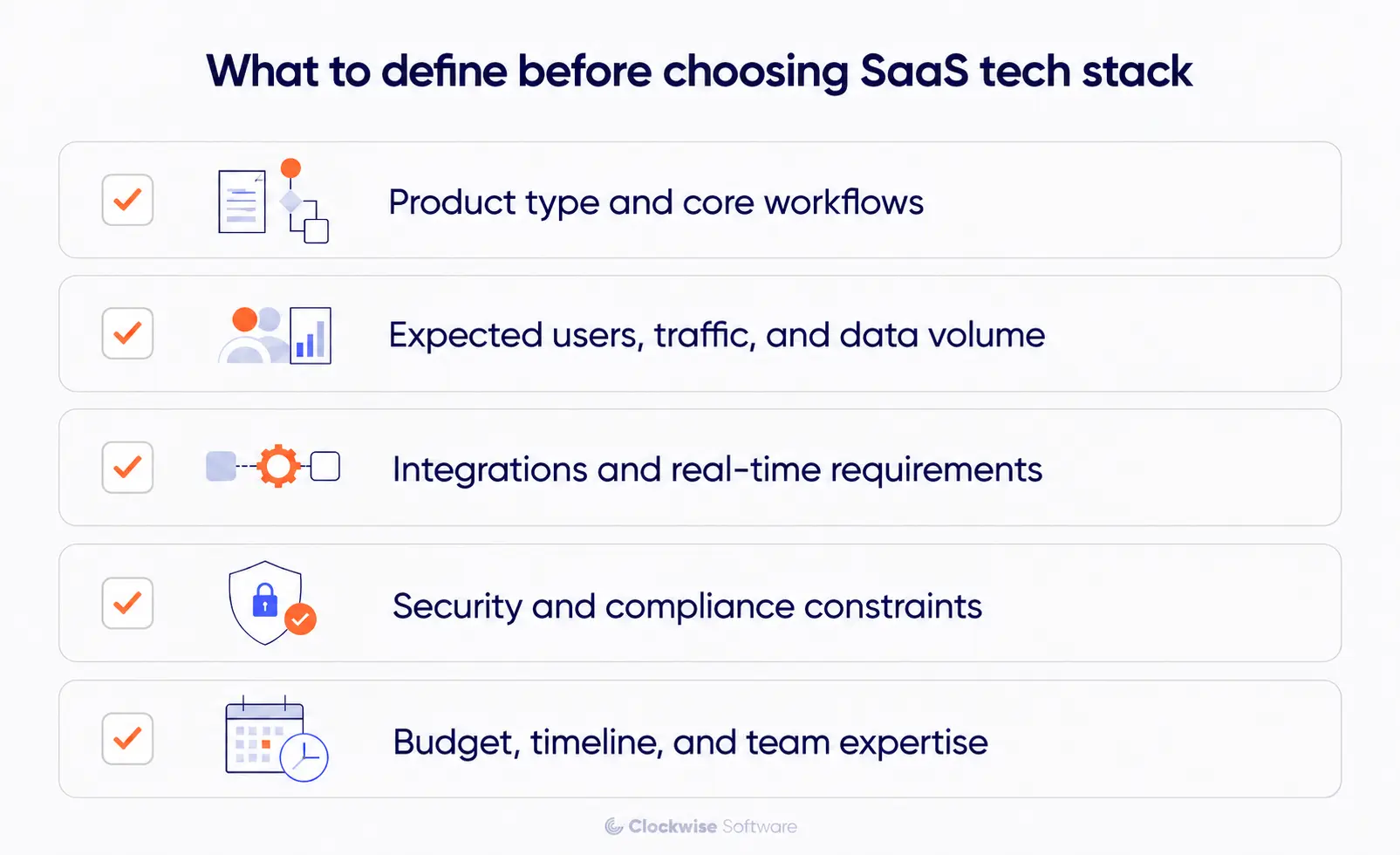
First, define who will use the product and what they must accomplish. A B2C subscription app may need simple account management and high-volume self-service onboarding. A B2B SaaS platform may need organizations, teams, custom roles, approval workflows, invoices, and SSO. An internal tool being converted into SaaS will need stronger tenant isolation and customer-facing administration than its original version.
The team should identify the workflows that create the product’s main value. These deserve more architectural attention than features that are useful but not central to the business model.
Capacity planning should use realistic assumptions. “The product may have millions of users” does not provide enough information. The team needs estimates for active users, peak concurrent sessions, request frequency, file sizes, data growth, and background processing.
A system with 100 enterprise customers may handle more data and integration traffic than a consumer product with thousands of light users. Architecture decisions should follow workload patterns, not account numbers alone.
Business-critical integrations need to be identified early. Payment systems, CRM platforms, accounting tools, mapping services, AI APIs, and enterprise identity providers can influence the data model and failure-handling strategy.
Real-time features also change the design. Live collaboration, location tracking, chat, and streaming updates require different communication and state-management patterns than standard request-and-response workflows.
Security requirements depend on the data being processed and the customers buying the product. Healthcare, finance, education, and enterprise SaaS may require stronger access controls, audit logs, retention policies, encryption, regional hosting, and documented recovery procedures.
Compliance should not be treated as a final certification task. It affects SaaS software architecture, infrastructure, development workflows, and vendor selection from the start.
The most technically flexible stack may not be the most practical one. The team must be able to build, operate, and hire for it within the available budget. A familiar framework with a mature ecosystem often creates less delivery risk than a newer tool with a theoretical advantage.
Before making a final decision, answer these questions:
A practical rule

If the team cannot connect a technology to a product requirement, operational need, or known risk, it probably does not belong in the initial stack.
This is where an experienced SaaS team adds value. At Clockwise Software, we evaluate technical options against product goals, performance expectations, budget, and future ownership. The result is not simply a list of tools. It is a documented decision that the business and engineering team can understand, challenge, and revisit.
Framework comparisons receive a lot of attention, but the most expensive SaaS problems often come from deeper architecture decisions. Tenant isolation, deployment boundaries, data ownership, and failure handling affect the entire product. Changing them later can require far more work than replacing a frontend library.
In a single-tenant model, each customer receives a separate application environment or infrastructure setup. This can provide strong isolation and support customer-specific configurations. It also increases deployment, monitoring, and maintenance work because every environment must be managed.
A multi-tenant architecture allows several customers to use shared application resources. This usually improves infrastructure efficiency and makes updates easier to distribute. But the system must consistently identify the tenant and enforce data boundaries across every request, query, background job, log, and integration.
A multi-tenant SaaS database architecture can use several isolation models:
The right model depends on customer expectations, compliance obligations, unit economics, customization needs, and team capacity. Some products use a hybrid approach, keeping most customers in shared infrastructure while providing stronger isolation for selected enterprise accounts.
PostgreSQL row-level security can help enforce which rows a user or role may access. However, no database feature removes the need for correct tenant context and authorization throughout the application.
For many SaaS MVPs, a modular monolith is a practical starting point. The application is deployed as one unit, but the codebase is divided into clear business modules such as accounts, billing, notifications, and reporting. This keeps development and testing manageable while preserving boundaries that can support future changes.
SaaS microservices become useful when there is a specific reason to separate parts of the system. One workload may need independent scaling. Different teams may need separate deployment cycles. A domain may require its own reliability or security boundary. In these cases, service separation can solve a real organizational or performance problem.
But microservices also introduce network failures, distributed tracing, service authentication, data consistency issues, deployment coordination, and more infrastructure. Starting with them before those problems exist can slow an MVP and increase SaaS development cost.
The decision should be based on deployment and domain boundaries, not on the assumption that microservices automatically make a product scalable.
A scalable SaaS architecture should allow application instances to be added when demand increases. This is easier when instances do not depend on local state and shared state is stored in suitable external systems.
Caching can reduce repeated database work and improve response times. But cached data can become stale, and invalidation rules may be difficult to maintain. The team should cache measured bottlenecks rather than add caching everywhere.
Background jobs are useful for work that does not need to finish within a user request. Email delivery, report generation, file processing, synchronization, and AI workloads are common examples. Queues can distribute this work and support retries, but failed or repeated jobs must be handled safely.
An API-first approach defines clear contracts between the backend, frontend, mobile clients, and external systems. This can help when a SaaS product must support multiple interfaces or expose functionality to customers and partners.
Good API design includes authentication, authorization, versioning, rate limits, error handling, and idempotency. These concerns matter even when the first API is used only by the product’s own frontend. They become critical once third parties depend on it.
External integrations should be treated as unreliable by default. Providers can return errors, apply rate limits, change response formats, or deliver webhook events more than once. The architecture must contain these failures so one unavailable vendor does not disrupt the entire product.
Managed services can help a team deliver faster, but every dependency should be evaluated for portability. The question is not whether vendor lock-in can be eliminated. Most useful platforms create some dependency. The goal is to understand its cost and keep an acceptable exit path.
The team should know:
| Architecture decision | When it may fit | Main benefit | Main trade-off |
| Shared multi-tenant database | SaaS products with many customers and similar data needs | Efficient infrastructure and simpler updates | Tenant controls must be enforced consistently |
| Separate database per tenant | Enterprise or regulated products requiring stronger isolation | Clearer customer-level separation | More provisioning and maintenance work |
| Modular monolith | MVPs and products managed by one development team | Faster delivery with lower operational complexity | Modules need disciplined boundaries |
| Microservices | Products with independent workloads or several autonomous teams | Separate deployment and scaling | Distributed-system complexity |
| Managed cloud services | Teams that need to reduce infrastructure work | Faster setup and less operational burden | Pricing and provider dependency |
| Self-managed components | Products with specialized control or portability needs | More configuration freedom | Greater DevOps responsibility |
Across our SaaS work, the recurring challenge is not choosing between two frameworks. It is finding the right balance between delivery speed and long-term control. Building every possible scaling mechanism into an MVP wastes time. Ignoring tenant boundaries, security, and deployment reliability creates a different kind of risk.
The practical answer is to design for the next credible stage of growth. Keep the initial system understandable, document why each major decision was made, and define the conditions that would justify changing it. That creates a stronger foundation than choosing a complex architecture simply because it appears more future-ready.
The examples below are starting points, not universal recipes. The best SaaS tech stack depends on the product’s workflows, customers, security requirements, expected load, and available engineering expertise. Even two products in the same market may need different architecture because their data models, integrations, or growth plans differ.
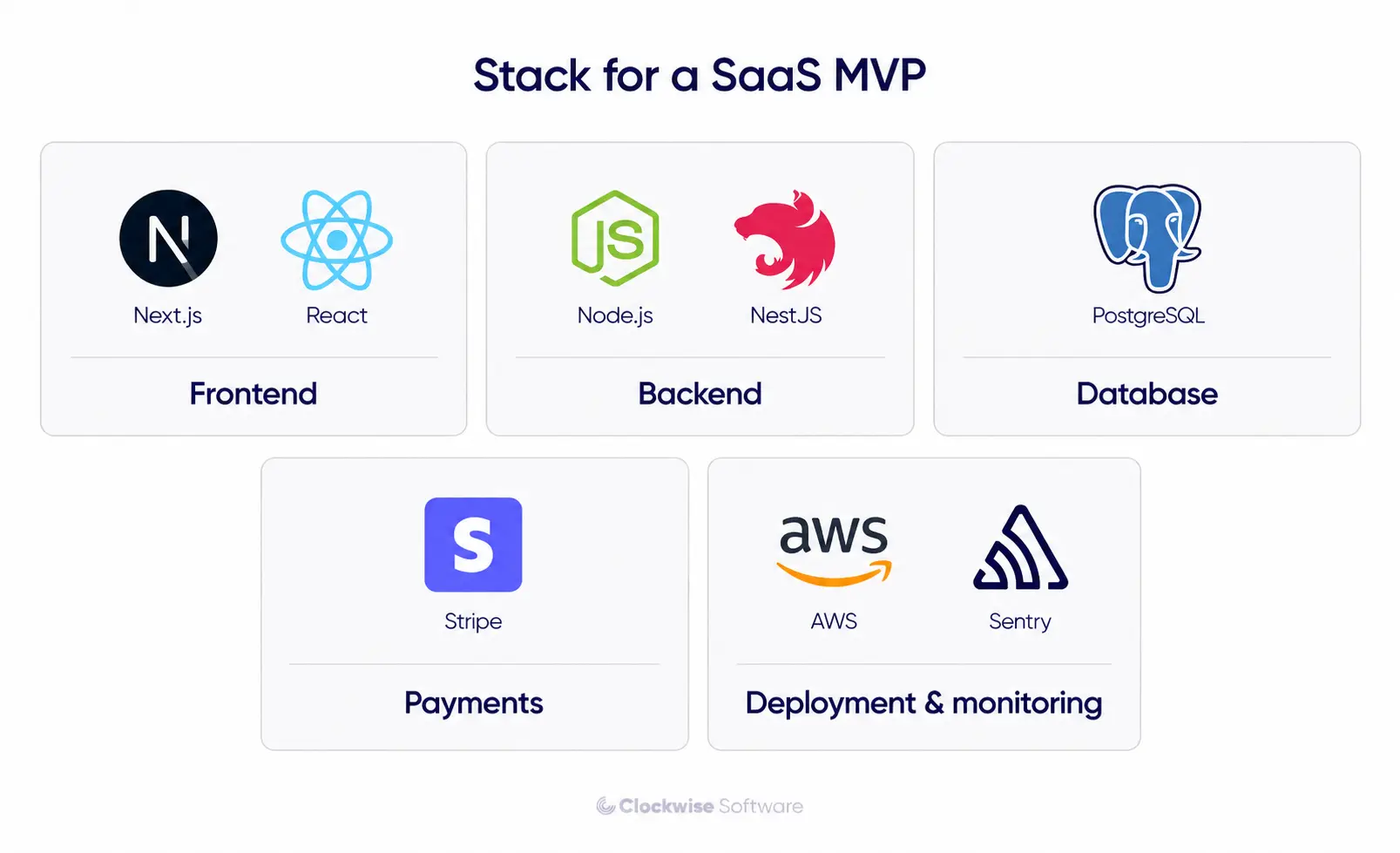
A practical SaaS MVP tech stack may include Next.js or React for the interface, Node.js with NestJS for the backend, and PostgreSQL as the primary database. Managed authentication can handle sign-in and account recovery, while Stripe supports subscriptions and payments. A managed deployment platform and Sentry or a similar error-tracking tool can reduce the operational work required for the first release.
This combination fits products that need to validate demand quickly. Its technologies are widely used, supported by large ecosystems, and easier to hire for than niche alternatives. A modular monolith usually keeps development simpler than splitting the product into several services before its boundaries are clear.
But this stack is not automatically right for every MVP. A product centered on machine learning may benefit from Python. A mobile-first service may need React Native or Flutter. A healthcare product may require stronger infrastructure controls than a general managed platform provides.
The goal is to build the smallest production-ready foundation that can test the business idea. Authentication, tenant separation, backups, and monitoring still need proper implementation. “MVP” should reduce product scope, not basic security or reliability.
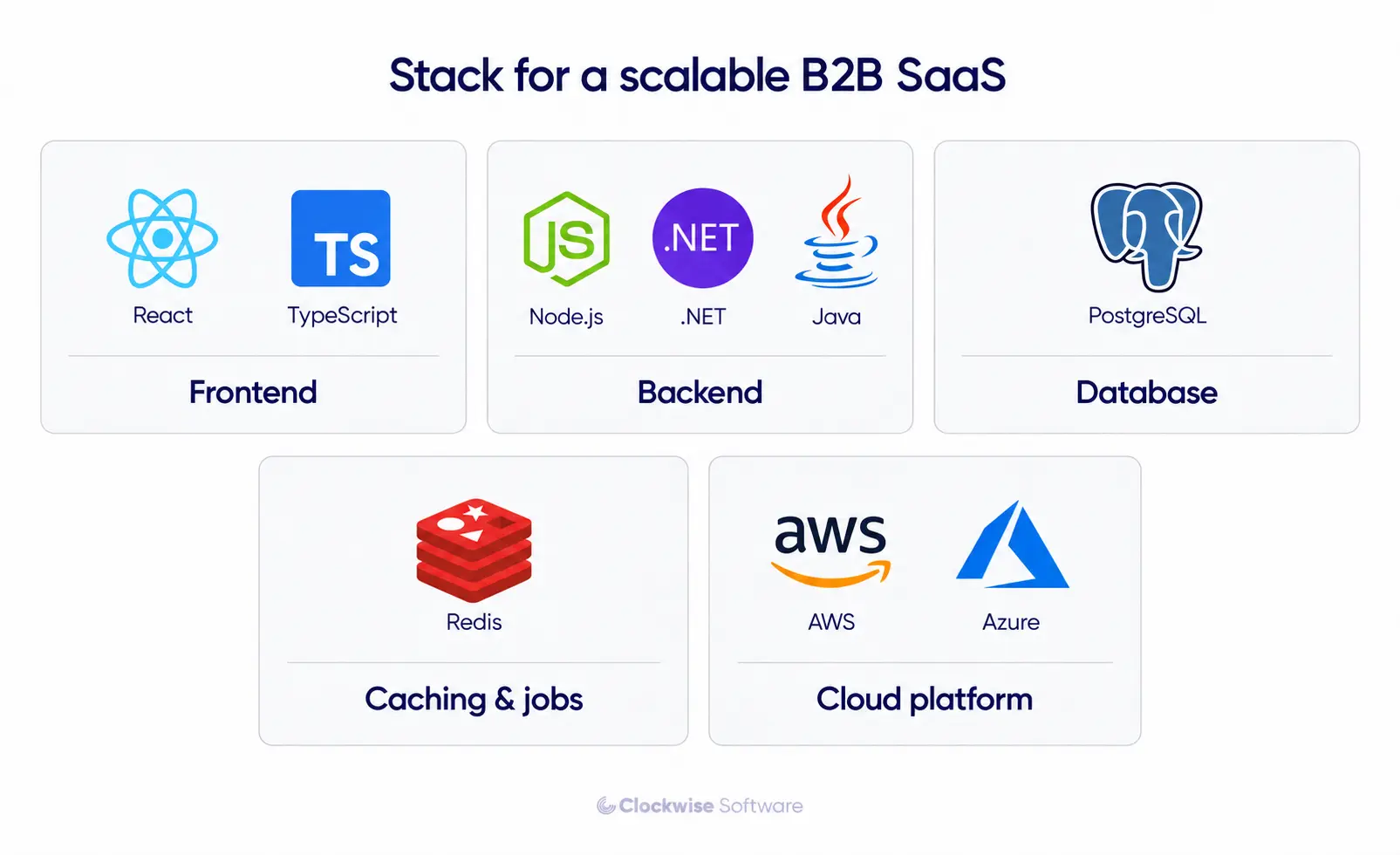
A B2B SaaS tech stack often needs to support organizations, multiple user roles, approval workflows, reporting, SSO, and numerous third-party integrations. React with TypeScript is a common frontend option. Node.js, .NET, or Java can provide a structured backend, while PostgreSQL handles relational business data. Redis may be added for caching, rate limits, or background job coordination when there is a clear need.
AWS and Azure both support scalable compute, managed databases, identity tools, private networking, monitoring, and automated deployment. The choice should account for customer requirements and the team’s existing cloud expertise. Azure may fit companies that depend on the Microsoft ecosystem. AWS may offer more familiar options to teams already operating cloud-native products.
Tenant-aware authorization is critical. Permissions should consider both the user and the organization in which the action occurs. This logic must remain consistent across APIs, background jobs, reporting, and administrative tools.
A scalable SaaS tech stack also needs reliable CI/CD and observability. Automated testing and deployment help several engineers release changes without turning every update into a manual operation. Logs, metrics, traces, and alerts make failures easier to detect and diagnose.
This setup works well for a growing B2B platform, but it requires more initial planning than a simple MVP. Without clear module boundaries and access rules, adding enterprise features later can become slow and expensive.
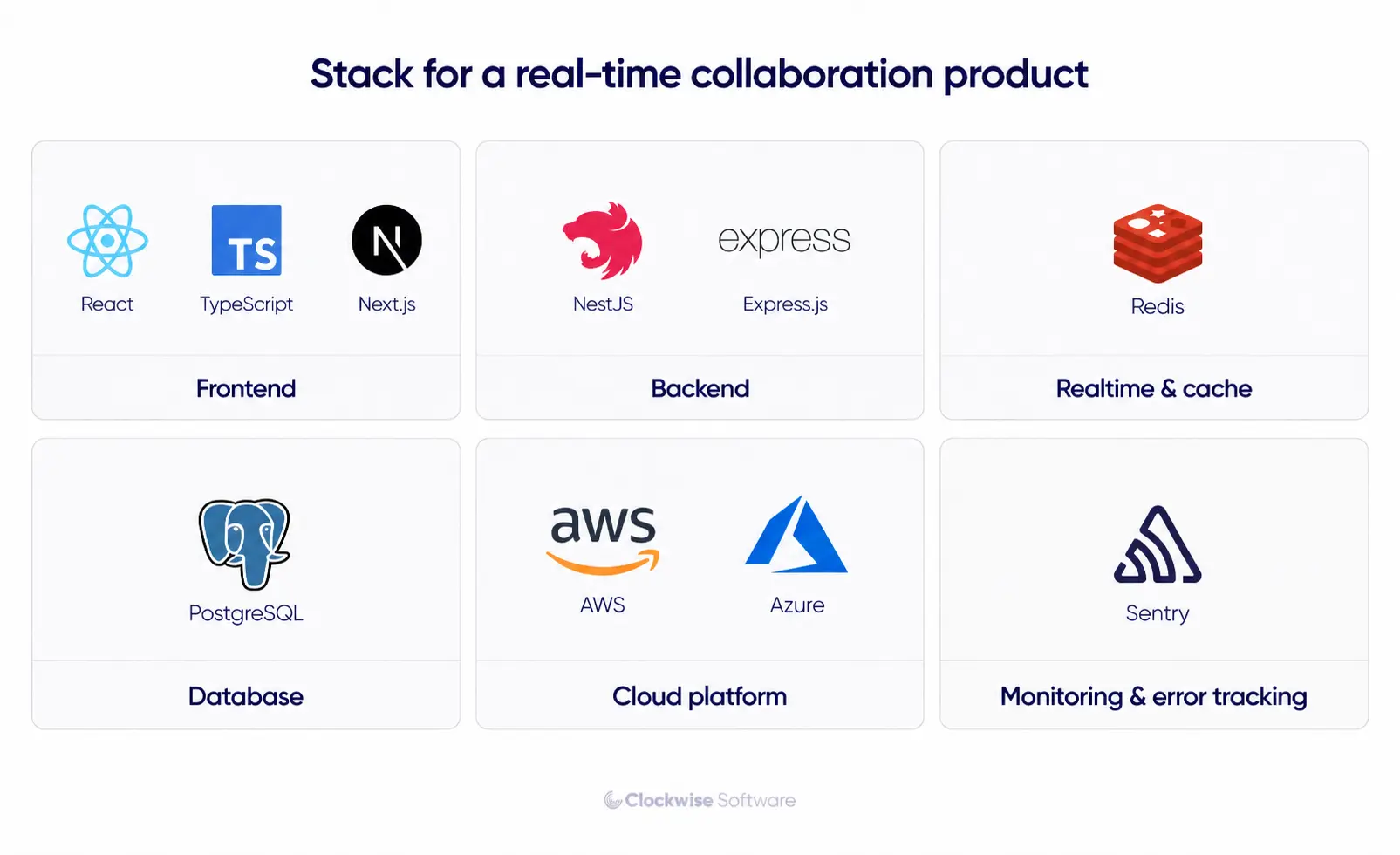
Messaging tools, shared workspaces, live dashboards, and collaborative editors need more than a standard request-and-response application. A typical stack may combine React or another reactive frontend with a backend that supports WebSockets or similar persistent connections. Redis can help distribute messages, cache short-lived state, or coordinate activity across application instances. Queues and event-driven components can process notifications, file updates, and other asynchronous work.
The difficult part is not sending an update quickly. It is keeping data consistent when several users change the same record, lose their connection, or reconnect from another device. The system needs clear rules for ordering events, resolving conflicts, retrying failed operations, and restoring the latest valid state.
This architecture fits products where live interaction creates real customer value. It is unnecessary for workflows where a short delay or manual refresh causes no harm. Real-time infrastructure increases testing, monitoring, and operational requirements, so it should be tied to a defined product need.
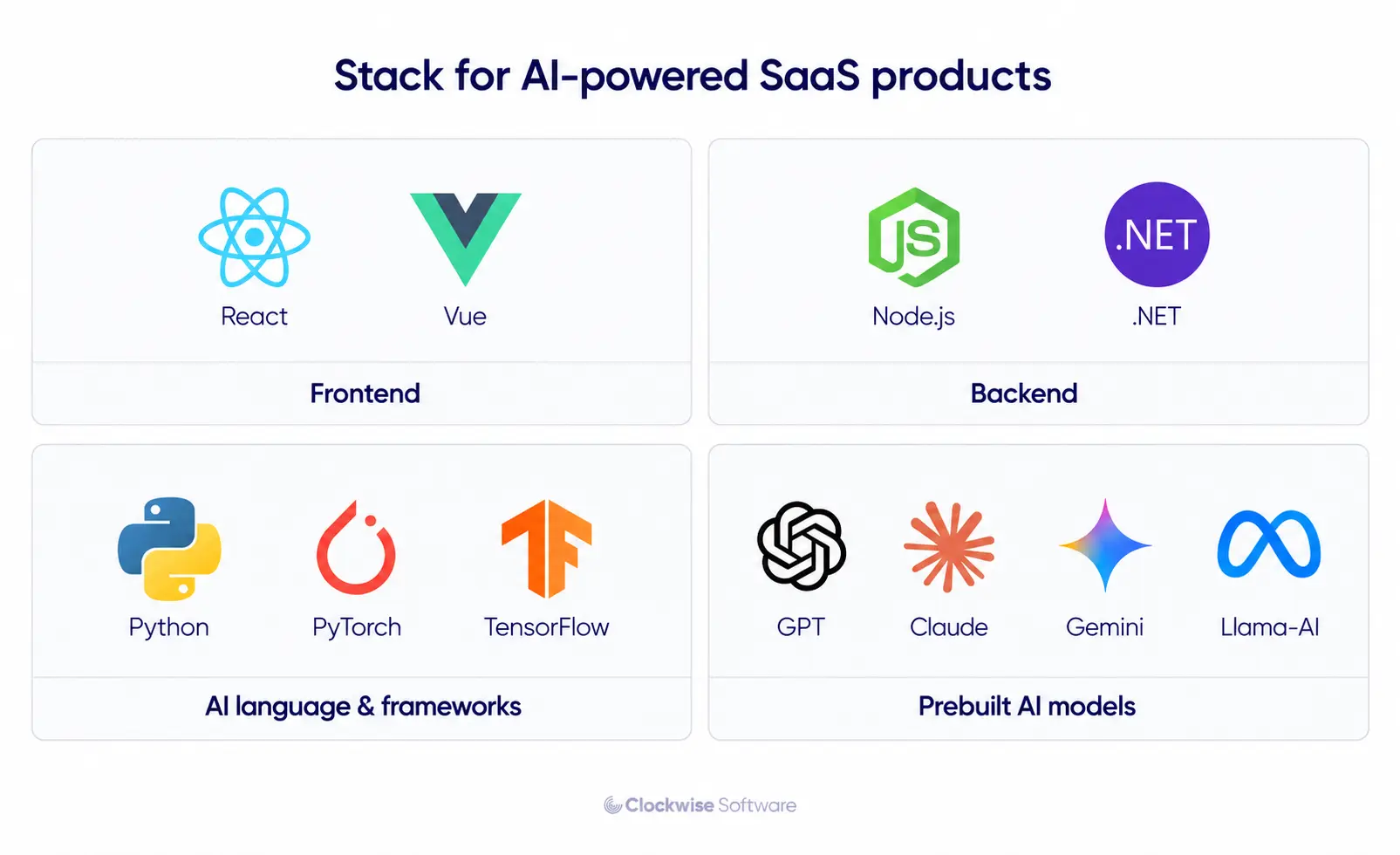
An AI SaaS tech stack often uses Python for data processing, model orchestration, and machine learning workloads. The main application can still use Node.js, .NET, or another backend if that better suits its core business logic. Separating AI workloads from the main application may allow them to scale and fail independently.
Model APIs can shorten development time because the team does not need to host and maintain models. Self-hosted models provide more control over data, configuration, and inference infrastructure, but they require stronger machine learning and DevOps expertise.
Vector storage should only be added when the product performs semantic retrieval or another workflow that benefits from vector similarity. It is not a standard requirement for every AI feature. Traditional relational databases remain suitable for users, accounts, permissions, billing, and most transactional data.
AI workloads are often asynchronous. Queues can process document analysis, content generation, or model evaluation without keeping a user request open. Data pipelines may be required to collect, clean, transform, and monitor source data.
The main trade-offs are cost, latency, reliability, and model dependency. External API charges can change with usage, while model responses may vary. The product therefore needs usage limits, fallback behavior, evaluation, and monitoring rather than a simple connection to an AI provider.
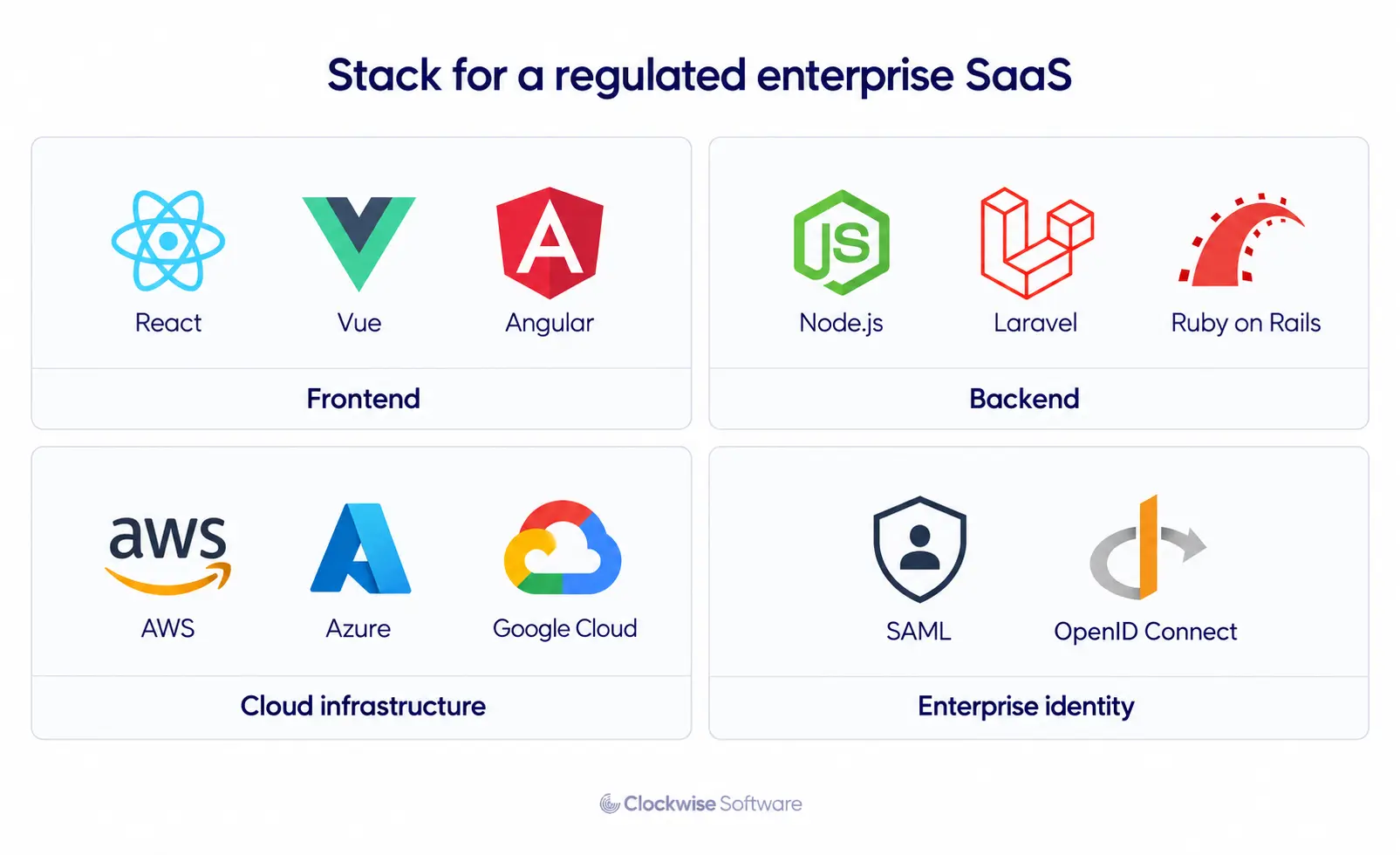
Enterprise SaaS architecture must support technical requirements that go beyond feature delivery. Depending on the industry and data involved, the system may need strict access controls, audit trails, encryption, regional data hosting, retention policies, verified backups, and documented recovery procedures.
The frontend and backend technologies can vary, but the surrounding controls must be designed as part of the system. Enterprise identity providers may require SAML or OpenID Connect. Role-based or attribute-based access rules should follow least-privilege principles. Logs must contain enough detail for investigation without exposing sensitive information.
Cloud platforms can provide many required security capabilities, but using AWS, Azure, or Google Cloud does not make an application compliant by default. The team must configure resources correctly, control access, document changes, and collect evidence that the controls work.
This approach is suitable for products selling to healthcare providers, financial organizations, large corporations, or public-sector customers. It creates a longer discovery and implementation process, but adding these controls after the product enters enterprise sales can delay deals and require significant architectural changes.
The following SaaS tech stack comparison summarizes the priorities behind each scenario. It should be used as a baseline for discussion, not as a ready-made architecture specification.
| SaaS scenario | Main priority | Suggested approach | Main trade-off |
| Early-stage MVP | Fast product validation | Managed services, modular monolith, relational database | Less infrastructure control and possible provider dependency |
| B2B SaaS platform | Maintainability, roles, and integrations | Typed frontend and backend, PostgreSQL, cloud infrastructure, CI/CD | More discovery and initial setup |
| Real-time SaaS | Low latency and synchronized state | WebSockets, Redis, queues, event-driven components | Higher operational and testing complexity |
| Data-intensive SaaS | Reliable processing and analytics | Relational storage, data pipelines, background processing, separate analytics layer when needed | More systems to operate and synchronize |
| AI-powered SaaS | Model access, data processing, and controlled costs | Python services, model APIs or self-hosting, asynchronous workloads | Variable latency, compute costs, and model dependency |
| Regulated enterprise SaaS | Security, isolation, and auditability | Strong identity management, audit logs, encryption, controlled infrastructure | Longer delivery and higher compliance overhead |
These SaaS technology stack examples show why the product scenario matters more than individual tools. PostgreSQL may appear in an MVP, a B2B platform, and a regulated product, but the way it is configured and operated will differ. The enterprise system may require stronger tenant isolation, detailed audit records, regional backups, and restricted administrative access. The MVP may only need a well-designed shared schema and reliable managed hosting.
The same applies to cloud infrastructure. Managed services can reduce operational work for a small team, while a growing product may need more control over networking, deployment, and cost allocation. Moving to more complex infrastructure too early wastes time. Waiting until the current setup is already failing can make the transition risky.
When comparing SaaS stack examples, evaluate the complete system rather than one framework. A sound decision should explain how the proposed stack handles customer data, account permissions, subscriptions, integrations, deployment, monitoring, and recovery. It should also state which assumptions still need validation.
The best stack for SaaS is therefore the one that fits the current product stage and leaves a practical path to the next one. A solution architect can help identify that path before the team commits months of development to assumptions that have not been tested.
Most SaaS tech stack mistakes do not cause an immediate failure. They create friction over time. Releases take longer, infrastructure costs rise, integrations become fragile, and security changes require work across the entire product. These problems often come from decisions made without a clear connection to product requirements.
A new framework may offer useful capabilities, but popularity on developer forums is not evidence that it fits the product. Immature tools may have limited documentation, fewer integrations, and a smaller hiring pool. A better decision compares the technology against specific requirements and uses a prototype to test any critical assumptions.
Microservices can separate workloads and allow independent deployment. They also require service communication, distributed monitoring, failure handling, and more complex testing. For a small team building an MVP, these costs may outweigh the benefits. A modular monolith often provides a clearer starting point while preserving boundaries that can support future separation.
Tenant isolation affects authentication, database queries, background jobs, file storage, logs, and support tools. Adding a tenant identifier to a few tables is not enough. If the model is not defined early, the team may later need to rewrite data access and permission logic across the product. Tenant context should be part of the SaaS architecture from the first technical design.
Custom authentication and subscription billing create security and financial risks. They must handle edge cases such as session revocation, account recovery, plan changes, prorated charges, failed payments, and duplicate webhook events. Established services can reduce this work. Custom development is justified only when the product has requirements that available platforms cannot support at an acceptable cost.
Logs and backups are often treated as post-launch improvements. But without usable logs, the team may know that customers are reporting a failure without knowing where it occurred. A backup also has limited value if restoration has never been tested. Basic monitoring, alerting, backup, and recovery procedures should be ready before production use.
Designing for millions of users before validating demand can create unnecessary SaaS technical debt. The team spends time operating distributed systems instead of improving the product. A better approach is to estimate the first year’s realistic load, identify likely bottlenecks, and define signals that will trigger infrastructure changes.
A technically strong architecture can still fail if only one developer understands it. Rare technologies and heavily customized infrastructure increase hiring and handover risks. Before approving a stack, the company should evaluate documentation, available talent, operational skills, and the time required to onboard a new engineer.
Vendor dependency needs the same attention. It is rarely possible or useful to avoid vendor lock-in completely. But the team should understand how data can be exported, which interfaces are proprietary, and what a migration would involve if pricing or business requirements change.
Out team addresses these risks during architecture planning rather than after they begin blocking releases. The team compares viable options, documents trade-offs, and checks high-risk assumptions before full development. This gives founders a clearer view of delivery cost, operational responsibility, and future scaling needs.
Architecture validation does not guarantee that the stack will never change. SaaS products evolve. It ensures that the initial decisions are deliberate, maintainable, and tied to real product goals instead of trends or unsupported growth assumptions.
A SaaS tech stack should change when the product creates new requirements, not because a different framework becomes popular. The architecture that supports an MVP may remain effective for years if it has clear module boundaries, reliable deployment, and a practical scaling path.
The goal is not to predict every future requirement. It is to protect the foundations that would be expensive or risky to fix later while postponing complexity that has no current business value.
A lean SaaS MVP architecture still needs a basic security model. Passwords and credentials must be handled correctly, access must follow defined permissions, and sensitive data must be encrypted where appropriate. In a multi-tenant product, every request and background process should preserve tenant context. One customer must never be able to access another customer’s data.
Backups should run automatically, and the team should know how to restore them. Logging must provide enough context to investigate errors without exposing confidential information. Basic monitoring should track availability, application failures, and critical infrastructure conditions.
Deployment should also be repeatable. A documented or automated process reduces the risk of manual errors and makes rollback possible when a release fails. These controls do not require complex infrastructure. They require clear ownership and consistent implementation.
Most early SaaS products do not need microservices, multi-region deployment, or a complex data platform. These capabilities solve real problems, but only when the product has the traffic, customers, workloads, or compliance requirements that justify them.
Custom infrastructure tooling can also wait when established cloud services already cover the requirement. The same applies to advanced caching and database optimization. Improving an unmeasured bottleneck takes time away from product validation and may optimize a workflow customers do not value.
This does not mean ignoring the future. The team should keep business modules separate, avoid unnecessary dependencies, and document major architecture decisions. A clear modular structure makes evolving a tech stack easier without paying for full enterprise complexity during the MVP stage.
SaaS infrastructure scaling should respond to evidence. The stack may need to evolve when release speed consistently declines, incidents repeat for the same architectural reason, or cloud costs grow much faster than customer usage. Another signal appears when one workload needs independent scaling but the current system can only scale as a whole.
Enterprise requirements may also trigger SaaS modernization. Large customers can require SSO, detailed audit logs, stricter data isolation, regional hosting, or defined recovery targets. If the existing architecture cannot add these capabilities safely, the company may need to change specific components or boundaries.
The team should also review the stack when engineers spend more time maintaining infrastructure than improving the product. This may indicate that the system is overengineered or that self-managed components should be replaced with managed services.
A practical evolution roadmap looks like this:
| Product stage | Main technical priority | Reason to move forward |
| MVP | Secure foundation and fast validation | Customers confirm demand and core workflows |
| Traction | Reliability, analytics, and efficient releases | Usage becomes consistent and failures affect revenue |
| Growth | Independent scaling and cost control | Workloads, data, or team structure outgrow the current model |
| Enterprise | Stronger isolation, identity, compliance, and recovery | Larger customers introduce verified security and operational requirements |
To scale a SaaS product well, change the parts that have reached a real limit. A full rewrite is rarely the first answer. Targeted improvements to the database, deployment model, background processing, or service boundaries are usually easier to validate and safer to deliver.
SaaS tech stack selection should produce an explainable decision. Founders and product leaders need to understand why a stack was chosen, which risks it creates, and what could force it to change later.
Clockwise Software uses a requirements-first approach to SaaS architecture planning. The process begins with the product and business model, then narrows the technical options. This prevents the team’s favorite framework from becoming the default answer to every problem.
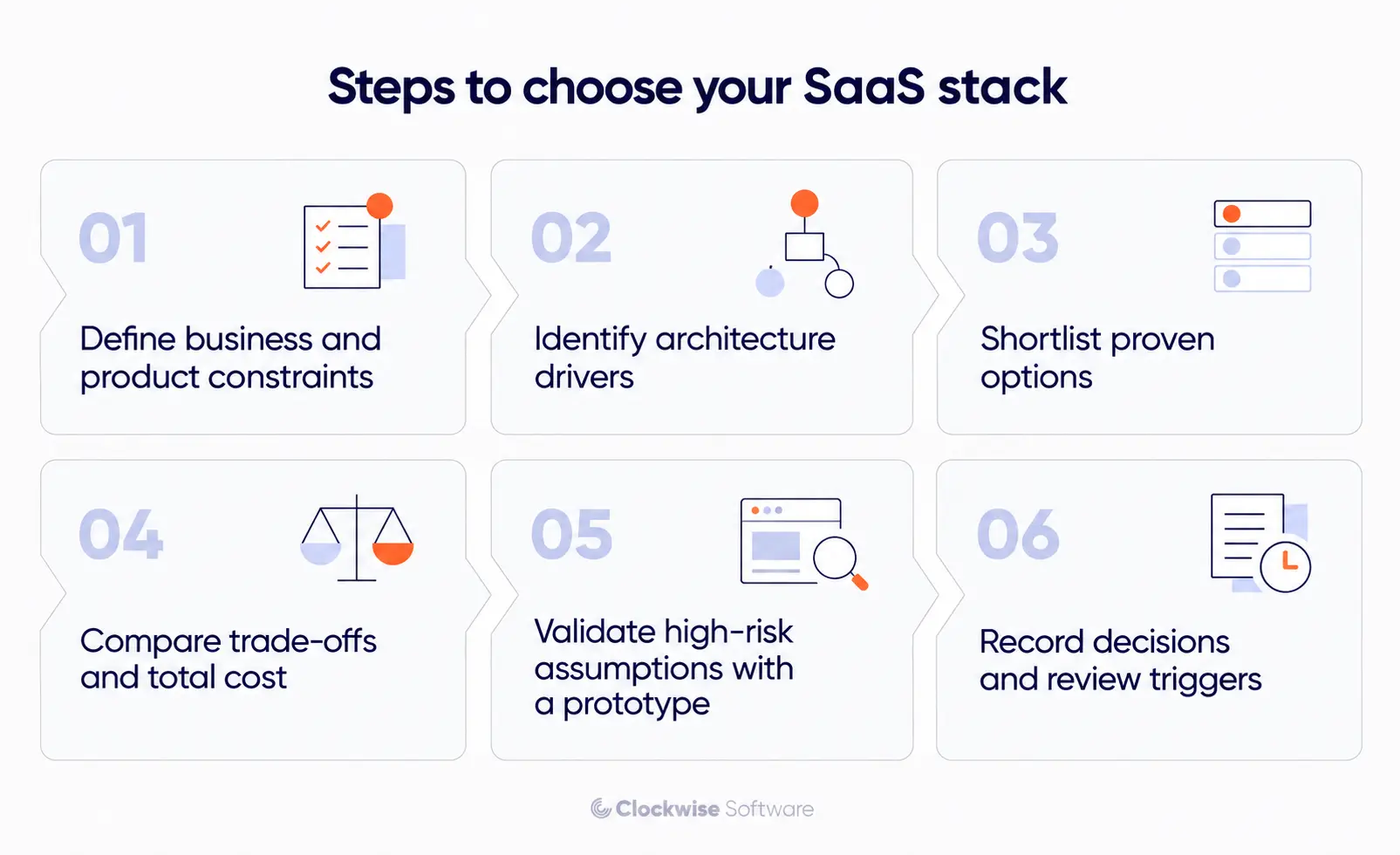
Start with the product stage, target customers, delivery deadline, available budget, and expected pricing model. Define the core workflows and separate launch requirements from ideas that may be added later.
A B2B platform selling to large companies may need SSO, organization-level roles, audit logs, and stronger data isolation. A self-service consumer product may prioritize fast onboarding, payment automation, and support for a larger number of smaller accounts.
Architecture drivers are requirements that materially affect the system design. They may include real-time collaboration, sensitive data, high-volume processing, mobile access, third-party integrations, regional hosting, or strict availability targets.
Not every requirement is an architecture driver. A standard profile page may affect development scope without changing the technology choice. Real-time document editing or tenant-specific encryption probably will.
Once the constraints are clear, compare a small number of viable combinations. Each option should have a team capable of building and maintaining it, an active ecosystem, suitable integrations, and a realistic deployment model.
The shortlist should remain focused. Comparing ten frontend frameworks rarely improves the decision. Two or three supported approaches are usually enough to expose the relevant trade-offs.
Each option should be evaluated against the same criteria:
For example, a managed platform may shorten deployment and reduce the need for DevOps work. A more configurable cloud setup may offer stronger network control and enterprise capabilities, but require more engineering time from the start. Neither is automatically better.
An experienced software development company should explain these trade-offs in business terms rather than recommending a stack based only on internal preferences.
A prototype or technical proof of concept can test the decisions with the greatest uncertainty. The team may need to confirm whether an external API handles the expected volume, an AI model meets latency targets, or a database can support a critical query pattern.
The goal is not to prototype the entire product. It is to test the assumption most likely to invalidate the proposed architecture.
Major decisions should be documented with their context, alternatives, and consequences. The record should explain why the team selected a particular database, cloud service, tenant model, or deployment approach.
It should also define review triggers. A decision might need reassessment when usage reaches a specific level, enterprise customers request stronger isolation, or infrastructure costs exceed an agreed threshold.
Consider a simple example:
| Evaluation factor | Managed application platform | Configurable cloud infrastructure |
| Initial delivery speed | Higher | Lower |
| DevOps effort | Lower | Higher |
| Infrastructure control | Limited | Strong |
| Enterprise networking | May be restricted | More flexible |
| Migration effort | Depends on proprietary services | Depends on cloud-specific architecture |
| Best fit | Early product with a small team | Complex or enterprise-focused SaaS |
This technology evaluation framework does not choose a technology stack automatically. It makes the reasons visible. We can then connect product requirements with suitable architecture options, validate risky assumptions, and provide a technical direction the client can maintain after launch.
A founder does not need to challenge every framework choice. But the development team should be able to explain how the proposed stack supports the product, what it will cost to operate, and where its limits may appear.
The following SaaS tech stack checklist can be used during discovery, vendor evaluation, or a SaaS architecture assessment:
These questions for a software development team help reveal whether the proposal is based on product requirements or technical preference. Strong answers should include trade-offs. If every choice is described as fast, scalable, inexpensive, and future-proof, the technology stack evaluation is incomplete.
Our architects assess the full system rather than isolated tools. They connect architecture with delivery scope, integrations, security, infrastructure, and future ownership. This gives the client a clear basis for approving the stack before major development costs have already been committed.
Not every product needs an external technical review. A capable internal team may already understand the system, its constraints, and the reasons behind previous decisions. A SaaS architecture review becomes useful when the business is preparing for a high-cost decision and needs an independent view of the risks.
An early SaaS technical assessment can prevent the team from committing to a stack before the main requirements are clear. It is especially useful when the company has no technical co-founder, the product depends on complex integrations, or the founder has received conflicting recommendations from development vendors.
The review should determine whether the proposed architecture matches the initial scope, budget, security needs, and expected workload. It should also identify which parts require custom development and which can use established services. The aim is not to design for every possible future. It is to avoid decisions that would make the first release slow, expensive, or difficult to maintain.
A stack that supports early customers may not satisfy enterprise requirements. Larger clients can require SSO, audit logs, stricter permissions, regional data storage, security documentation, or stronger tenant isolation. Rapid user growth may also expose limits in database queries, background processing, or cloud configuration.
This is a good point to review the SaaS tech stack before signing commitments that the current system cannot support. The assessment should show which components can remain, which need improvement, and whether any workloads require separate scaling.
A complete rewrite is expensive and risky. It can consume months of engineering work while the current product still needs maintenance and new features. Before approving one, the company should confirm that targeted modernization cannot solve the main problems.
Legacy SaaS modernization may focus on a specific database, deployment process, application module, or integration layer. A review can separate architectural limits from code-quality issues and operational gaps. This helps the business avoid replacing working parts of the system without a clear reason.
A useful SaaS architecture review should provide:
Our specialists at Clockwise Software can provide an independent assessment when technical decisions are blocking the product roadmap, your team expects rapid growth, or a proposed rewrite needs validation. The result should give you enough evidence to choose the next step without committing to unnecessary development.
There is no single best SaaS tech stack. The right choice depends on the product being built, the customers it serves, the data it processes, and the team responsible for maintaining it.
An early product needs a stack that supports fast validation without ignoring security, tenant separation, backups, monitoring, and repeatable deployment. A growing B2B platform may need stronger integration patterns, role management, observability, and independent scaling. An enterprise product may add stricter isolation, compliance controls, SSO, audit trails, and documented recovery procedures.
The stack should be simple enough for the current team to understand and operate. At the same time, its core boundaries should leave room for the product to grow. That does not require building microservices, multi-region infrastructure, or a complex data platform from day one. It requires knowing which decisions are difficult to reverse and protecting those foundations early.
Every major SaaS architecture decision should record its assumptions and trade-offs. The team should know why a technology was selected, what risks it creates, and which signals would justify reviewing it.
A scalable SaaS product is not one that starts with the most complex infrastructure. It is one that can evolve without forcing the company to rebuild everything whenever requirements change. Choose the right technology stack for the next credible stage, measure how it performs, and adjust it when product evidence shows that the current approach has reached its limit.
At Clockwise Software, we can review your requirements, compare suitable architecture options, and explain the trade-offs in terms of delivery time, scalability, security, and cost. You'll receive a technical direction aligned with your product goals.