
Explore our services
AI solutions
What we do
Services
Experts in
How we work


Building a SaaS product involves more than writing frontend and backend code. The work starts with validating the product idea and continues through architecture, design, engineering, testing, deployment, and ongoing improvement. Decisions made during one stage directly affect the stages that follow.
End-to-end SaaS development services bring this work under one coordinated delivery model. Instead of hiring separate vendors for strategy, design, engineering, infrastructure, and maintenance, a business works with one cross-functional team throughout the product lifecycle. That team shares the same requirements, architecture decisions, delivery plan, and product context.
This approach does not mean that every project needs every possible service. An early-stage founder may need product discovery and an MVP. An established company may need architecture modernization, new integrations, or support for a growing platform. The scope should reflect the product’s current stage, business goals, and technical risks.
At Clockwise Software, our approach is based on experience delivering more than 200 software projects since 2014, including over 25 SaaS products. We have supported products from initial discovery through launch, scaling, and post-launch development. Our experience shows us that continuity matters. When strategy, design, engineering, and infrastructure decisions are handled in isolation, teams lose context and problems surface late.
This guide explains what full-cycle SaaS development covers, what each service should produce, and when a single delivery partner makes sense. It also helps you distinguish a genuine end-to-end engagement from a development contract that covers coding but leaves product planning, launch preparation, and operational ownership to the client.
End-to-end SaaS development services cover the work required to move a SaaS product from an initial business concept to a stable, operating product. Depending on the engagement, they may also include modernization or continued development of an existing platform.
The central idea is not the number of services included. It is the continuity of responsibility. The same SaaS development company connects product goals, user needs, technical decisions, delivery planning, and post-launch performance. Each stage produces inputs for the next one, and the team remains accountable for how those decisions work together.
An end-to-end engagement usually covers four connected areas:
For example, Discovery defines the problem, users, scope, and constraints. Architecture translates those constraints into a technical system. UX/UI design turns core workflows into usable interfaces. Engineering implements the planned functionality. QA verifies that it works as expected. DevOps prepares the production environment, while post-launch work uses operational and customer data to guide improvements.
The exact scope remains flexible. A company with validated requirements may not need market research. A business with an existing design system may require only UX review. End-to-end delivery means the partner can cover the entire lifecycle and manage the dependencies between stages, not that every client must purchase an identical package.
Traditional software development engagements often begin with a predefined specification. The client decides what to build, and the vendor supplies engineers to implement it. This can work when the requirements, architecture, acceptance criteria, and ownership model are already clear.
SaaS products often contain more uncertainty. The business must make decisions about user roles, subscriptions, tenant isolation, permissions, integrations, onboarding, analytics, security, and future scale. A feature can be technically correct but still fail because it addresses the wrong user problem or creates an unsustainable operating cost.
Full-cycle SaaS development addresses these dependencies before and during implementation. The team does not only ask how to build a feature. It examines why the feature is needed, who will use it, how success will be measured, and what technical consequences it creates.
The difference can be summarized as follows:
| Engineering-only engagement | End-to-end SaaS development |
| Starts from a prepared specification | Can start from a business problem or product concept |
| Focuses mainly on implementation | Connects strategy, design, architecture, engineering, and operations |
| Product decisions remain with the client | Product decisions are supported by a cross-functional team |
| Deliverables are usually features and code | Deliverables include validated scope, designs, architecture, software, infrastructure, and launch preparation |
| Responsibility may end at deployment | Responsibility can continue through monitoring, maintenance, and product growth |
Neither model is automatically better. The right choice depends on the capabilities already available inside the client’s organization.
End-to-end delivery is useful when a business needs more than additional engineering capacity. Common situations include:
In these cases, separate contractors can create coordination costs. Design decisions may ignore technical constraints. Architecture choices may not support the planned business model. Infrastructure may be considered only shortly before release. When problems appear, responsibility becomes difficult to assign.
A provider of end-to-end SaaS development services closes these gaps through shared planning, documented decisions, and clear ownership. The client still controls business priorities and the product vision. The delivery partner turns those priorities into an executable plan and provides the roles needed to implement it.
The scope of SaaS development services should be defined around outcomes. Labels like “design,” “development,” or “support” can describe very different amounts of work depending on the vendor. Before signing a contract, clarify the activities, deliverables, responsibilities, and completion criteria for each service.
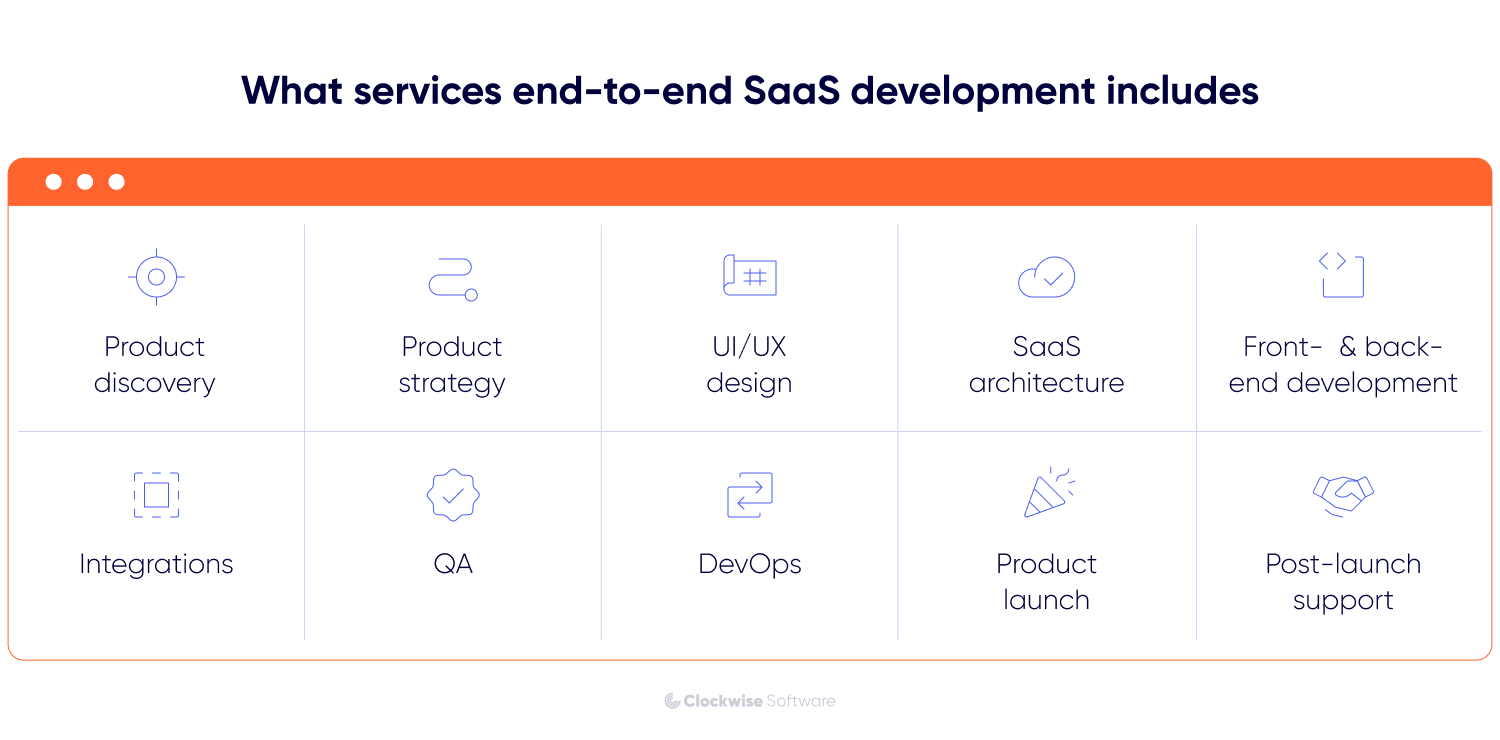
Product discovery turns an idea or business requirement into a product direction the team can evaluate and implement.
What it covers: Target users, the core problem, the business model, assumptions, constraints, and intended outcomes. Activities may include stakeholder workshops, user or market research, competitor analysis, feature prioritization, user-flow mapping, technical investigation, and risk assessment. For an existing product, the team also reviews analytics, customer feedback, architecture, and current delivery problems.
What you receive:
You need it when: Requirements are incomplete, stakeholders expect different things, or the product depends on untested assumptions.
Product strategy connects the planned software to a viable business and adoption model.
What it covers: Value proposition, positioning, release priorities, pricing assumptions, customer acquisition constraints, and success metrics. For a B2B SaaS product, it also covers onboarding, account structures, purchasing roles, administrative controls, and expansion opportunities.
What you receive: A documented product direction, a prioritized roadmap, success metrics, and decision criteria for future features.
You need it when: The business knows what it wants to ship but has not defined how features support adoption, retention, revenue, or operational goals. It also pays off for existing products with many possible directions and a limited budget.
UX/UI design defines how users complete tasks in the product. In SaaS, that means designing for users with different roles, permissions, goals, and levels of technical knowledge.
What it covers: Information architecture, user flows, wireframes, interactive prototypes, usability testing, interface design, responsive states, accessibility, and a reusable design system.
What you receive:
You need it when: You are launching a new product, changing substantial workflows, or fixing usability and adoption problems.
SaaS architecture defines how the application stores data, isolates tenants, controls access, connects services, and handles expected load. These decisions shape security, development speed, infrastructure costs, and how far the product can scale.
What it covers: Multi-tenancy, database structure, identity and access management, service boundaries, API design, integration patterns, data processing, observability, deployment, backups, and disaster recovery. The scope targets foreseeable growth: the next customer tier, the next integration, the next order of magnitude in data.
What you receive: Architecture diagrams, technology decisions, data models, integration specifications, infrastructure requirements, and records of major technical tradeoffs.
You need it when: You're building the product from scratch and need to define the right architecture, or you’re rewriting/modernizing your existing platform and need a new architectural design.
Frontend development implements the interfaces users interact with. Backend development handles business logic, data processing, authentication, permissions, billing, notifications, and other system functions.
What it covers: Feature implementation, data models, APIs, background processes, logging, automated checks, code review, and technical documentation.
What you receive: Working, tested product features, reviewed source code, technical documentation, and access to the repository.
You need it when: You are creating any custom SaaS product. Team composition scales with scope. A focused MVP may need two to four full-stack engineers. A mature platform may need separate frontend, backend, data, mobile, or platform specialists.
Most SaaS products exchange data with external systems: payment providers, CRM and ERP platforms, identity services, analytics tools, messaging systems, AI providers, accounting software, logistics services, and industry-specific databases.
What it covers: authentication, field mapping, rate limits, retries, duplicate events, data validation, version changes, logging, failure recovery, and rules for which system owns each type of data.
What you receive: documented APIs, integration services, webhook processing, synchronization rules, monitoring, and test scenarios.
You need it when: the product exchanges data with external platforms or provides an API to customers and partners.
Quality assurance verifies that the product meets its functional and operational requirements.
What it covers: Functional, integration, regression, usability, compatibility, performance, security, and accessibility testing. Automated tests cover stable, repeated workflows. Exploratory testing catches issues that scripted checks miss. Testing depth matches the cost of failure: a prototype for 20 invited users can ship with a basic regression suite, and a financial or healthcare platform needs strict controls on every release.
What you receive: Documented test coverage, defect reports, release criteria, user acceptance test results, and a list of unresolved risks with their severity.
You need it when: The product will reach real users. Every production product needs QA.
DevOps sets up the environments and delivery systems used to develop, test, release, and operate the product.
What it covers: Cloud configuration, deployment pipelines, environment management, monitoring, logging, backups, access controls, and infrastructure documentation. An early MVP can skip enterprise-grade infrastructure. It still needs recoverable data, controlled access, and enough monitoring to diagnose failures.
What you receive:
You need it when: The product is headed to production. Every production SaaS product needs it.
Product launch is the controlled transition of the product into production for real users.
What it covers: Release planning, data migration, production configuration, performance checks, security review, analytics setup, support preparation, rollback procedures, and final approval.
What you receive: A documented release plan with owners, readiness criteria, and recovery steps, plus a production environment with active monitoring and analytics.
You need it when: You are releasing a new product, a major version, or a migration that can affect customers.
Post-launch support covers operating and evolving the product once real users are on it.
What it covers: Monitoring, incident response, bug fixes, security updates, infrastructure management, analytics review, customer-feedback analysis, roadmap planning, and continued feature development.
What you receive: A support agreement with defined response times, responsibilities, communication channels, and prioritization rules. It also states which work falls under warranty, which under maintenance, and which requires a separate development agreement.
You need it when: You have no internal engineering team or want the same partner to continue product development.
When one partner delivers all of these services, product context stays with a single team. The client avoids coordinating several vendors and re-explaining the product at every handoff.
Next, let’s see how that work is sequenced.
A structured process tells the client what happens next, which decisions they need to make, and what each stage should produce. The stages are connected, and several of them overlap. QA starts during development, design stays a sprint or two ahead of engineering, and architecture gets refined as technical investigation answers open questions.
A typical end-to-end SaaS development workflow looks like this:
Discovery → Planning → Design → Development → Testing → Launch → Continuous Improvement
Each stage ends with an approval point, where the client and the delivery team agree that the product is ready to move forward.
Discovery establishes what the product should achieve. Stakeholder interviews and a review of existing research, business goals, and technical constraints give both sides a shared starting point. For a live product, the team also audits the codebase, infrastructure, and analytics.
Approval point: the core user problem, the business goal, and the purpose of the first release are clear. If any of the three is still vague, the project stays in discovery.
Planning turns discovery findings into an executable delivery approach. This is where product strategy, architecture, and integration planning come together. The team sets release priorities, makes the major architecture decisions, and runs proof-of-concept work for uncertain integrations. DevOps planning starts here too, since infrastructure choices follow architecture.
A realistic plan shows its assumptions and gives ranges for time and budget. It also separates must-have scope from functionality that can wait, which gives the client room to adjust if budget or timing changes.
Approval point: scope, budget range, and responsibilities are accepted, and the highest-priority workflows have acceptance criteria.
Designers turn requirements into flows and screens that stakeholders can review and click through. Prototypes expose missing states, unclear permissions, and unnecessary steps while a fix still takes hours.
Engineering can start once the core workflows are designed and approved. From there, design stays one or two sprints ahead, with both teams working from the same priorities.
Approval point: design for core workflows is usable and approved.
Engineers work in sprints of two weeks. Each sprint covers planning, implementation, code review, testing, and a demo of finished functionality. The client sees working pieces of functionality every sprint and can redirect work early.
Integrations and the deployment pipeline progress alongside features, so releases to staging are routine by the end of this stage. The client has access to the repository and the project management system throughout.
Approval point: delivered functionality meets its acceptance criteria.
QA specialists test each increment during development, so this stage is the final release check. It covers full regression testing, performance and security testing at the depth the product’s risk requires, and user acceptance testing against agreed business scenarios.
Approval point: critical defects are resolved. Lower-risk issues are documented and scheduled for later releases.
Launch moves the product into production using the release plan prepared in earlier stages. The team deploys, verifies monitoring and backups, activates analytics, and keeps the rollback procedure ready. For products with uncertain usage patterns, a pilot group or phased migration goes first.
Approval point: the product is ready for controlled use, and support procedures are in place.
The first release produces evidence that planning alone cannot. Analytics, support requests, customer interviews, and infrastructure data show where users succeed and where they struggle.
The team reviews this data on a regular cadence and updates the roadmap. Changes may cover onboarding, performance, feature refinement, new integrations, security updates, or architecture. Technical debt sits on the same backlog as customer-facing work and gets prioritized with it.
Approval point: new priorities are backed by evidence.
| Stage | Primary deliverables | Approval point |
| Discovery | Product vision, user flows, initial scope, risks | The problem and first-release goal are clear |
| Planning | Backlog, roadmap, estimates, team plan | Scope, budget range, and responsibilities are accepted |
| Design | Wireframes, prototype, UI designs, design system | Core workflows are usable and approved |
| Development | Working features, reviewed code, documentation | Functionality meets acceptance criteria |
| Testing | Test results, defect reports, release assessment | Critical risks and blockers are resolved |
| Launch | Production release, monitoring, rollback plan | Product is ready for controlled use |
| Continuous improvement | Analytics, feedback insights, revised roadmap | New priorities are supported by evidence |
The client stays involved at every approval point. A full-cycle partner manages the work, and product and budget decisions stay with the client’s stakeholders.
Businesses choose end-to-end SaaS development services when they need coordinated ownership across product strategy, design, engineering, infrastructure, and ongoing development. The value is not simply having more specialists available. It comes from keeping these specialists aligned around the same product goals and technical context.
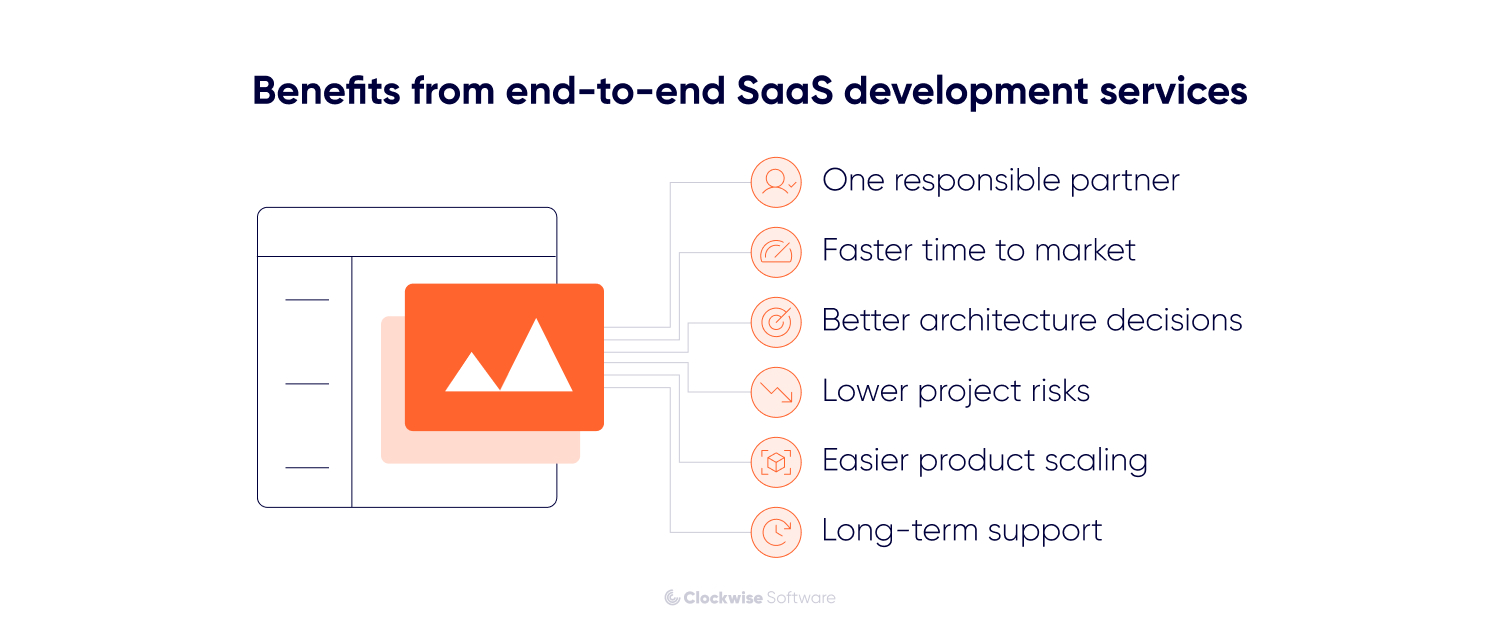
When several vendors handle different stages, responsibilities can become unclear. A design agency may create workflows that exceed the development budget. Engineers may implement features without understanding the original product assumptions. An infrastructure provider may join shortly before launch and discover architecture limitations.
With one delivery partner, the dependencies between these areas are managed within the same process. The SaaS development company owns the handoffs between discovery, design, engineering, QA, and operations. The client has one accountable team instead of coordinating several contracts and resolving disagreements between vendors.
This does not remove the client from decision-making. Business priorities, investment limits, and product direction remain client responsibilities. The partner is accountable for turning those decisions into a coordinated delivery plan.
Changing vendors between stages creates onboarding work. Each new team must review documentation, understand earlier decisions, request missing context, and establish a new working process. Important knowledge is often lost during these transitions.
An end-to-end team builds shared context from the start. Designers can consult engineers before finalizing complex workflows. Architects can identify integration risks during dicovery. DevOps specialists can prepare deployment requirements before the product is ready for release.
This overlap can shorten delivery without forcing the team to skip validation or testing. Across SaaS projects, we often see that early clarification saves more time than rushing into development. A focused discovery phase can prevent weeks of rework caused by unclear requirements or unsuitable technical choices.
Architecture should reflect the product model, user roles, security needs, integration requirements, and realistic growth expectations. These inputs come from several areas of the project.
A team responsible only for coding may receive these decisions too late or may not have enough context to challenge them. In end-to-end delivery, architecture planning begins while the scope and workflows are still being defined.
For example, the team can decide how tenants will be isolated before implementing data models. It can account for enterprise permissions before the interface is finalized. It can review expected integration volumes before selecting a synchronization approach.
This does not mean choosing the most advanced architecture available. A responsible team also knows when a modular application is more appropriate than a distributed system. The goal is to support current needs without creating obvious barriers to planned growth.
SaaS projects face product, technical, delivery, and operational risks. A feature may lack customer value. An integration may have undocumented limits. A security requirement may change the architecture. A compressed release date may reduce testing time.
End-to-end delivery makes these risks visible across the project instead of isolating them within individual departments. Discovery identifies uncertain assumptions. Planning records dependencies. Architecture reviews address technical consequences. Regular demonstrations expose misunderstandings. QA and release-readiness checks reduce launch risk.
At Clockwise Software, our team provides delivery visibility through weekly demonstrations, documented risks, scope tracking, and cost and schedule performance indicators such as CPI and SPI. These controls do not guarantee that estimates will never change. They make changes easier to detect and manage before they become major budget or schedule problems.
Scaling involves more than adding cloud resources. The product may need changes to data processing, permissions, billing, customer administration, integrations, monitoring, and support workflows.
A team that has worked with the product from discovery understands why earlier decisions were made. It can distinguish intentional constraints from temporary shortcuts and identify which components require improvement.
This context makes it easier to plan growth without rewriting the entire platform. For example, the team may strengthen a high-load workflow while keeping stable parts of the system unchanged. It may introduce new infrastructure only after product usage justifies the additional complexity.
The result is a scaling roadmap tied to actual product behavior rather than assumptions made before launch.
A SaaS product requires ongoing maintenance, security updates, infrastructure management, and feature development. Customer expectations, third-party APIs, cloud services, and compliance requirements continue to change.
Working with the same partner after launch preserves technical and product knowledge. The team already understands the architecture, deployment process, business rules, and known risks. It can respond to incidents and plan improvements without repeatedly rebuilding this context.
Long-term support should not create vendor dependence. The client should retain ownership of source code, infrastructure accounts, documentation, and product data. A professional engagement makes continued cooperation efficient while keeping future handover possible.
Businesses should choose end-to-end SaaS development when continuity and coordinated responsibility provide more value than assembling separate specialists. For products with significant uncertainty, complex workflows, or long-term growth plans, this model can reduce coordination costs and make delivery more predictable.
Full-cycle delivery is useful, but it is not the right model for every project. Paying one partner to cover strategy, design, engineering, infrastructure, and support adds little value when those capabilities already exist inside the business or when the task is narrowly defined.
A reliable provider of SaaS development services should help determine the appropriate engagement model rather than recommend the largest possible scope.
An established product organization may already have product managers, designers, architects, QA specialists, and DevOps engineers. If these roles work effectively together, the company may need only specific technical expertise or extra delivery capacity.
For example, an internal team may require help with a complex billing migration, performance optimization, or a new mobile application. Replacing its existing process with a full-cycle external model could create unnecessary overlap and unclear authority.
In this situation, a focused project team or specialist consulting engagement is usually more efficient. Responsibilities should be divided clearly so internal and external specialists do not repeat the same work.
A small feature with stable requirements may not require discovery, product strategy, or extensive architecture planning. Examples include adding a reporting filter, updating an existing integration, or building a simple administrative function.
The key condition is that the change is genuinely isolated. The team should still review dependencies, permissions, data handling, testing requirements, and deployment risk before confirming the scope.
A limited fixed-scope engagement can work when the expected behavior and acceptance criteria are clear. But if the “small feature” affects billing, tenant data, access control, or core workflows, broader technical analysis may still be necessary.
Legacy products often need maintenance, stabilization, or gradual modernization rather than a complete product-development cycle. The immediate priority may be resolving recurring incidents, updating unsupported components, improving deployment, or documenting an unfamiliar codebase.
In this case, the work should begin with a technical assessment. The resulting engagement may focus on code audit, architecture recovery, test coverage, infrastructure, and prioritized remediation.
Full-cycle SaaS development becomes relevant only if the business decides to redesign major workflows, rebuild the platform, or launch a substantially different product. Until then, a modernization or maintenance team may be a better fit.
The dedicated development team (DDT) model works when the client already has strong product ownership, technical leadership, delivery management, and established engineering standards. The external provider supplies individual specialists who work inside the client’s process.
This model can help fill temporary skill gaps, increase delivery capacity, or cover a hiring delay. It also gives the client direct control over priorities and daily work.
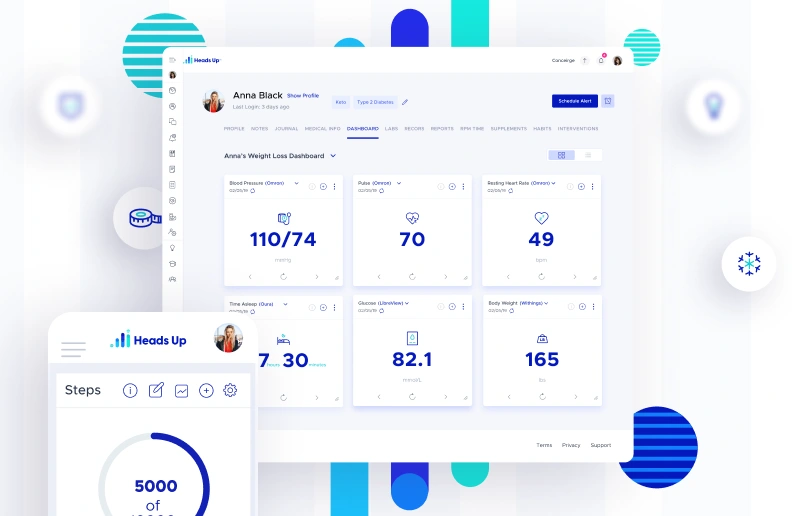
Take a look at our work with HeadsUp Health, for example. The company had its own engineering team but needed more capacity to modernize the platform quickly and improve its performance and user experience. For this request, a dedicated development team was the right fit: our engineers joined the in-house team, working within its process.
We stayed on as HeadsUp's goals grew, and the cooperation has been ongoing since 2019. Over that time, we've rewritten the front-end, rebuilt the mobile apps, set up a dedicated testing team, and delivered multiple integrations.
But the DDT model does not transfer full delivery responsibility. The client normally remains responsible for requirements, architecture, task coordination, quality standards, infrastructure decisions, and release outcomes. If those capabilities are missing, adding engineers may increase activity without solving the underlying delivery problem.
The distinction is practical:
| Situation | Better-fit model |
| Product direction and requirements remain uncertain | End-to-end SaaS development |
| Internal team owns strategy, architecture, and delivery, but needs more engineering capacity | Dedicated development team |
| A defined component or integration is required | Dedicated specialist or a team |
| Existing platform needs stabilization | Legacy support or modernization |
| Business needs a complete product team | End-to-end SaaS development |
| Short-term specialist gap must be filled | Dedicated specialist or team |
Before choosing a model, identify which responsibilities the business can manage internally. If the organization can define the product, lead architecture, coordinate delivery, and operate the platform, targeted SaaS development services may be enough. If several of these capabilities are missing, an end-to-end partner can provide clearer ownership and reduce coordination risk.
A company may describe itself as an end-to-end provider while outsourcing key responsibilities or limiting its work to engineering. Before selecting a partner, verify that it can manage the dependencies between product strategy, design, architecture, development, infrastructure, and post-launch operations.
The evaluation should focus on evidence. A polished proposal is less important than relevant experience, clear deliverables, direct access to the proposed team, and a process that makes risks visible.
General software experience does not always translate into SaaS expertise. SaaS products introduce specific requirements related to multi-tenancy, recurring billing, user roles, account administration, data isolation, integrations, security, and continuous delivery.
Ask the SaaS development company to explain how it has handled these issues in previous projects. The answers should include specific decisions and tradeoffs rather than broad claims.
Useful questions include:
The team does not need experience in your exact industry. But it should have solved comparable product and technical problems.
Discovery quality shows how the company handles uncertainty. A capable partner should not turn an incomplete product idea into a precise estimate after one introductory call.
Ask what the discovery phase covers, who participates, and what you will receive. Expected outputs may include product goals, user flows, prioritized scope, architecture direction, delivery risks, a roadmap, and an estimate.
The process should also identify assumptions that require validation. If the company only collects requirements without challenging priorities or examining technical dependencies, it is performing documentation rather than meaningful product Discovery.
Clarify whether the discovery deliverables belong to you and whether another team could use them. This helps verify that the output will be practical rather than designed to keep you tied to one vendor.
Technical evaluation should cover the product’s actual risk areas. A simple technology list provides little evidence that the team can design, release, and operate a reliable SaaS platform.
Request a technical discussion with the proposed architect or engineering lead. Ask how the team would approach:
A trustworthy partner will explain alternatives and their consequences. It should not recommend microservices, complex cloud infrastructure, or expensive tooling without a clear reason. Good architecture supports foreseeable needs while avoiding complexity that the current product does not require.
Communication should be evaluated before the contract is signed. Notice whether the company answers questions directly, documents decisions, and involves technical specialists when needed.
Meet the proposed project manager and technical lead. Confirm who will make product, architecture, delivery, and budget decisions. You should also know how often the team will demonstrate progress and how risks or scope changes will be reported.
A practical communication model may include sprint planning, regular status updates and demos, backlog access, and documented decisions. The exact meeting schedule matters less than consistent visibility.
If all communication must pass through an account manager, ask whether you will have direct access to delivery specialists. Slow or filtered communication can become a serious problem when technical decisions require quick clarification.
Deployment is not the end of SaaS product development. Real users will expose unexpected behavior, integration issues, performance limits, and gaps in the original assumptions.
Ask what happens after launch. The company should explain its approach to monitoring, incident response, bug resolution, security updates, infrastructure management, analytics, and future development.
Review the support agreement carefully. It should define response expectations, responsibilities, communication channels, and pricing. Clarify which issues are covered by warranty and which require a maintenance or development agreement.
The partner should also support documentation and knowledge transfer. You should retain control of source code, cloud accounts, analytics, domains, third-party services, and product data.
Relevant case studies provide stronger evidence than a large portfolio. Look for projects with similar workflows, technical constraints, product stages, or growth challenges.
A useful case study should explain:
Ask follow-up questions. A company may include a SaaS product in its portfolio even if it only developed several screens or provided one engineer.
If confidentiality prevents disclosure, the partner should still be able to describe the challenge and its contribution without revealing the client’s sensitive information. References can provide additional confirmation when available.
Use this short checklist before selecting a provider of end-to-end SaaS development services:
The best partner is not necessarily the company with the largest team or lowest estimate. Choose the provider that understands the product problem, makes uncertainty visible, and can demonstrate responsibility across the full lifecycle.
At Clockwise Software, our services always begin with understanding the product. Our workflow is based on experience with more than 200 software projects since 2014, including over 25 SaaS products. The specific process changes with the product stage, but the principles remain consistent.
We begin by defining the business goal, target users, core workflows, constraints, and unresolved assumptions. The team examines which features are essential for the first release and which can wait until there is stronger evidence.
Discovery may involve a business analyst, project manager, designer, solution architect, and engineering specialists. Together, they prepare the product scope, user flows, risks, architecture direction, roadmap, and estimate.
This stage creates a shared starting point for the client and delivery team. It also exposes integration, security, data, or infrastructure constraints before they become expensive development problems.
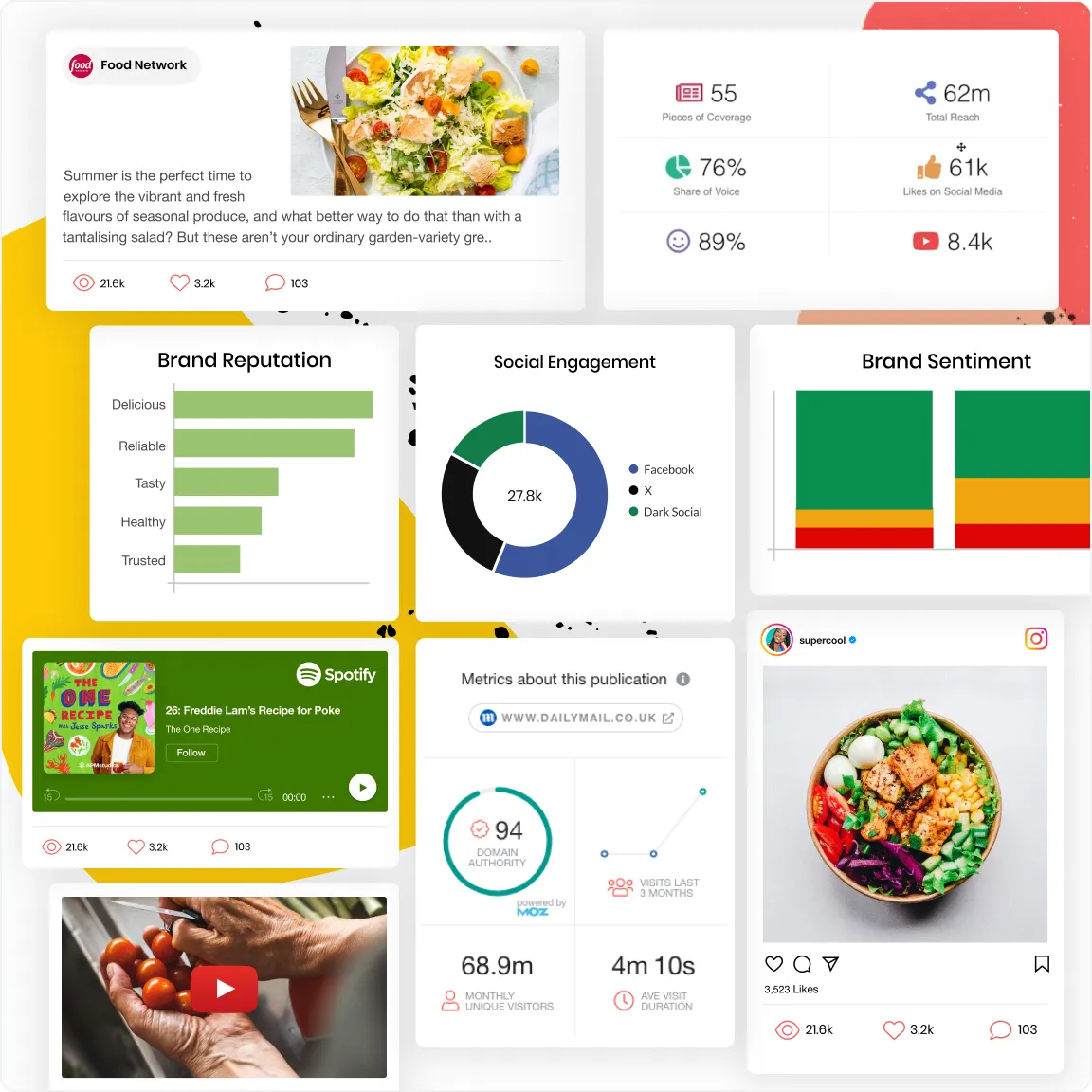
For example, when worked on Releasd, a PR analytics platform used by brands like BBC and Renault, the client planned to add an AI feature. Our team first validated it with a proof of concept. We built a piece of core functionality to check if it’s possible to meet client’s expectations with the chosen tech stack. Thanks to this previous check, we were able to launch fast — the feature went live in about a month. All constrains and nuances where discovered upfront during the PoC, so the team implemented the feature without delays.
We select a team setup around your product’s actual requirements. It may include a business analyst, UX/UI designer, solution architect, frontend and backend engineers, QA specialists, DevOps expertise, and a project manager.
These roles do not work as separate vendors. Designers can validate technical feasibility with engineers. QA specialists can review acceptance criteria before implementation. DevOps work can begin before the first production release.
We also offer flexibility in the team composition as the product moves through different stages. Discovery may require more analytical and architecture work, while active development requires greater engineering capacity. This keeps the team aligned with the current workload.
We divide the approved scope into manageable increments. Each increment has defined requirements, acceptance criteria, dependencies, and ownership.
During discovery, we consider realistic and pessimistic scenarios and estimate them both. During development, we track and communicate progress, sharing sprint results, budget use (estimates vs. actuals), risk updates, and schedule performance index.
Transparency does not automatically mean that the original plan never changes. SaaS products can develop as teams learn more about users and technical constraints, and it’s possible that some of your requirements will change mid-project. We are ready for it. Transparent delivery supports better change management, as our team clearly explains how a change affects cost or timing, so it’s easier to find the optimal adjustment path.
Clients receive access to the working backlog and communicate with the specialists responsible for the product. Regular planning meetings and weekly demonstrations show what has been completed and what the team plans to address next.
Demonstrations connect implemented functionality with acceptance criteria and product goals. This allows stakeholders to identify misunderstandings early. Decisions, risks, and scope changes are documented so that important context does not remain inside meetings or private conversations.
AI-assisted development tools may be used where they improve speed or consistency. Their output remains subject to human review, testing, security practices, and the same quality controls as other engineering work.
Our SaaS development services can continue after the initial release. Post-launch work may cover monitoring, maintenance, incident response, infrastructure, analytics, customer feedback, feature development, and scaling.
The client retains control of the source code, product data, documentation, and infrastructure access. Knowledge sharing remains part of the delivery process, whether our team continues as the long-term development partner or prepares the product for an internal team.
This model gives the client one accountable SaaS development company throughout the lifecycle while keeping product and business decisions under the client’s control.
Use this checklist to confirm whether a prospective provider covers the full product lifecycle. A missing item does not always disqualify a company. But the provider should explain who will own that responsibility and how the work will connect with the rest of the project.
Complete end-to-end SaaS development services should connect these areas through one delivery model. If strategy, architecture, testing, infrastructure, or support is excluded, determine whether your internal team can own it. The important question is not whether one company performs every task. It is whether every responsibility has a qualified owner and the handoffs between them are clear.
End-to-end SaaS development fits projects where one team should own the entire process, from discovery to post-launch support. It's one of several engagement models, and the right one depends on what you already have in-house and which parts of the work you want external specialists to cover.
If you already have an in-house team and need to fill specific gaps, a dedicated development team is the right model. External engineers join your process, work with your leads, and add the skills or capacity your team is missing. The same model suits projects that need help with just a few features.
At Clockwise Software, we cover every scenario above. If you need one team to own the product, we take it from discovery and architecture through engineering, launch, and continued development. If your in-house team needs extra skills, more capacity, or help with a few features, we provide dedicated engineers who work inside your process and report to your leads.
In both models, you get visible scope, documented risks, direct communication with the engineers, and regular delivery reviews. We've worked with SMBs, scaling startups, and enterprises on projects with budgets from $50,000 to $1.5M+.