AI solutions
What we do
Services
Experts in
How we work


Whether you build the product in-house or work with a digital product development services provider, the key challenges you’ll face and decisions you’ll make are much the same. You need to decide what deserves to be built now, what can wait, and where moving faster is worth the trade-off, without creating unnecessary cost or technical debt along the way.
That’s what we will walk you through today, along with everything else that is worth knowing about software development.
This guide covers the full digital product development lifecycle, from early validation to post-launch growth. We’ll look at the decisions that have the biggest impact on scope, cost, and timeline, the risks worth addressing early, the people you need at different stages, and what to look for in a development partner. Each section gives you the practical context you need to make the decision and points you to a deeper guide when you need more detail.
Digital product development is the process of creating, launching, and continuously improving software that delivers ongoing value to users or supports a core business process. Unlike a one-time software project, a digital product isn’t finished at launch. What the team builds next depends on real usage, user feedback, and changing business needs.
This applies to both customer-facing and internal products. A subscription SaaS platform and an internal dispatch system serve different audiences, but both need someone to own the direction, set priorities, and keep improving the product after release.
Digital product development and custom software development often involve much of the same work, including UX design, engineering, testing, and release. The difference is less about what teams do and more about what drives the work.
Custom software development usually starts with a defined set of requirements and focuses on delivering the system against them. Software product development starts earlier, with the problem itself. The team tests whether the proposed solution makes sense, then keeps adjusting the product after launch as real usage provides new evidence.
| Custom software development | Digital product development | |
| Starting point | A defined business need and a set of requirements | A business goal, a user problem, and assumptions to test |
| Main question | How should the required solution be built? | What should be built first, and how will we know it works? |
| Typical scope | Design, development, testing, and delivery | Discovery, design, development, launch, monitoring, and iteration |
| Planning approach | Scope is usually defined before development begins | Scope frequently evolves as the team validates assumptions and gathers evidence |
| Success measures | Requirements, quality, budget, and delivery timeline | Adoption, retention, user value, and business outcomes |
Which approach makes more sense depends on how much uncertainty you’re dealing with. A company replacing a well-documented internal system may already have clear requirements and need a conventional custom development process. A team launching a new SaaS product usually has more to prove first, from the target audience to whether the core workflow is worth building at all.
The boundary is not strict. Custom software projects often borrow product development practices when requirements are likely to change once real users start working with the system.
Digital products can serve external customers, internal teams, or both. Common examples include:
Each type comes with different risks. Marketplaces depend on balanced supply and demand, ERP systems on workflow fit and adoption, SaaS products on retention, and data or AI products on data quality. The product type helps determine what to validate first.
Off-the-shelf software is usually the better choice when your process is standard and mature tools already cover it well. Most companies, for example, have little reason to build their own accounting software, CRM, or payment system from scratch.
Custom development makes more sense when:
Build versus buy is rarely an all-or-nothing decision. Many products use existing services for standard functions like billing or authentication and reserve custom development for the workflows that actually make the business different.
Vendor comparisons can narrow the options, but they can’t tell you whether a tool will fit your workflow in practice. That comes down to the actual requirements, integration limitations, and what the solution will cost to operate over time.
Full-scale development is not a good candidate for the first step when your idea still involves some major unknowns. Before design and engineering, your team should validate the assumptions that could have the greatest impact on the product:
Not every detail needs to be settled before development starts. What matters is testing the assumptions that could make the product fail or force expensive rework later.
Different validation methods answer different questions, so the cheapest useful test is usually the best place to start.
| Method | Best for validating | Typical output | Rough investment |
| Concept validation | Problem, demand, and target audience | Interviews, landing page tests, lean canvas | A few weeks, relatively low cost |
| Prototype | UX, user flows, and product logic | Clickable screens in Figma | Up to 1 month; cost depends on scope and number of screens |
| Proof of concept | Technical feasibility | A working implementation of the riskiest technical part | 1 month or more, depending on the risk |
| MVP | Real-world usage and adoption | A focused, production-ready product | 3 to 6 months, $50K to $100K |
Concept validation is useful when the biggest question is whether the problem is worth solving at all. Interviews and lightweight market tests can provide that evidence before you invest in product design or engineering.
A prototype makes more sense when the uncertainty is in the user flow. Because it is much cheaper to change clickable screens than production code, this is the stage to catch confusing navigation or weak product logic.
A proof of concept is for technical uncertainty. It isolates the riskiest part of the solution and tests whether it can work under the conditions the product requires.
Before developing BackupLABS, for example, we built a PoC for GitHub backup. It proved the core technical pattern around authentication, scheduled backups, encryption, and recovery. That foundation was later extended to GitLab, Trello, Jira, and Notion. Today, the platform protects more than 4.5 million assets for over 1,000 corporate clients.
An MVP development is a good fit when the remaining assumptions can only be tested with working software and real users. Since it requires the largest investment, it usually follows concept, UX, and technical validation rather than replacing them.
The software product development life cycle can be divided into nine stages. This structure is useful for planning, but the real digital product development process rarely follows it step by step. Stages overlap, some work happens in parallel, and new findings can force the team to revisit decisions made earlier.
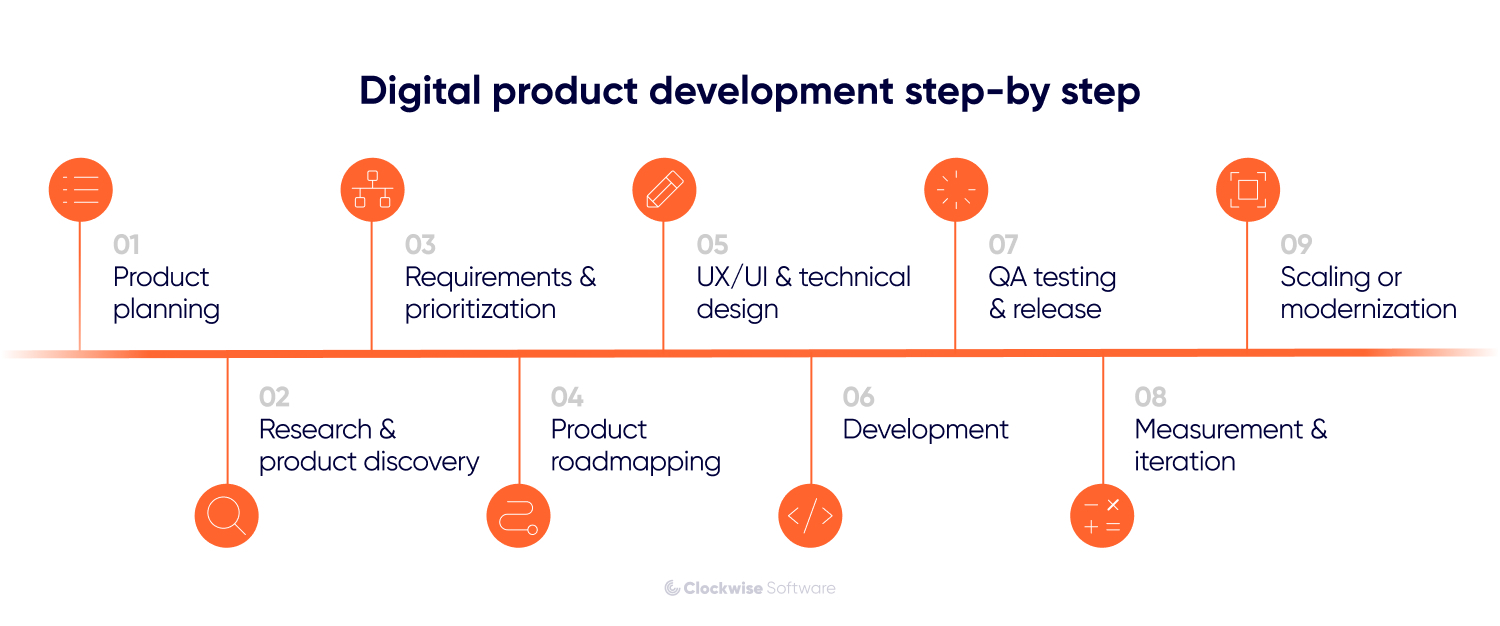
At this stage of software product development, you don’t need to have everything figured out. You need enough clarity to decide what problem you’re solving, who you’re solving it for, and what belongs in the first release. The risky assumptions should surface here too, before they become expensive to test in development.
That’s how we approached SmartSkip. Instead of trying to cover every possible use case, we focused the MVP on one core problem and the workflow around it. That tighter scope helped the product reach the market faster, and SmartSkip attracted its first paying users within a month of launch.
Discovery is where you pressure-test what you think you know about the product. You look at users and existing workflows, then dig into the technical constraints and business risks that could change the scope. The point is to replace the most expensive assumptions with evidence before development starts.
See how we approach project discovery for a more detailed breakdown.
Once you have enough evidence, you can turn it into requirements and decide what deserves to be built first. The first release should cover the core workflow without becoming a home for every useful idea. Acceptance criteria also give the development team a clear way to tell when a feature is actually done.
Connect product goals with the order in which the team plans to address them. A useful product roadmap shows where you want the product to go without pretending every feature and date is already fixed. As you learn more, allow the roadmap to change.
This is where you turn the idea into something both users and engineers can work with. UX decisions and technical digital product design should happen together: a seemingly simple interface can require a very different data model or integration setup behind the scenes. Working through those dependencies early helps avoid redesign and rework later.
Building in short iterations lets you review what actually works, catch problems earlier, and adjust as requirements become clearer. AI-assisted software development can take repetitive work off the team’s plate, but it doesn’t replace digital product engineering judgment where architecture or security is involved.
You don’t need the same testing strategy for every product. An early MVP may rely more on manual QA, while products with higher security or operational risks need stronger automated coverage. Before release, you also need monitoring in place and a clear way to roll back if something goes wrong.
See how we ensure quality for a closer look at our QA process.
Launch gives you something digital product strategy never can: evidence from real use. Analytics, feedback, and support requests show where the product is working and where it isn’t. Use that evidence to decide what deserves improvement, what can be dropped, and what should come next.
As usage grows, the product may need infrastructure changes, security improvements, architectural updates, or the replacement of components that no longer meet current requirements.
UDK, for example, continued expanding its ERP system over more than 9 years. The modernization was less about adding functionality and more about rebuilding it around new business processes and a newer technology stack.
Long-term success doesn’t depend on a single release. It usually comes from a series of product, technical, and business decisions that continue to matter as the product grows.
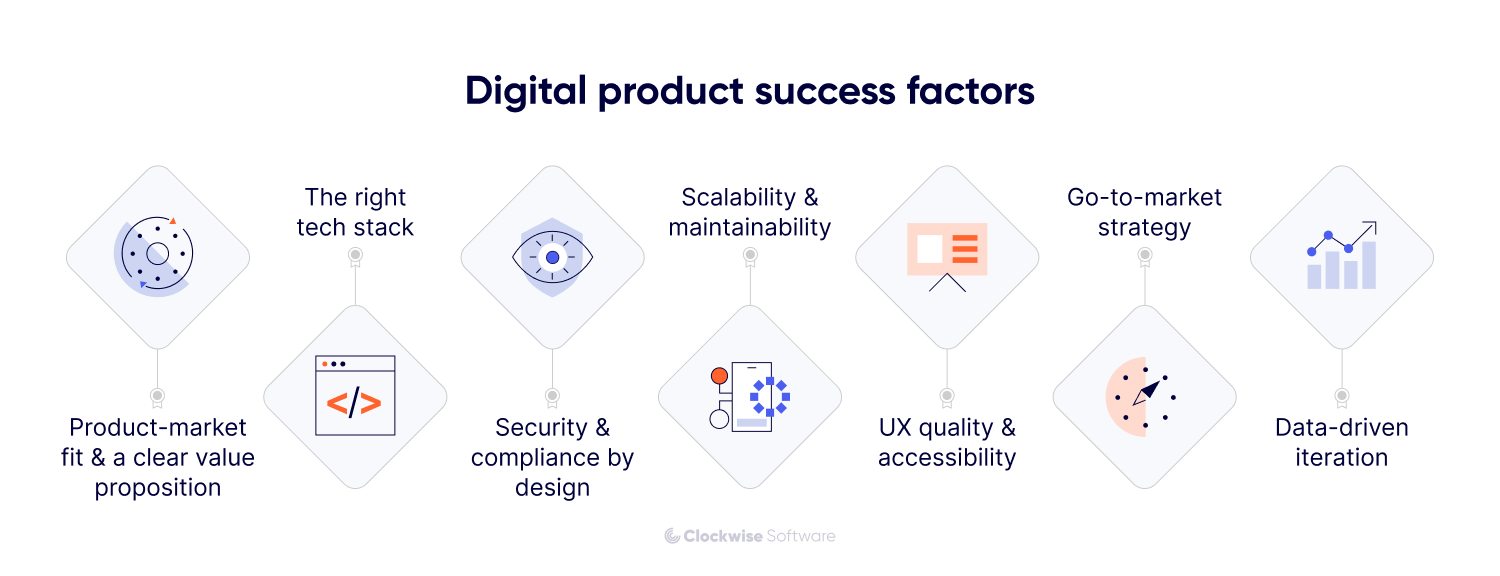
Product-market fit and a clear value proposition. You should be able to explain who the product is for and why they would choose it over the alternatives they already have. That answer may change after launch, which is why product-market fit needs to be watched through actual adoption and retention, not assumed once and forgotten.
The right tech stack. The best stack is not necessarily the newest one. It should fit the product’s requirements, expected load, and the expertise you can realistically hire for. Mainstream technologies such as React, Node.js, or Python often make development and recruitment easier, so a less common choice should earn its complexity.
Security and compliance by design. Security is much cheaper to account for before the architecture hardens around the wrong assumptions. If privacy or regulatory requirements appear late, they can force changes far beyond the code itself, including infrastructure and data handling.
Scalability and maintainability. You need enough room to grow without designing the first release for a scale you may never reach. The architecture should support realistic growth while remaining simple enough to maintain and change as the product evolves.
UX quality and accessibility. If users struggle with the core workflow, more features will not fix the problem. Good UX matters just as much in internal software, where friction often shows up later as poor adoption, more training, and extra support work.
A go-to-market strategy. Plan product development and market launch together. Early decisions about the target audience, positioning, pricing, and acquisition channels help define what the first release needs to demonstrate.
Data-driven iteration. After launch, the roadmap should respond to what the product is actually doing in the market. Analytics and user feedback help separate real problems from internal opinions. Without that evidence, the backlog can easily turn into a collection of stakeholder requests.
Digital product development involves more than engineering. The exact software development team structure depends on the product’s scope and complexity, but most projects require these roles.
On a smaller product, one person may cover more than one role. A product owner can also handle business analysis, for example. What matters is that responsibilities don’t disappear just because the team is small. Architecture decisions still need proper review, and QA should not become something developers do only when there is time left.
How we size a team

We build the team around the product, not the other way round. Scope, complexity, and how much needs deciding early tell us which roles we need and when. On a smaller product, that's a handful of people wearing two hats each; on a platform with multiple entities and integrations, it's a fuller team with clearer boundaries. Either way, we plan who's involved in which phase before we start.
Internal team. Makes sense when the product is core to the business, and you expect to keep developing it for years. You get more control over day-to-day decisions, but hiring takes time, and the operational overhead stays with you.
External team. Works better when speed matters more than building an internal engineering function first. It can also be a practical option if you need skills that would be slow or expensive to hire in-house.
Combined team. Fits companies that already have engineers but need extra capacity or a specific area of expertise. It can also keep a new workstream from competing with the existing roadmap. On Heads Up Health, for example, we worked alongside the client’s team while owning a clearly defined part of the product.
The hybrid model only works if ownership is explicit. Shared technical standards matter too; otherwise, two capable teams can still make decisions that pull the same product in different directions.
There is no universally “best” development methodology. The wrong one usually shows up as friction: too many ceremonies for a small team, slow decisions, or a process that can’t absorb change when the product starts moving.
The right choice depends on how predictable the work is and how often priorities are likely to shift.
Plus, there are Design Thinking and the Double Diamond frameworks that belong earlier in the process. They help teams understand the problem and test possible directions before delivery starts. Scrum or Kanban can then take over once the team knows what it is ready to build.
Many teams end up with a mix: structured discovery first, then Agile delivery. That gives them enough clarity to move without locking the product into decisions made too early.
The cost of digital product development varies widely because the product label says little about the amount of work behind it. Two MVPs can have similar feature lists and still require very different budgets once the team gets into the details.
An exact estimate requires enough clarity around the scope and the main technical unknowns. At an early stage, a range is usually more useful than a single figure.
Based on more than 200 products we’ve delivered since 2014:
| Stage | Typical range | What you get |
| Discovery | $12,000–$25,000 | Requirements, an initial architecture, prioritized scope, risk register, and project estimate |
| Prototype | From $4,500 | Clickable screens for testing user flows, presenting the concept, or supporting a pitch |
| Proof of concept | Scoped to the technical risk | A working answer to a specific feasibility question |
| MVP | $50,000–$100,000 | Core features, template-based design, two to three integrations, and cloud infrastructure |
| Market-ready product | $100,000–$300,000 | Custom UX/UI, modular architecture, five to ten integrations, and a security baseline |
| Enterprise platform | $500,000+ | Complex domain logic, multiple user roles, distributed architecture, and enterprise-level security |
| Maintenance | 15–20% of the build cost per year | Hosting, monitoring, updates, fixes, and ongoing support |
See our custom software development cost guide for a detailed breakdown and our guide to reducing software development costs for practical ways to control the budget.
Scope has the biggest effect on cost. The harder part is that scope often looks clearer on paper than it really is.
Take reporting as an example. A few dashboards built on clean, available data are one thing. Reporting that depends on legacy systems, complex permissions, or data that first needs to be cleaned is a very different amount of work. Both can still appear as one line in a feature list.
On a typical full-cycle project, the budget is distributed approximately as follows:
When one estimate comes in much lower than the others, it is worth checking what is actually included. Sometimes the scope is genuinely smaller. In other cases, design or QA has been cut back, while difficult integrations have been estimated too optimistically. Those gaps tend to show up later as additional work.
To make the ranges more concrete, here are a few products we’ve worked on. Their budgets reflect very different scopes and technical demands.
StoneBay. A property management and analytics MVP with lead tracking, contract management, user roles, and a REST API. The founders already had the concept and initial designs, which helped keep the budget close to $50K.
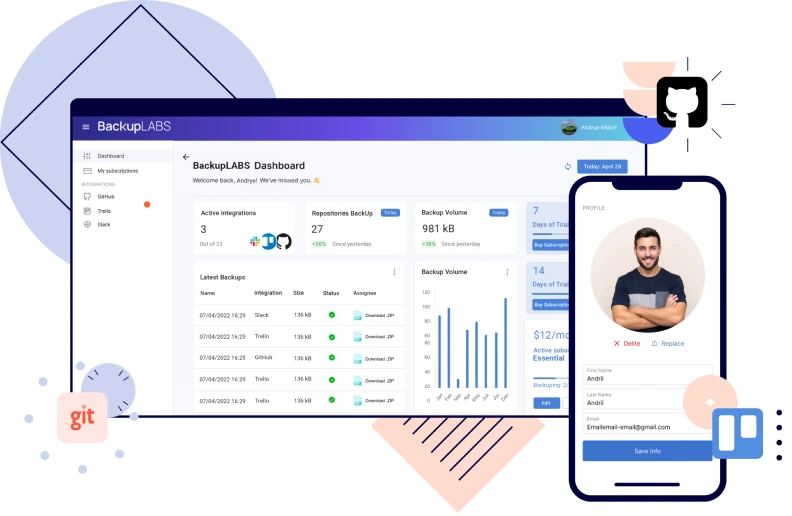
BackupLABS. A production-ready SaaS MVP with GitHub, GitLab, and Trello integrations, AWS S3 and KMS encryption, Stripe billing, and a microservice architecture. The project cost $80K–$150K and took 11 months to market.
Attention Nest. An SMM platform with scheduling across four social networks, approval workflows, analytics, and a creative editor. The project cost $200K–$400K, made campaign launches 4 times faster, and later evolved from an internal tool into a SaaS product.
UDK WebOffice. A custom ERP system with order management, invoicing, contractor bidding, Google Maps route planning, and warehouse synchronization. The project cost $500K–$700K, helped increase daily truck capacity from 45 to 92, and saved over $100K in operational costs in the first year.
The gap between these budgets comes down to how much each product had to do and how difficult it was to build.
There is no single timeline for every digital product, but these ranges are a useful starting point:
Real projects don’t always fit neatly into standard timeline ranges. Our own work shows how much the product scope and type of challenge can change the schedule. For example, Muzi reached MVP in six months and attracted more than 500 users in its first month. A route planning module we built for Foresolutions took ten months to bring to market and is now used by London’s largest bus operator. On the other end of the spectrum, an LLM-powered proof of concept for Releasd took just one month.
Scope usually sets the pace. Integrations can add weeks, legacy systems tend to uncover surprises, and slow stakeholder decisions can hold up even a relatively small build.
For a more detailed breakdown, see our guide to how long it takes to develop an app.
Team size matters too, but adding engineers late in a project can slow things down at first. New people need context, and the existing team has to spend time bringing them up to speed.
A written risk gives your team something concrete to assess, assign, and manage. The risks left unspoken tend to become expensive later.
Technical risks. An integration may behave differently from its documentation, an AI model may miss the required accuracy, or legacy data may be much harder to migrate than expected.
Business risks. Priorities can change quickly once budgets shift, funding is delayed, or the market moves. That can force the team to revisit the scope or change the product direction altogether.
Vendor risks. Warning signs include estimates with little reasoning behind them, unclear code ownership, weak handover, or a delivery team that looks stronger in the proposal than it does in practice.
Communication risks. Decisions get lost, stakeholders join too late, and the same requirement can mean different things to different people.
Each project will have its set of risks — it’s inevitable, because risks are an integral part of the process. But you don’t need to eliminate every risk at the start; it’s rarely possible.
What’s useful is knowing how to manage them: which ones deserve attention early, while the team still has room to respond, and which ones just need a clear mitigation plan and monitoring.
Risk management starts during discovery. The team identifies what could go wrong, estimates the likelihood and impact, assigns ownership, and agrees on a response. The risk register then stays active throughout development, because new risks appear and old ones change as the project moves forward.
Known risks should also affect the estimate. If an integration is uncertain or a technical assumption still needs to be tested, the budget and timeline should leave room for that uncertainty.
On our projects, we also track Cost Performance Index (CPI) and Schedule Performance Index (SPI). This makes budget or schedule drift visible once it happens instead of discovering it several months later. Using this approach, we keep cost and schedule variance below 10%, with work acceptance at 99.89% across our projects. Problems still happen; the advantage is seeing them while there is still time to respond without major rework.
For a deeper look at risk types and the full process, see our guide to software development risks.
When you decide on a development partner, a strong portfolio is useful, but it only tells part of the story. Look for products with similar technical complexity, even if they come from a different industry.
Domain experience matters when the product involves regulation or specialized workflows. Technical expertise should match the difficult parts of your project, such as integrations, scaling, AI performance, or legacy systems.
Plus, a good partner should be able to explain how the estimate was built, who will work on the project, and what happens when the scope changes. Code ownership and handover terms should also be clear from the start. See how we work with clients requests to better understand this process.
Red flags include estimates with little explanation, vague answers about IP ownership, no clear QA process, or a vendor that agrees with every idea without challenging risky assumptions.
The following questions can help you better assess if a vendor is a match:
The last question often tells you more about how a team works than another polished case study.
See our guide on how to find app partners for more detail.
Use this checklist to see whether your product is ready for the next stage.
Before discovery:
Before development:
Before launch:
After launch:
Digital product development is an ongoing process of testing assumptions, releasing focused product versions, and learning from real use.
More budget won’t fix a weak product decision. Teams get better results when they reduce uncertainty early, keep the first scope realistic, and continue adjusting the product after launch.
That is where discovery earns its place. It gives the team enough clarity to make informed decisions about the product before those decisions become expensive to change.