AI solutions
What we do
Services
Experts in
How we work


In 2026, the vendor market is crowded. Many digital product development companies have Clutch badges, decent portfolios, and a discovery phase on their homepage. The real signals that let you understand whether a company is a right fit for your project are in the specifics: what did they build, what problems did they solve during the build, and whether they can support the product as it grows after launch.
We created this list around those specifics. Each digital product development company was researched beyond their Clutch profile: through client outcomes, methodology, public case studies, and honest positioning. The result is a shortlist that spans US agencies, European product studios, and nearshore LATAM partners, at price points from $25/hr to $200/hr.
We didn’t just pull this list of product development companies from a search results page. Here is exactly what we looked for.
We prioritized product engineering companies with verifiable experience building SaaS platforms, marketplaces, consumer mobile apps, and complex web products. A strong portfolio shows that a team can work with real product requirements, evolving user needs, and long-term development goals.
Does the company run a proper product discovery phase? Do they help define scope, architecture, and MVP boundaries before writing code? We also evaluated post-launch capacity: ongoing support, dedicated team models, and the ability to iterate based on real user feedback.
We looked for digital product development companies experienced with cloud-native infrastructure (AWS, GCP, Azure), clean API design, and systems built to support future integrations without full rewrites.
Minimum threshold: 4.7 rating with meaningful review volume. The content of those reviews mattered too. Feedback about communication, delivery predictability, technical expertise, and long-term collaboration often provides more useful context than the score alone.
Clear processes make collaboration easier. We looked at how companies approach scope changes, communicate timelines and budgets, and support different engagement formats, including fixed-price projects, time-and-material arrangements, and dedicated teams.
The list deliberately includes leading digital product development companies across the US, Europe, and Latin America, from $25/hr to $200/hr. The best company for your project depends heavily on your budget, timezone, and the level of strategic input you need.
The companies below all approach digital product development a bit differently. Some are best for discovery and MVPs, while others are stronger at scaling, modernization, or long-term engineering support. Here’s where each one fits best.
Location: USA
Founded: 1993
Clutch rating: 5.0
Average rate: $150+/hour
EPAM is a US-headquartered digital engineering and consulting company with more than 62,750 professionals across 55+ countries. Its capabilities span product and platform engineering, experience design, cloud, data, and AI. The company works with more than 345 organizations from the Forbes Global 2000.
EPAM is particularly experienced in large digital environments where the work extends beyond developing a single application. Its teams can help modernize connected platforms, improve delivery processes, and coordinate changes across internal departments and customer channels.
The company combines consulting, design, and engineering within large multidisciplinary engagements. This allows EPAM to work on technology modernization alongside broader changes to how an organization develops, operates, and scales its digital services.
Best for: Large enterprises planning multi-year transformation programs across several systems, business units, or markets. EPAM is most relevant when global delivery capacity, enterprise governance, and access to a large talent pool matter more than a lean product studio setup.
Location: Ukraine
Founded: 2014
Clutch rating: 4.9
Average rate: $50+/hour
At Clockwise Software, we help companies turn product ideas into scalable digital solutions. Since 2014, we have delivered more than 200 projects across SaaS, marketplaces, ERP, HealthTech, MarTech, and logistics.
Our work usually starts with a structured discovery phase. Before development begins, we map user flows, clarify technical constraints, define MVP priorities, and identify the functionality your product actually needs at its current stage. This helps our clients reduce uncertainty early and build around clear business goals instead of assumptions.
AI is also helping us with delivery. Around 80% of our engineers now use AI tools on commercial projects to speed up routine tasks while keeping senior review and quality control in place. This approach let us deliver up to 30% faster, keeping the same level of quality.
Our portfolio includes projects for companies like Releasd, a MarTech SaaS used by Dyson, the BBC, and Renault, and Geocaching, a location-based platform with 3M+ users, where we built Lilypad Chat — a companion app that fits inside its existing product ecosystem. We've also delivered an ERP system for a manufacturer inside a global corporation of 1M+ employees, reducing operational errors by 75% and doubling delivery volume.
Across projects, we maintain a 99.89% work acceptance rate and less than 10% variance in cost and timeline performance. We also support long-term product development through dedicated teams, including engagements where we have contributed to multiple internal projects for the same client over several years.
For companies that want to add AI features to existing products, we offer AI product development services. Over the past year alone, we have delivered 5 AI projects, including LLM-powered automation, analytics, and workflow improvements.
Best for: If you are building a SaaS platform, marketplace, logistics product, or data-heavy system, we can take it from initial planning to a production-ready release. Our team covers discovery, UX/UI design, architecture, development, testing, deployment, and post-launch improvements. We are also a strong fit for established products that need scaling, modernization, or new AI functionality.
Location: USA
Founded: 2014
Clutch rating: 5.0
Average rate: $100+/hour
Goji Labs is a US-based product development company that combines product strategy, UX/UI design, and software development. Since 2014, the company has launched 500+ products that collectively support over 25 million users. Its portfolio includes work for startups, nonprofits, and established organizations, with projects ranging from early product concepts to more complex digital platforms.
One of the company’s strengths is helping teams bring clarity to the product before moving into full-scale development. Goji Labs works on user and market validation, roadmap definition, UX research, prototyping, and technical delivery within one process. For teams that need to make key product decisions quickly, the agency also offers focused strategy sprints designed to turn priorities and assumptions into a more actionable roadmap.
The company’s portfolio includes mobile apps, SaaS outsourcing projects, healthcare products, media experiences, and data-heavy tools. Its integrated strategy, design, and engineering model is particularly useful for teams that want close collaboration with a US-based agency throughout the product lifecycle.
Best for: Funded startups and established companies looking for a premium US-based product development partner with a strong focus on strategy, UX, and close collaboration. Goji Labs is especially relevant for user-facing mobile and web products where a polished experience and hands-on agency involvement justify a higher investment.
Location: Poland
Founded: 2004
Clutch rating: 4.8
Average rate: $50+/hour
Boldare is a Polish digital product development company with more than 20 years of experience. The team has delivered 300+ digital products for almost 90 clients, including startups, mid-sized companies, and established brands such as BlaBlaCar, Bosch, and Decathlon.
The company structures its work around the full product lifecycle, with a clear focus on product stages. Depending on the project stage, Boldare can help create a prototype, launch an MVP, improve product-market fit, or scale an existing platform. Its public portfolio includes many European client examples, which makes this experience especially relevant for companies building products for European markets or cross-border use cases.
Alongside new product development, Boldare works on modernization, system migrations, architecture improvements, and integrations. The company also uses agile delivery methods and cross-functional product teams to connect product design, engineering, and business priorities throughout the engagement.
Best for: European companies looking for a long-term product development partner that can support different stages of growth. Boldare is particularly relevant for teams moving beyond an MVP, improving product-market fit, scaling an existing platform, or modernizing a product that needs a stronger technical foundation.
Location: USA
Founded: 2003
Clutch rating: 4.9
Average rate: $150+/hour
thoughtbot is a global product design and development consultancy with 20+ years of experience and over 1,000 clients. The company works with products at different stages, from early validation and roadmap planning to modernization and ongoing development support.
A key part of thoughtbot’s approach is close collaboration with internal teams. Their designers, developers, and product strategists work alongside client-side specialists, helping improve not only the product itself but also the processes used to build and maintain it. This can be particularly useful when your company wants to strengthen its internal capabilities while moving an important product initiative forward.
The company is also well known for its open-source contributions and engineering culture. Alongside product delivery, thoughtbot supports team augmentation, process improvement, DevOps, cloud, and CI/CD initiatives.
Best for: Companies that want to improve both their product and the way their internal team works. thoughtbot is a strong fit for technical inflection points such as platform modernization, architecture changes, scaling challenges, or product initiatives that require close collaboration with an experienced consulting team.
Location: USA
Founded: 2007
Clutch rating: 4.9
Average rate: $150+/hour
Fueled is a digital strategy, design, and engineering agency with a global team of 300+ specialists. Following its merger with 10up, the company combines digital product development with strong capabilities in web platforms, content systems, cloud infrastructure, analytics, and enterprise WordPress.
The company has worked with brands and institutions such as Apple, Google, The New York Times, The White House, and Warby Parker. Its portfolio includes the relaunch of WhiteHouse.gov in 8 weeks, the development of Google Site Kit for WordPress, now used by 5 million site owners, and an augmented reality try-on feature for Warby Parker that received Apple’s App of the Year recognition.
Fueled’s work often sits at the intersection of product quality, scale, and brand visibility. The team supports both customer-facing applications and large digital ecosystems where design, content, engineering, and platform stability need to work together.
Best for: Enterprises, media companies, and consumer brands looking for a premium digital partner to deliver public-facing platforms, mobile products, or large-scale digital experiences. Fueled is especially relevant when launch quality, brand consistency, and the ability to coordinate multiple disciplines are central to the project.
Location: Poland
Founded: 2008
Clutch rating: 4.8
Average rate: $50+/hour
Netguru is a Polish software development company with a team of 630+ developers and designers. The company provides strategy, product design, software engineering, and modernization services for startups, growing businesses, and larger organizations.
Commerce is one of Netguru’s strongest areas of specialization. The team works with headless and composable commerce architectures, including platforms such as commercetools, Shopify Plus, Medusa, and SAP Commerce Cloud. Its projects can also involve PIM, CMS, search, personalization, and order management tools, which makes the company relevant for retail ecosystems with multiple connected systems.
For commerce projects, Netguru can support the full product lifecycle, from discovery and UX/UI design to mobile development, cloud architecture, integrations, and platform modernization. Combined with its experience across specialized commerce technologies and its larger delivery capacity, this makes the company well suited to complex replatforming initiatives and long-term ecosystem development.
Best for: Mid-sized and enterprise companies building or modernizing e-commerce platforms, marketplaces, and retail ecosystems. Netguru is particularly relevant if you need a larger European delivery team to support replatforming, integrations, and long-term product development.
Location: Brazil
Founded: 1995
Clutch rating: 4.7
Average rate: $50+/hour
CI&T is a Brazil-founded technology transformation company that combines strategy, customer experience, software engineering, cloud, data, and AI. Founded in 1995, it now has more than 8,000 professionals and works with over 100 large enterprises and fast-growing companies. Its scale and delivery model place it closer to an enterprise transformation consultancy than a conventional product studio.
One of the company’s strengths is modernizing large, business-critical technology environments while improving how internal teams build and operate software. Its engagements can cover application modernization, customer-facing platforms, cloud migration, managed services, and data initiatives, often across a broader product portfolio rather than one standalone application.
For a major US audio company operating across 150 advertising markets, CI&T modernized a fragmented sales platform and consolidated inventory into a single system. The project reduced application maintenance costs by 50%, shortened the turnaround time for digital sales proposals by 60%, and enabled sales teams to work seven times more efficiently.
Best for: North American enterprises looking for an established nearshore partner with delivery centers in Latin America and the capacity to support long-term transformation programs. CI&T is a good fit when time-zone overlap, access to a large talent pool, and coordination across several internal teams are more important than the compact setup of a boutique product studio.
Location: Uruguay
Founded: 2014
Clutch rating: 5.0
Average rate: $50+/hour
LoopStudio is a Uruguay-based software development company with a team of 50+ specialists across Latin America. As a nearshore partner, the company works with clients in the US and other international markets, providing product design, software development, data engineering, and staff augmentation services.
Security is an important part of LoopStudio’s positioning. The company focuses on high-trust digital platforms, including products in cybersecurity, fintech, healthtech, and analytics. Its secure-by-default approach is based on NIST SSDF and OWASP practices, with security considerations introduced early in the product development process rather than added only before launch.
LoopStudio also brings a strong UX/UI focus to technically complex products. This is particularly relevant for cybersecurity platforms and data-heavy tools, where users need to navigate large volumes of information without losing clarity. Alongside new product development, the company supports prototypes, MVPs, product redesign, accessibility audits, and dedicated nearshore teams.
Best for: US companies looking for a nearshore LATAM team to build or improve cybersecurity platforms and other high-trust digital products. LoopStudio is a good fit if secure development, clear UX for complex workflows, and convenient time-zone overlap are important from the start of your project.
Location: USA
Founded: 2009
Clutch rating: 4.9
Average rate: $50+/hour
BairesDev is a US-headquartered nearshore digital product development firm founded in Buenos Aires. Since 2009, it has completed more than 1,200 projects for over 500 companies, from startups to organizations such as Google, Pinterest, Adobe, and Rolls-Royce.
The company’s model is built around flexible access to Latin American engineering talent. Clients can add individual specialists through staff augmentation, bring in a dedicated development team, or outsource an entire development project. BairesDev covers more than 100 technologies and can assemble teams in a matter of weeks, making it particularly useful when an internal roadmap is moving faster than the hiring process.
For example, for Rolls-Royce, BairesDev assembled a five-person team to create an MVP for remote nuclear power plant monitoring. The team delivered the application in 5 months, extending real-time sensor data, alerts, and historical analysis from an existing web system to mobile users.
Best for: North American companies that already have clear product ownership and need to expand engineering capacity quickly. BairesDev is a practical option when you need time-zone-aligned specialists, access to a broad technical talent pool, or the flexibility to scale a team without committing to a lengthy internal hiring cycle.
When choosing a digital product development services vendor for your project, the key is to make sure they match the kind of support and expertise your product needs. Some digital product development companies are strongest at early-stage strategy and discovery. Others are better suited for complex delivery, product scaling, or a particular technical domain. The companies on this list broadly fall into four categories:
Once you know which archetype fits your situation, here are five things to check before signing a contract.
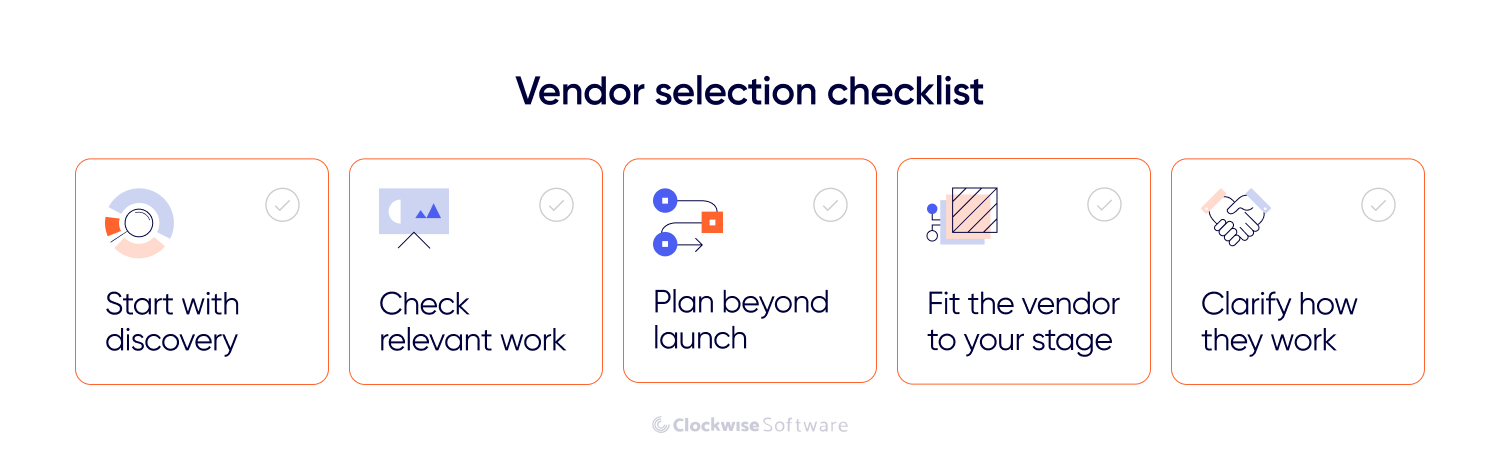
A reliable estimate starts with a clear understanding of what you are building. Before development begins, product development companies should help define or validate user flows, technical requirements, MVP priorities, and key risks.
You may not need a full discovery phase if you already have research, documentation, and a clear roadmap. Still, the team should review your materials, identify gaps, and confirm that the scope is realistic before writing code.
Ask how this validation works and what you will receive at the end. You should enter development with a clear scope, budget, timeline, and understanding of the main risks.
A strong case study should explain more than what the final product looks like. Look for details about the original challenge, the decisions made during development, and the measurable results after launch.
Pay attention to whether the company describes:
This gives you a better sense of how the team approaches real-world product decisions.
The first release is usually the beginning of the product lifecycle, not the end. After launch, you may need to improve features, respond to user feedback, strengthen the architecture, or scale the team.
Ask whether product development companies offer long-term support, dedicated development teams, and a clear approach to technical debt. It is also worth discussing how they handle infrastructure changes as the number of users, integrations, or data volumes grows.
A company can have an impressive portfolio and still be a poor match for your current needs. Premium AI product development companies may be a good choice for a high-visibility consumer platform, while a smaller European studio may offer a more practical setup for an MVP or a focused product redesign.
Consider your budget, timeline, internal technical expertise, and the type of collaboration you expect. Some teams need a partner to shape the product direction. Others already have a clear roadmap and need additional engineering capacity.
Before choosing a digital product development company, discuss how the team works in practice:
The right partner should be able to answer these questions clearly and explain how their process supports your specific goals. A good fit is not only about technical expertise. It is also about transparency, communication, and the ability to adapt as your product evolves.
To find a software development company that can build a digital product is not difficult. The harder part is choosing a partner that can define the right scope, make sound architecture decisions, and support the product as it evolves after launch.
Top digital product development companies in this guide bring different strengths, from early-stage discovery and UX design to platform modernization, mobile development, and long-term engineering support. The right fit depends on your product stage, budget, internal capabilities, and the level of strategic involvement you expect from an external team.
Use the profiles and criteria to narrow the list to a few relevant options. Then review case studies, discuss delivery processes, and ask for references before making a final decision.
If our expertise and digital product development services seem like a good fit for your product, we can support you across the full product lifecycle, from planning and design to engineering, launch, and post-release improvements.
You can start with a structured discovery phase to validate the scope, identify technical risks, and receive realistic cost and timeline estimates. This gives you a clear development plan and helps you decide whether to move forward with the full build.