AI solutions
What we do
Services
Experts in
How we work


The AI world is growing fast, you’ve probably felt it yourself. Every week, there’s a new tool, a new model, or a new company promising to “redefine the future”. It’s exciting, but it’s also a lot. In 2025, more than 90,000 companies called themselves AI developers. That’s great for innovation. It also makes choosing the right AI software development services partner harder than ever.
Here’s the tricky part: many AI development companies can plug in an API or spin up a quick demo. Few can take an AI idea and turn it into a production feature that performs well, scales with your product, and gives you real business value.
If you’ve ever tried to pick a vendor and felt like everyone sounds the same, you’re not wrong. A polished pitch doesn’t mean they can ship reliable AI.
That’s why we created this list. Each company here earns its place for a clear reason. That makes it easier for you to spot the right fit and move forward with confidence.
AI software development companies can look similar from the outside, so we used a clear set of criteria to spot the teams that consistently deliver strong, reliable work. These are the things that actually make a difference once you start building:
Proven experience building AI that runs in the real world. Naturally, the first thing we looked for was AI development companies that have proof (case studies, testimonials, etc.) that they actually built and shipped AI systems. This includes machine learning, LLM-powered features, predictive analytics, or automation tools that people depend on every day, often supported by clear data visualization for faster decision-making \
Ability to handle the full AI lifecycle. Strong AI development companies don’t stop at model training. They help you from early project discovery through data prep, development, deployment, and ongoing tuning. In other words, they stay with you from the idea stage to real usage.
Deep understanding of AI tech. We considered how well each company understands the nuts and bolts of AI. Things like choosing the right model, explaining the generative AI meaning behind generated content and outputs, setting up a RAG pipeline, using embeddings, fine-tuning, or running good MLOps practices. You don’t need to know all the details, but you do want a generative AI development company that does.
Ability to design systems that scale. Good AI is only useful if it runs well as you grow. We checked whether these companies can build systems that stay fast, reliable, and cost-efficient when traffic or data volume increases.
Clear communication about scope and cost. No one likes surprises. We favored companies who explain timelines, budgets, constraints, and trade-offs clearly. Teams that communicate clearly earn trust. Overpromising usually leads to problems later. \
Strong senior talent on the team. AI is still a senior-heavy field. We gave preference to companies with seasoned engineers and ML specialists who stay hands-on throughout the project.
A good fit for different stages and goals. Some AI software development companies shine at fast MVPs. Others excel at enterprise-scale systems. We matched companies to the kinds of problems they solve best, so you can find your ideal fit quickly.
Based on these criteria, we highlighted the best AI development companies that show strong, repeatable results when delivering AI systems in practice.
Location: Ukraine
Founded: 2014
Hourly rate: $50+
Clutch rating: 4.9
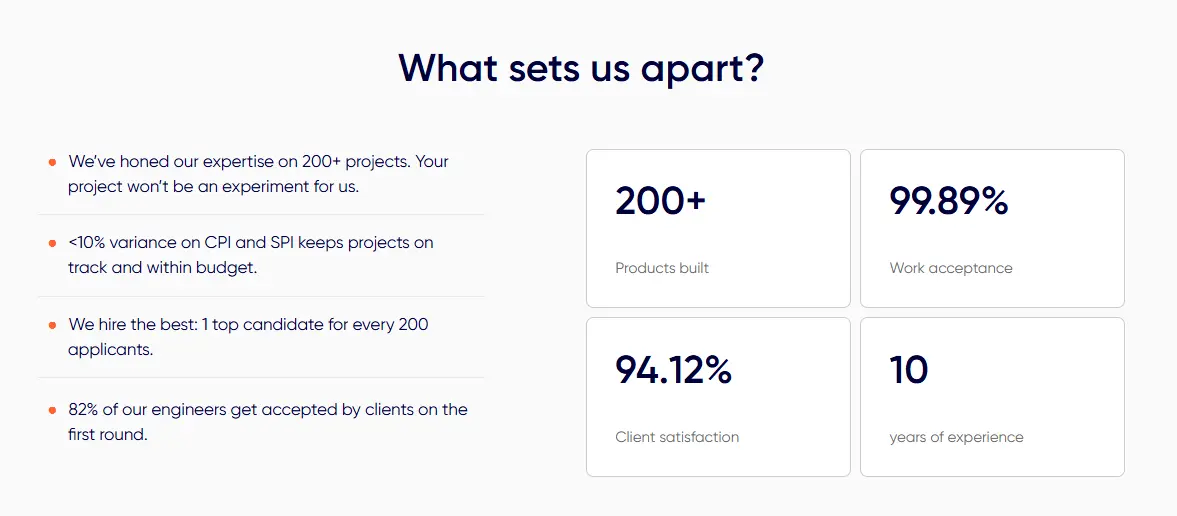
At Clockwise Software, we help teams bring AI into their products in a way that feels practical, predictable, and worth the investment. We have spent 10+ years building software and have delivered over 200 products, so the AI work we do today sits on top of a strong engineering foundation.
Our company helps teams make AI practical by turning abstract ideas into structured, product-ready implementations. We start with your goals, look at your data and tech setup, and match you with the simplest path that can deliver actual value. Sometimes that means integrating a pretrained model, sometimes it means RAG or fine-tuning. The point is to choose what fits your product instead of overbuilding.
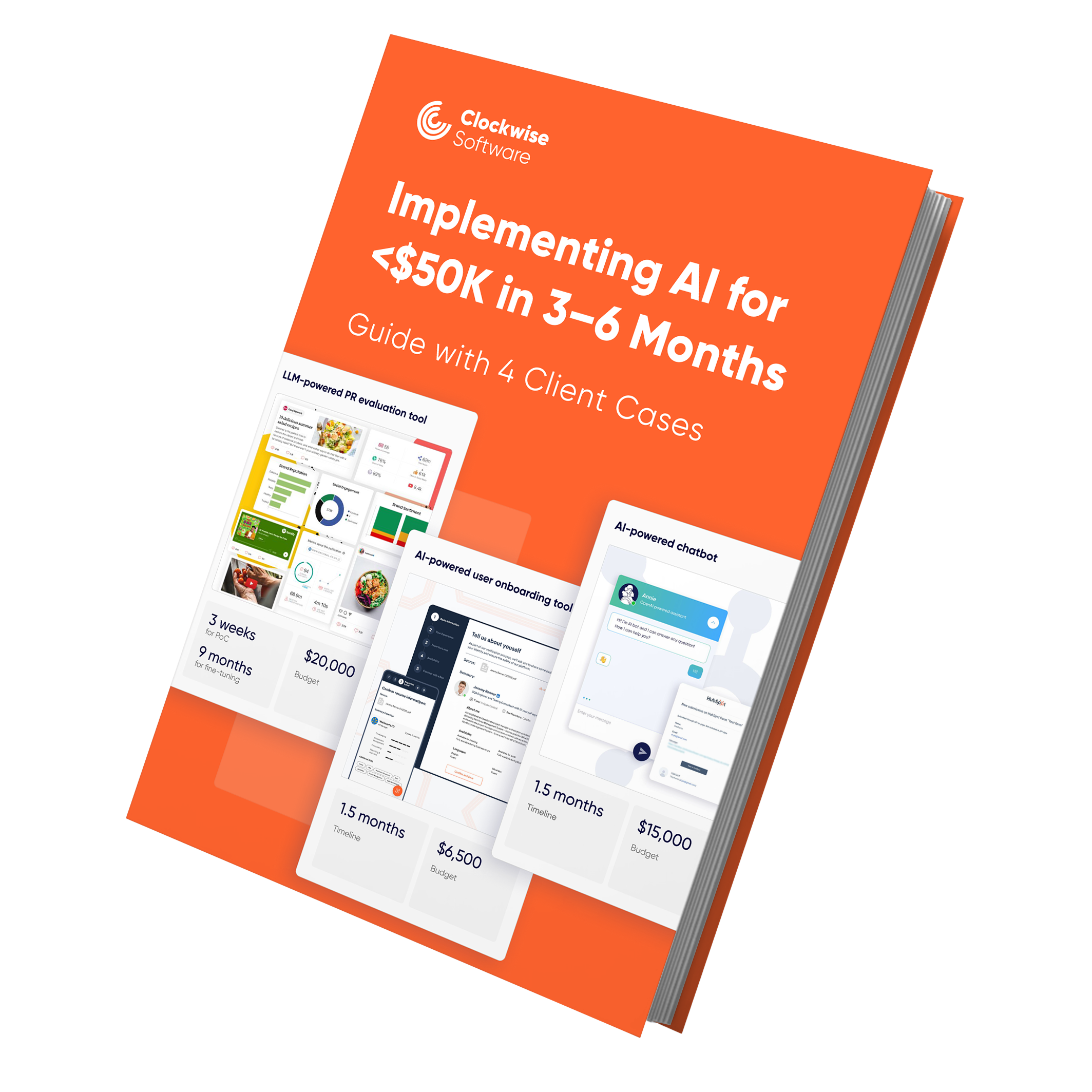
This approach has worked well across different industries. For example, we:
Because delivery discipline matters as much as the tech, our AI software development company pays close attention to project predictability. Our projects stay within 10% variance on cost and timelines, backed by long-term team stability and consistently high client satisfaction.
If you want to add AI to an existing product, modernize your data workflows, or validate whether an AI feature is worth building, we are a good match.
Location: Poland
Founded: 2005
Hourly rate: $50+
Clutch rating: 4.7
STX Next is a large Python-focused engineering company with a long history in data-heavy projects. A lot of their AI work is built on strong data engineering skills. They often help teams clean up data flows, build modern pipelines with tools like Snowflake or Databricks, and prepare cloud setups before any AI features are added. For companies that see data readiness as their main bottleneck, this can be useful.
This machine learning development company covers model development, workflow automation, and integrating AI into existing products. They also work with vision-based use cases, such as their Deepnext project, where they supported medical teams with image analysis. Their approach is structured and process-driven, which fits organizations that prefer a steady, predictable delivery model.
STX Next is generally a match for teams with data-intensive products or legacy systems that need modernization before AI can make a real impact. They focus on building the groundwork and helping companies move toward AI in a measured, incremental way rather than jumping straight into advanced features.
Location: United States
Founded: 2009
Hourly rate: $100+
Clutch rating: 4.7
BlueLabel focuses on strategy, UX, and integrating generative AI into workflows rather than building heavy ML systems from scratch. They do a mix of AI consulting, generative AI setups, RAG implementations, conversational AI, and agent-like workflows. These capabilities are usually embedded within broader product development that includes mobile, design, and web work.
Their artificial intelligence software development practice centers on designing AI features that fit naturally into the user flow. For example, they build chat-style assistants, AI-driven recommendations, and tools that use your own data through retrieval augmented generation. They also provide data and LLM engineering to clean and prepare content before feeding it to a model. Their experience usually appeals to brands that want AI to feel well-designed and on-brand, not just technically functional.
BlueLabel is generally a match for companies that see AI as part of a bigger product redesign or user experience improvement. They are less focused on deep data engineering or custom model training, and more on helping teams define use cases, plan workflows, and ship AI features that fit smoothly into an existing app.
Location: India
Founded: 2007
Hourly rate: $50+
Clutch rating: 4.7
LeewayHertz is an AI software development company based in Gurugram, India. Now part of The Hackett Group, it works on enterprise AI initiatives that combine early strategy with engineering and integration into existing systems.
A central part of its offering is ZBrain, a platform designed to help companies find practical AI use cases, assess their feasibility and potential ROI, and turn the strongest ideas into implementation plans. This gives LeewayHertz a more platform-led approach than companies focused mainly on building individual AI features.
Its public portfolio includes an AI assistant for compliance platform Scrut and a troubleshooting solution that helps a Fortune 500 manufacturer retrieve relevant equipment and safety information.
LeewayHertz may be worth considering if you are exploring several GenAI or agentic AI opportunities at once, especially if you need AI development companies that can support deciding what to build before moving into implementation.
Location: United States
Founded: 2010
Hourly rate: $25+
Clutch rating: 4.8
Simform is a digital product development company that often approaches AI as part of a larger technology program. Alongside building AI features, its teams work on the cloud architecture, data platforms, and product systems those features depend on.
The company covers generative and agentic AI, machine learning, RAG, and MLOps, with a particularly strong focus on Microsoft and Azure technologies. It also uses reusable frameworks and accelerators to help enterprise teams test ideas and move successful concepts into production.
One public project involved a GenAI research tool used by more than 150,000 people, where Simform reports making search 20 times faster. In another, an AI-powered supply chain platform helped reduce shipment costs by 20% and connectivity disruptions by 40%.
This approach may suit enterprises and larger product companies introducing AI alongside cloud, data, or platform modernization, especially when the work needs to continue across several systems and teams.
Location: United States
Founded: 2016
Hourly rate: $25+
Clutch rating: 4.9
Azumo is a San Francisco-based development company with a nearshore engineering team in Latin America. AI has been part of its offering since the company launched, with services spanning generative AI, intelligent agents, RAG, computer vision, NLP, predictive models, and MLOps.
The team takes a model-neutral approach to AI product development, working with commercial and open-source models depending on the product, budget, and deployment requirements. Its public portfolio includes a semantic search engine for Meta, generative AI work for Omnicom’s cultural intelligence platform, and forecasting tools for financial and energy markets.
Azumo is a good fit for North American companies that already have a product direction and need experienced dedicated developers to strengthen an internal team. Its nearshore model is particularly useful for ongoing development where time-zone overlap, close collaboration, and flexible access to technical talent matter.
Location: United States
Founded: 2016
Hourly rate: $50+
Clutch rating: 4.9
HatchWorks AI is an Atlanta-based generative AI development company with delivery teams across Latin America. Its work covers AI strategy, data readiness, agentic automation, and AI-powered software development, making it a broader digital transformation partner rather than a team focused only on building individual AI features.
One of its main differentiators is Generative-Driven Development, or GenDD. This proprietary approach brings AI agents into the software delivery process while keeping planning, key decisions, and quality checks under human control. HatchWorks also offers workshops and assessments that help enterprise teams identify viable use cases before investing in full development.
Its public projects include an AI assistant for aircraft maintenance, RAG-based access to real-time fleet data, recruitment automation, and a system that now handles 47% of a client’s sales emails.
HatchWorks AI is a good fit if you want to introduce AI across several workflows while also improving data foundation and internal development practices. Its combination of consulting, training, proprietary delivery methods, and nearshore engineering support works particularly well for larger, long-running AI programs.
Location: United States
Founded: 1993
Hourly rate: $100+
Clutch rating: 4.8
SoftServe is a Ukrainian-founded AI software development company headquartered in Austin. Its AI work is closely tied to cloud, data, security, and product engineering, which allows the team to work on initiatives that reach beyond a single application or workflow.
The company develops generative AI functionality, products based on machine learning, agentic systems, and physical AI solutions. Its partnerships with AWS, Google Cloud, Microsoft, and NVIDIA also make SoftServe a natural option for organizations already building within one of these technology ecosystems.
One recent project involved introducing AI agents into the software delivery lifecycle at Fortified Health Security. SoftServe reports that the rollout created additional capacity roughly equal to two full-time employees per quarter for a 20-person team.
SoftServe may be especially relevant for large organizations bringing AI into established platforms, internal processes, or cloud environments where several technical disciplines need to move together.
Location: United States
Founded: 1997
Hourly rate: $50+
Clutch rating: 4.9
DataArt is a long-established engineering consultancy that brings AI into complex enterprise environments. The company works heavily with finance, healthcare, travel, retail, and media, where new tools usually have to connect with legacy systems, sensitive data, and processes that cannot simply be rebuilt from scratch.
Its work covers generative AI, RAG, custom machine learning solutions, data platforms, and agentic systems. DataArt also uses Artisyn, its own AI-enabled delivery approach, to bring reusable components, engineering agents, and governance into the development process.
Public examples include a maintenance assistant that cut information search time by 50%, a GenAI tool that generated $60,000 in annual savings, and an internal support platform that resolves up to 60% of requests automatically.
DataArt makes the most sense when your organization already has substantial technology infrastructure and you want to introduce AI without disrupting the systems around it. It is less of a focused product studio and more of a partner for broader, long-term modernization.
Location: India
Founded: 2010
Hourly rate: Under $25
Clutch rating: 4.9
eSparkBiz is an Indian product engineering company that combines AI product development with broader web, cloud, and enterprise software work. This allows its teams to add AI functionality as part of a larger product roadmap rather than treat it as a separate initiative.
Their experience includes generative AI, RAG, agents, and custom machine learning. One recent example is its collaboration with Credo AI, where eSparkBiz engineers contribute to ongoing product development and integrations for an AI governance platform.
The company may appeal to tech startups looking for flexible engineering support across both AI and the surrounding product. Its broader development capabilities can be useful when new AI features need to connect with existing applications, workflows, and infrastructure.
Picking a perfect partner among dozens of AI development companies is not just about who has the fanciest model or the flashiest case study. You want a team that understands your product, your data, and how AI fits into your real-world workflow. A few practical signals make it easier to assess whether a team is the right fit.
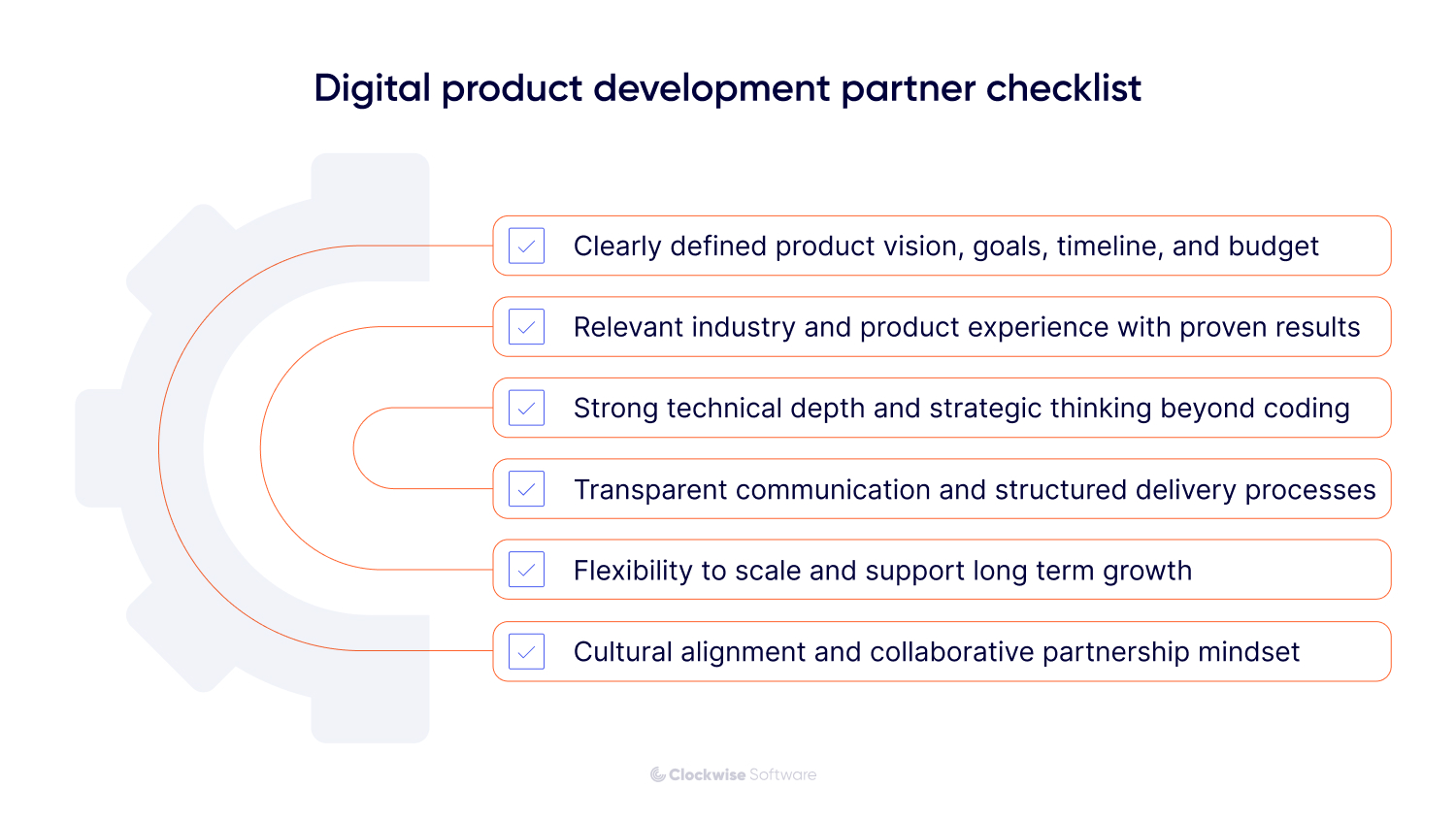
A good partner should “get” your world quickly. They should be able to talk about your users, your data, and your constraints in plain language. AI in real estate is different from AI in fintech. If AI development companies jump straight to model talk without asking about your business, that’s usually a sign to keep looking.
AI only works well when the whole system works well. That means data pipelines, architecture, integrations, monitoring, and a plan for updates. Ask AI software development companies how they handle these pieces. You want someone who treats AI as part of your product, not a cool experiment glued on top.
Before writing code, best AI development companies help you check data readiness, define success, and run a simple proof of concept. This saves time and money. If a company wants to jump straight into full development without validation, you may end up paying for fixes later.
Building a prototype is easy, running it in production is not. Ask how an artificial intelligence development company handles AI frameworks selection, versioning, model drift, uptime, and ongoing tuning. Teams with real production experience can explain these things clearly and calmly.
AI work does not end at launch. You want AI software development companies that can support the next few versions of your product, not just deliver a one-off feature. Look for stability, clear communication, and a working style that matches how you like to build. For example, knowledge of the latest SaaS trends can be a useful signal here.
Choosing the right AI development company means finding a partner that balances technical depth with practical execution — one that can turn AI from an experiment into a dependable part of your product or operations.
Finding the right AI software development company can feel overwhelming, especially when every company uses the same language to describe very different strengths. The good news is that once you understand what really matters (clear goals, reliable engineering, and a practical path to production), the choice becomes much easier. Each company in this guide brings something unique, and depending on your stage and needs, any of them might be a fit.
If you are looking for a team that treats AI as part of your product and integrates it into existing workflows instead of rebuilding everything around a model, that is where we put most of our focus at Clockwise Software. We like to keep things grounded. helping you move from idea to working, measurable features without unnecessary complexity. For many teams, that balance of speed and stability is exactly what gets AI out of the “maybe later” bucket and into real use.
So take your time, compare approaches, and choose a partner that feels like an extension of your team. And if you want help shaping or implementing AI in a way that fits your product and budget, we are always happy to talk through options and share what has worked for others. With the right plan and the right support, AI becomes a lot less intimidating and a lot more useful.