AI solutions
What we do
Services
Experts in
How we work


When you plan to build logistics software with an external team, you definitely want to get a vendor who can:
Structure development so it feels stress-free and stays on time
Deliver software that doesn’t require constant hot fixes, because a delayed update, a broken integration, or a slow route calculation can disrupt the whole operation.
If you struggle to choose a company that can meet these requirements, we’ve got you.
We know exactly what smooth logistics and transportation software development should look like. Since 2014, we’ve delivered 200+ products, including 10+ logistics software development projects and 30+ mobile apps. Our solutions have helped clients plan routes 40% faster, cut process complexity by 60%, and save more than $80K a year on delivery costs.
We used that experience to review logistics software development companies by their projects, technical expertise, client feedback, rates, and product focus. And we’re ready to share the criteria, the list, and some tips to choose a perfect company for your project.
When you’re looking for a tech partner in logistics, you don’t just want a team that can code. You want a reliable, experienced crew that understands the inner workings of the industry and can take ownership of the development process. That’s the mindset we used when curating this list. Here are the key criteria we focused on while selecting the top 10 logistics software development companies:
We prioritized companies with hands-on experience with custom logistics software development: fleet management software, route optimization platforms, and transportation apps. Practical delivery results matter far more than buzzwords or theoretical expertise.
Logistics software development services vendors with consistent high ratings (4.5 or above), verified reviews on Clutch, and returning clients ranked higher. Ongoing relationships signal trust, reliability, and steady project delivery.
The best logistics software development companies use modern frameworks like React, Node.js, and Python, along with cloud solutions such as AWS or Azure. This foundation supports flexible, scalable systems that can handle large data volumes and evolving business needs.
The best logistics software companies know how to integrate GPS, mapping APIs (Google Maps, Azure Maps, Mapbox), and live data streams for accurate route planning and fleet visibility. At Clockwise, for example, we’ve built systems that process live updates for hundreds of active users daily.
Logistics systems need to stay stable as data and users grow. We look for logistics software development companies that show this ability through real projects, strong cloud expertise, and proven work with high-load platforms. These signs usually reflect mature practices around scalability, security, and reliable system performance.
Successful collaboration depends on clarity. A strong logistics software development vendor offers open communication, transparent pricing, and detailed project roadmaps. That’s how we work too, with no hidden costs and no surprises.
Smooth communication keeps complex logistics software development services projects moving. We highlighted companies with strong English proficiency and overlapping working hours for reliable daily coordination. We also chose vendors with clients in Europe, North America, and Australia, since steady work in these regions often indicates a good cultural fit and reliable communication.
Logistics evolves quickly, and the best teams evolve with it. They rethink requirements, integrate new tools, and deliver smarter, leaner solutions that keep logistics running efficiently.
If you’re looking for a logistics software development services partner that brings all of the above to the table, start with these.
Location: United States
Founded: 1998
Clutch Rating: 4.9
Average Rate: $25+/hour
Itransition is a U.S.-headquartered logistics software development company with more than 25 years of experience and a team of 3,000+ specialists distributed across 10+ offices around the world. Their custom software development for logistics expertise covers TMS, WMS, fleet management, route optimization, GPS tracking, process automation, and supply chain software development.
The company has worked on logistics systems that handle high order volumes and connect data across multiple tools. One example is an RPA solution for a global logistics provider processing around 800 orders per day. Itransition has also helped modernize shipping software by moving a legacy platform to a cloud-based microservices architecture.
With experience in Java, Python, .NET, React, AWS, Azure, and UiPath, the team is well-suited for complex integrations, legacy modernization, and enterprise-scale logistics platforms.
Best for: Mid-sized and enterprise logistics companies that need a large transportation software development company to modernize existing systems or build integrated TMS, WMS, fleet, and shipping solutions.
Location: Ukraine
Founded: 2014
Clutch Rating: 4.9
Average Rate: $50+/hour
At Clockwise Software, we’ve delivered over 200 projects since 2014, including 10+ logistics platforms. Our logistics software development experience includes:
Fleet management systems
Route planning and scheduling solutions
Real-time tracking tools
Supply management modules
Shipment tracking features
Integrations with custom and third-party logistics services
We also build location-based applications and have delivered AI-powered features, including predictive analytics and intelligent automation, alongside more than 30 mobile apps with an average rating of 4.7 stars.
We work with logistics teams at different stages. From building focused MVPs for logistics tech startups to developing large-scale platforms with complex role-based access, real-time data processing, and cloud architectures designed to grow with the business. For our clients, this has translated into concrete outcomes: more than $80K saved on delivery costs each year, route planning completed 40% faster with higher accuracy, and a 60% reduction in process complexity across day-to-day logistics operations.
One of our key projects is a route-planning and scheduling platform used daily by the #1 bus operator in London. This system supports thousands of passengers and helps the operator improve efficiency, resource use, and on-time performance.
Our delivery process is built for consistency. Across projects, we have a 99.89% work acceptance rate, keep overall satisfaction at 94.12%, and maintain cost and schedule variance within 10% of the original plan.
Best for: Teams that want a reliable, transparent partner to build or scale logistics platforms, from MVP to ERP software for supply chain management. We design functionality that covers your workflows end-to-end, build real-time tracking and fleet modules, implement role-based access, integrate mapping services, add AI functionalities, and develop custom features that keep operations efficient and connected.
Location: Ukraine
Founded: 2009
Clutch Rating: 4.9
Average Rate: $25+/hour
Stfalcon is a Ukrainian software development company with a deep focus on transportation and mobility systems. While many vendors cover general logistics needs, Stfalcon specializes in transportation software development services, building products that bridge physical assets and digital control.
Their edge lies in IoT integrations and AI-powered analytics. Stfalcon’s team develops systems for real-time vehicle tracking, route prediction, and sensor-based fleet monitoring. They've worked on solutions involving cargo diagnostics, vehicle telemetry, and predictive maintenance, ideal for businesses that rely on high-frequency data from hardware in the field.
Their experience with hardware integration, mobility platforms, and transportation software development makes them a go-to partner for projects requiring close coordination between software and IoT infrastructure.
Best for: Companies seeking a logistics software development services vendor with deep IoT expertise, real-time vehicle tracking, and connected system design.
Location: United States
Founded: 2010
Clutch Rating: 4.8
Average Rate: $25+/hour
Simform is a U.S.-based engineering company that specializes in modernizing backend systems and scaling logistics technology with enterprise-grade cloud architecture. Their co-engineering model pairs Simform engineers directly with in-house teams, which helps accelerate delivery, maintain transparency, and ensure smooth knowledge transfer throughout the project.
They have strong experience with real-time data, AI development and ML, and large-scale infrastructure. Simform offers route optimization, real-time tracking, and supply chain software development services, often rebuilding legacy systems to support automation, analytics, and long-term scalability. Their work is well suited to logistics platforms that depend on high-performance cloud systems rather than UI-heavy or product-centric builds.
Best for: Enterprises modernizing logistics infrastructure or scaling data-driven systems that need additional engineering capacity to strengthen and extend an existing product team.
Location: United States
Founded: 2001
Clutch Rating: 4.9
Average Rate: $150+/hour
Atomic Object is a U.S.-based software development company with over 20 years of custom software development for logistics experience. Their work spans freight and carrier management, route and pricing optimization, and TMS platforms tailored to real-world operations.
What sets this transportation software development company apart is a UX-first approach paired with strong engineering. Their platforms help logistics teams simplify complex workflows, improve visibility, and gain tighter control, without overcomplicating the tech. From demand forecasting to custom process automation, everything is built to fit the way each business works.
Atomic Object takes on fewer projects at a time and works closely with clients through every step. While they may not be the most cost-effective option, they bring depth, transparency, and long-term quality, especially for North American logistics teams looking for a high-touch, tailored build.
Best for: U.S. and Canadian logistics providers seeking custom, user-friendly software with close collaboration and a strong focus on quality.
Location: United States
Founded: 2003
Clutch Rating: 4.9
Average Rate: $25+/hour
Fingent is a global software development company with 450+ specialists and offices and development centers in the United States, Australia, the UAE, and India. Their work in logistics covers transportation and warehouse management, last-mile delivery, tracking, business process automation, and supply chain software development services.
One of their projects involved developing a software suite for an e-commerce locker company, helping reduce the client’s internal workload by 50%. This reflects Fingent’s broader strength: connecting logistics tools with existing enterprise workflows rather than treating them as isolated products.
Their experience with cloud platforms, AI app development, SAP, and other enterprise technologies is particularly useful in projects where logistics software must integrate with complex existing infrastructure.
Best for: Large logistics organizations running multi-system modernization projects, especially those involving SAP or legacy platforms.
Location: United States
Founded: 2011
Clutch Rating: 4.8
Average Rate: $25+/hour
TwinCore is a software development company with a strong focus on Microsoft technologies and logistics. Their portfolio includes TMS, fleet management, routing, freight pricing, order management, billing, and customer-facing logistics tools.
The team often works with modular .NET-based systems, helping transportation and 3PL companies replace outdated software or add new capabilities without rebuilding the entire platform.
Their experience with .NET, Blazor, Azure, APIs, and a variety of logistics integrations makes them a good fit for focused modernization projects and backend-heavy operational systems.
Best for: Transportation and 3PL businesses looking for a specialized .NET team to modernize legacy software or extend an existing TMS.
Location: United States
Founded: 2017
Clutch Rating: 4.9
Average Rate: $50+/hour
Zoolatech is a global logistics software development company with 600+ specialists and offices in the United States, Mexico, Poland, Turkey, and Ukraine. The company mainly works with large businesses and long-term product teams, offering both managed delivery and team extension.
Their logistics portfolio covers TMS, WMS, fleet management, supply chain visibility, route optimization, warehouse automation, and carrier integrations. Zoolatech also works with real-time data, IoT and telematics, AI-based forecasting, and cloud modernization for established logistics platforms.
Rather than focusing on smaller standalone products, the team is well positioned for custom logistics software development projects that involve complex infrastructure, high data volumes, and gradual modernization without interrupting daily operations.
Best for: Large organizations that need to expand an internal engineering team or modernize a complex custom logistics software platform over the long term.
Location: United States
Founded: 2013
Clutch Rating: 4.9
Average Rate: $25+/hour
Computools is a global software development and consulting company. Their logistics portfolio spans ground transportation, rail, maritime operations, air cargo, warehouse management, fleet systems, and supply chain visibility.
The company combines software engineering with IT consulting and process automation. This makes them particularly relevant for logistics management software development that helps businesses to connect operational systems, introduce real-time tracking, or modernize workflows across several parts of the supply chain. Their experience also covers IoT, AI-based optimization, cloud platforms, and integrations with established logistics tools.
Best for: Organizations managing complex, multimodal operations and looking for a logistics custom software development services partner that can support both technology strategy and implementation.
Location: Romania
Founded: 2016
Clutch Rating: 4.8
Average Rate: $25–$49/hour
Webamboos is a Romanian digital product studio with a team of 30+ engineers. Its compact size and strong focus on Node.js, React, and Vue make it a practical option for focused web platforms and products that need a lean development team.
The company’s logistics portfolio includes warehouse and inventory management solutions, package shipping tools, GPS-based monitoring, order fulfillment, and forecasting platforms. Much of this work centers on cloud-based applications that simplify specific operational workflows rather than large enterprise transformations.
Best for: Startups and smaller logistics businesses looking to build an MVP or focused web platform with a compact JavaScript team.
Finding the right technology partner for a logistics project can feel complex, but it doesn’t have to be. The key is to look beyond promises and focus on concrete, verifiable signs of expertise, reliability, and alignment. This checklist can help you make a confident choice.
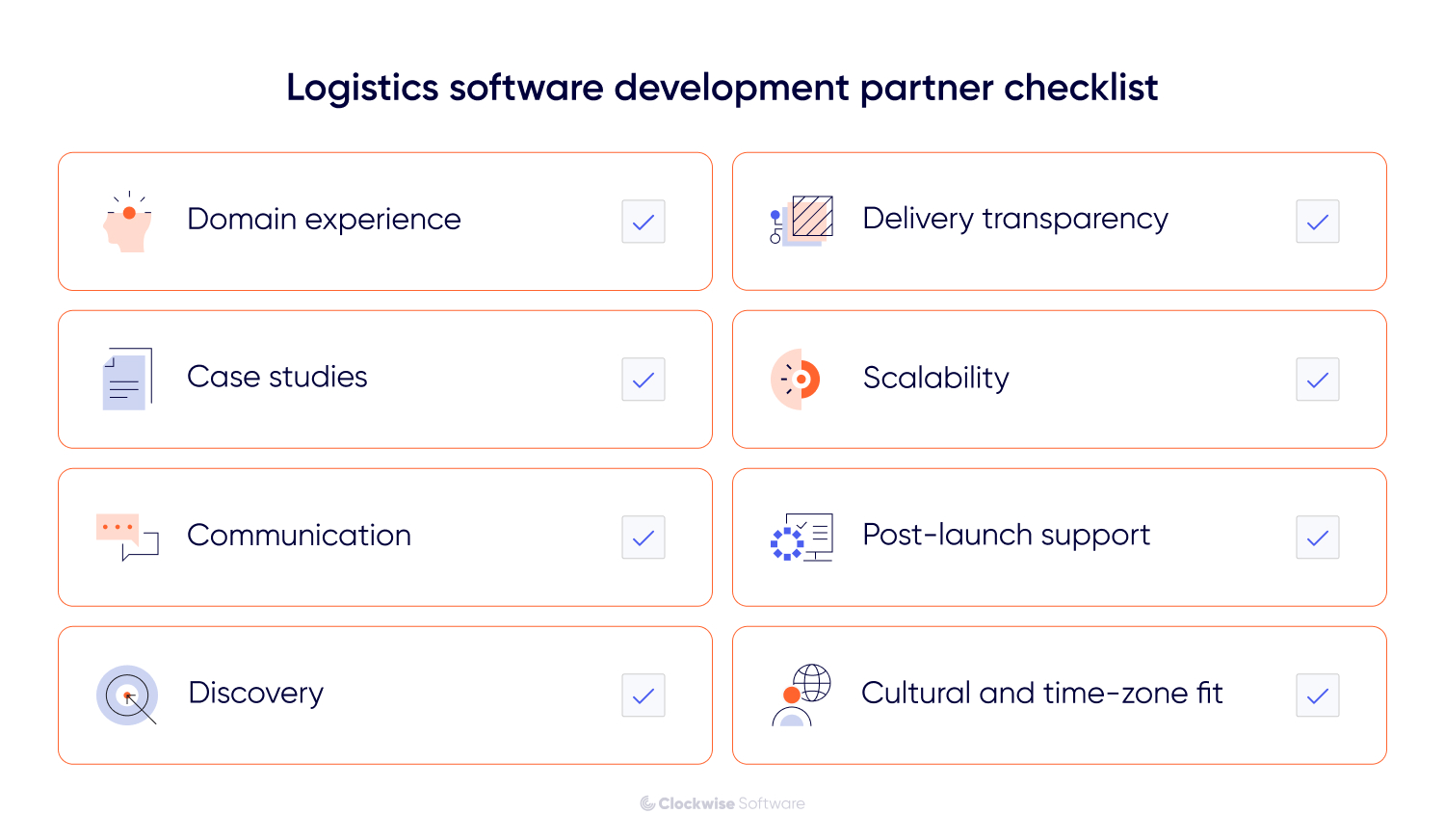
Look for digital product development teams with direct experience in transportation and logistics software development. A proven track record with systems like TMS, WMS, fleet management, or route optimization shows that logistics software development companies understand how your industry moves, its timing, data flows, and compliance demands.
How we work

Early on, we usually walk the client through two or three ways a feature could work and point out in what scenarios each option is optimal. in real operations. We’ve already seen the same routing, dispatch, and access-control decisions play out across different logistics products, so we can rule out weak options quickly. That helps us lock the logic and scope without dragging the planning stage out.
Go beyond surface-level testimonials. Ask logistics software development companies for real case studies that explain the challenge, the approach, and the outcome. In early conversations, pay attention to how clearly the team explains their thinking. Clear, confident communication early on is often a sign of healthy collaboration later.
A well-structured project discovery phase sets the tone for the entire process. It helps clarify goals, surface risks, and establish realistic budgets. As for delivery transparency, look for a logistics software development company that offers regular updates, shares demos throughout development, and keeps budget tracking visible from start to finish.
The right custom logistics software should scale with your business. Ask how the team handles architectural scalability, what support options they offer, and whether they can step in to expand the team if your needs grow. Flexible, ongoing support reduces long-term risk and cost.
Stress-free development depends on clear communication and shared expectations. When you hire dedicated developers, choose a logistics and transportation software development company whose working hours overlap with yours and whose communication style matches your team’s pace. If you're expecting frequent syncs or shared product ownership, strong alignment here is critical.
Choosing the right partner means more than finding good engineers. It’s about teaming up with people who understand your logistics challenges, can build solutions that perform under load, and maintain a clear development process with open communication throughout the project.
Behind every efficient logistics system is a team that knows how to turn complexity into control. Logistics software development companies on this list have earned their reputation by doing just that, solving real problems for real operators.
At Clockwise Software, we’ve done the same. From route optimization to real-time tracking, we’ve helped 10+ logistics teams build platforms that deliver day after day. And we’ve done it with a 99.89% acceptance rate, 94.12% client satisfaction, and delivery with less than 10% variance from the plan. If you’re ready to take the next step, we’re ready to help you make it count.