AI solutions
What we do
Services
Experts in
How we work


A SaaS development budget is more than the amount allocated to writing code. It should cover product discovery, architecture, UX/UI design, development, testing, deployment, and the work required to operate the product after launch.
Two SaaS products that appear similar can require very different investments. The difference may come from user roles, business rules, integrations, security requirements, data volume, AI functionality, or the level of uncertainty at the start. Even the same product can have a different budget depending on whether the goal is to test an idea, launch a focused MVP, replace legacy software, or prepare an existing platform for enterprise growth.
This guide is for founders, product leaders, and companies preparing to request or evaluate a SaaS development estimate. It explains how to:
The focus is budget planning rather than general pricing benchmarks. If you need current dollar ranges for discovery, MVP, market-ready, and enterprise products, review our detailed guide to SaaS development costs.
The planning principles in this guide are based on our experience across more than 200 software projects, including 25+ SaaS products. Our team at Clockwise Software has worked with products ranging from early discovery to enterprise delivery and projects with budgets above $1.5 million.
Different companies can review the same SaaS idea and return estimates that are several times apart. That does not always mean one vendor is overpriced or another is more efficient.
Often, the companies are estimating different products.
One estimate may cover a prototype with limited error handling and no production infrastructure. Another may include a secure, tested SaaS application with tenant isolation, monitoring, automated deployment, documentation, and post-launch support.
To compare SaaS development pricing, the buyer must first understand what each estimate assumes and includes.
A short product description leaves many important questions unanswered.
Consider a company requesting an estimate for “a SaaS platform that helps businesses generate reports.” That description does not explain:
One vendor may assume a standard dashboard, one data source, and basic PDF exports. Another may assume a multitenant analytics platform with configurable dashboards, granular permissions, scheduled reports, and several integrations.
Both estimates may be reasonable for the product each company imagined. Neither is reliable if the assumptions remain undocumented.
Team composition also affects the estimate. A junior-heavy team may offer a lower hourly rate but require more time and supervision. A senior team may cost more per hour but reduce architecture mistakes, rework, and delivery risk.
The proposed development standard matters as well. A production-ready SaaS product usually requires:
A quote that excludes these activities will naturally look lower. Their absence does not remove the work permanently. It often appears once development started, just quoted separately.
The initial build is only one part of a SaaS project budget.
The build cost covers the work required to create and launch the product. Depending on the scope, it may include discovery, design, architecture, engineering, QA, DevOps, and project management.
The total product cost includes the expenses required to operate and improve the SaaS after launch:
These costs behave differently. Development is usually a planned investment over a defined period. Infrastructure and third-party services become recurring expenses and may grow with users, data, transactions, or AI usage.
A realistic SaaS development budget should therefore separate at least three categories:
| Budget category | What it covers | Planning method |
| Initial product investment | Discovery, design, development, QA, and launch | Project estimate based on defined scope |
| Operating costs | Infrastructure, APIs, monitoring, support tools, and licenses | Monthly forecast based on expected usage |
| Continued product development | Maintenance, improvements, scaling, and new features | Ongoing team or quarterly roadmap budget |
Combining these categories into one number makes the plan harder to manage. Founders may believe they have funded the product, but it’s hard to estimate continued product cost when the first version of the product is not even built. It only leads to an unreliable estimate, so it's better to plan the budget for each category separately.
“Starting from” prices can help indicate the minimum engagement size. They cannot provide a dependable SaaS development estimate without a defined scope.
The lowest advertised price usually assumes:
A real product may not match those assumptions.
A more trustworthy estimate shows a range and explains what could move the project toward either end, like certain technical dependencies, known risks, or scope of work.
Estimate precision will improve as product clarity improves. At the idea stage, a broad range may be honest. After discovery, architecture planning, and backlog decomposition, the estimate should become narrower and more detailed.
At Clockwise Software, we use a work breakdown structure to divide the planned product into smaller tasks. The team prepares realistic and pessimistic estimates for each task and for the whole scope, so a client can see what budget to expect in different scenarios.
The current product stage determines what the company should fund, how accurate the estimate can be, and which deliverables matter most.
A company validating an early idea should not budget in the same way as a business scaling a platform with paying customers. The first needs evidence and scope clarity. The second may need performance work, migration, stronger security, or a larger delivery team.
So, here is a budgeting logic depending on product stages:
| Product stage | Primary budget goal | Estimate confidence | Typical timeline | Expected deliverables |
| Prototype | Test a workflow or product assumption | Low to medium | Several weeks | User flows, clickable or technical prototype, findings |
| MVP | Launch the smallest viable production product | Medium after discovery | Several months | Core workflow, essential integrations, production infrastructure |
| Version 1.0 | Deliver a product ready for paying customers | Medium to high after planning | Several months or longer | Broader functionality, refined UX, billing, analytics, support readiness |
| Existing SaaS scaling | Remove confirmed growth constraints | High for defined work, lower for legacy uncertainty | Depends on the constraint | Performance improvements, new modules, migration, stronger operations |
| Enterprise SaaS | Support complex workflows, security, and scale | Medium after technical assessment | Long-term program | Advanced permissions, compliance, high availability, enterprise integrations |
A prototype budget should be tied to a question.
The company may need to test whether users understand a workflow, whether an integration is technically feasible, or whether an AI model can produce sufficiently accurate results.
A design prototype may include user flows, wireframes, and clickable screens. A technical proof of concept may test an integration, data-processing approach, architecture decision, or AI use case.
The deliverable is evidence, not a production product. Prototype work becomes wasteful when the company treats it as cheap production development. Code built only to test feasibility may need to be replaced before launch.
An MVP budget funds the smallest production release that solves one important user problem and generates reliable market feedback.
The scope usually includes:
Budget accuracy depends heavily on discovery. If the target user, core workflow, tenant model, integrations, and acceptance criteria are defined, the team can estimate the MVP with reasonable confidence.
If these decisions remain open, the estimate needs a wider contingency range.
Version 1.0 goes beyond validating the core idea. It prepares the SaaS for repeatable acquisition, paying customers, and ongoing operation.
So, the budget is now estimated for broader functionality, refined UI/UX, more complex integrations, and scaled infrastructure.
At this stage, the company should budget for the complete customer experience, not only the main product feature. A buyer may reject an otherwise useful platform because onboarding is confusing, account management is limited, or essential administrative controls are missing.
Scaling an existing product requires a different estimation method because the team is working with a live system, existing users, and earlier technical decisions.
The budget may focus on:
Before producing an estimate, the development team should assess the current architecture, code quality, infrastructure, data model, deployment process, and known incidents.
A feature that would be straightforward in a new product may be difficult to add to a legacy system. The estimate must account for regression risk, backward compatibility, migration, and continued service for existing customers.
For this reason, estimates based only on a feature description are unreliable. A technical audit or architecture review is often needed first.
Enterprise SaaS development is usually funded as a long-term program rather than one fixed build.
The budget for such products includes:
Enterprise estimates also need to account for coordination. More stakeholders, approval processes, environments, and dependencies increase delivery overhead even when the visible feature set appears manageable.
The company should divide the roadmap into controlled releases. Each release needs a business objective, approved scope, estimate, risk assessment, and measurable outcome.
The important budgeting question here is not “How much does the complete enterprise vision cost?” A more useful question is “Which investment delivers the next operational or commercial result, and what evidence is required before funding the following stage?”
That approach gives decision-makers more control and prevents the SaaS development budget from becoming one large commitment based on assumptions that may change during delivery.
A reliable SaaS development budget is built from product decisions. Every additional workflow, user role, integration, security requirement, and scaling assumption creates design, engineering, testing, and maintenance work.
The factors below explain why SaaS development pricing differs between products that may initially appear similar.
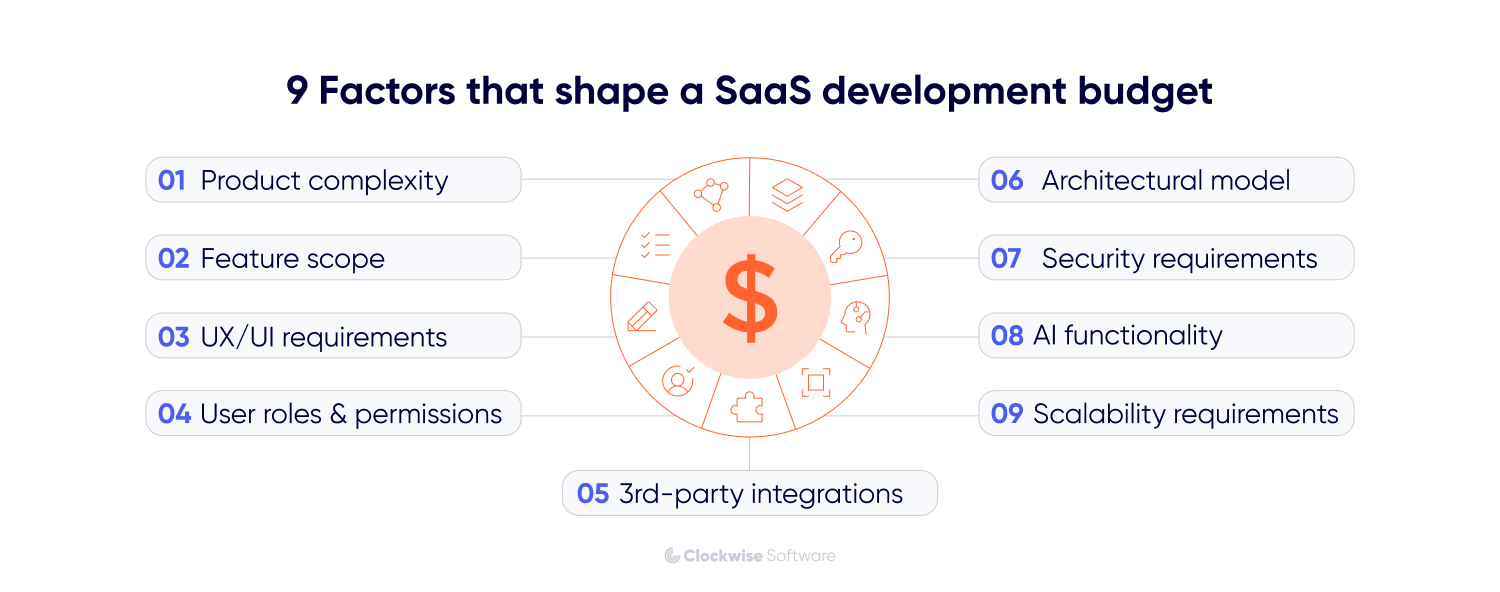
Product complexity comes from the number of rules, decisions, data relationships, and exceptions the system must manage.
A simple SaaS product may collect information, process it through one defined workflow, and show a result. A complex product may coordinate several departments, apply different rules to each customer, process large data volumes, and connect with external systems.
Complexity increases the budget because the team needs more time to clarify requirements and design, implement, and test the solution.
The investment is justified when the logic represents the product’s core value. For example, a logistics platform may need complex route-planning rules because optimization is the reason customers buy the product.
Complexity should be reduced when it comes from internal assumptions rather than validated customer needs. A founder may want to support every possible workflow before the product has users. A focused first release can instead cover the most common scenario and add exceptions after the team has real evidence.
Feature scope is usually the largest driver of the initial SaaS development cost. Every feature creates work across product analysis, design, development, testing, deployment, and documentation.
The true scope is larger than the feature name suggests. “Subscription billing” may include plans and pricing tiers, free trials, upgrades and downgrades, failed-payment recovery, taxes and several other workflows.
That’s why the budget should be based on complete workflows rather than a list of high-level feature names.
Same as with product complexity, a broader feature scope is justified when your product is replacing an established system, supporting a signed customer contract, or entering a market with clear baseline expectations. If your company is still validating the product, it’s better to simplify the scope.
UX/UI requirements affect both design and development effort.
Custom UX/UI is justified when the experience is part of the product’s competitive value. Consumer products, marketplaces, creative platforms, and workflow tools with complex daily use may benefit from deeper design investment.
A standard B2B SaaS interface can often use established components for tables, filters, navigation, forms, and settings. This reduces design time and gives users familiar interaction patterns. It’s a good option when the product’s value comes mainly from functionality and speed of validation. A component library can still produce a clear and professional interface if the user flows are well planned.
But note: reducing the design budget should not mean skipping user flows or prototypes. Correcting a confusing workflow during design costs less than rebuilding it after development.
User roles create more than separate account types. Each role may see different data, perform different actions, approve specific changes, and access different parts of the platform.
A product with an owner, administrator, manager, employee, external partner, and auditor needs a permissions model that works across every relevant feature.
Early-stage products can often begin with two or three fixed roles. Custom permission builders should wait until the team confirms that standard roles cannot support real customers.
Permissions should still be planned early. Adding a consistent authorization model later can require changes throughout the backend, frontend, database, and test suite.
Integrations connect the SaaS product with payment services, CRMs, accounting tools, analytics platforms, communication systems, identity providers, maps, AI models, or industry-specific software.
The budget depends on more than the number of integrations. It also depends on API quality, available documentation, data volume, and rate limits.
An integration is justified when it is essential to the product’s main workflow or removes a major barrier to adoption. It can be delayed when it supports only a small segment or duplicates a manual process that is acceptable during validation.
Planning integrations early improves estimated quality. A team that discovers API restrictions during development may need to redesign the workflow or architecture.
Multi-tenancy defines how customers share application resources while keeping their data and settings separated.
The main options include:
The decision affects development effort, infrastructure costs, security, customization, analytics, backup, and scaling.
A shared multi-tenant model usually improves operational efficiency but requires reliable tenant isolation throughout the system. A more isolated model, called single-tenant, may support strict enterprise or regulatory requirements but increase infrastructure and maintenance costs.
The investment in a more advanced tenant model is justified when required by data sensitivity, enterprise contracts, regional restrictions, or customer-specific performance needs.
A simpler model may be enough for an early B2B product with similar customers and standard configuration. But the team should still plan tenant identification, authorization, data access, and monitoring correctly from the start.
Changing the tenancy model after launch can affect most parts of the system. This is one architecture decision where early planning protects the future SaaS development budget.
Every production SaaS product needs secure authentication, authorization, data protection, dependency management, backups, and access control.
Additional security and compliance requirements may include:
The investment is justified when required by the product’s data, market, or customer contracts. A healthcare platform cannot treat patient data protection as a future enhancement.
Security can be simplified only by reducing exposure, not by ignoring the risk. For example, an MVP can avoid storing sensitive data or processing payments directly. It should not launch with weak tenant isolation or unrestricted production access.
AI functionality affects both development and ongoing operating costs.
The initial budget usually includes:
The recurring budget includes model inference, vector storage, data processing, monitoring, and repeated evaluation.
AI investment is justified only when the feature improves a specific decision or workflow. It may help classify data, extract information, generate drafts, identify patterns, or recommend actions. Adding a general chatbot to follow a market trend can increase cost without improving activation, retention, or revenue.
Model choice also affects SaaS development pricing. Using one large model for every task may be easy to implement but expensive to operate. Smaller models, routing rules, caching, or deterministic logic may handle part of the workflow at lower cost.
Scalability requirements define how the system should behave as users, tenants, data, and transactions increase.
The budget may grow when the product requires high availability, large data volumes, real-time processing, or heavy background jobs.
These investments are justified when growth expectations are supported by current demand, customer contracts, migration requirements, or existing usage data.
Simplify when the product is still testing demand. Building an early MVP for millions of users can consume budget without improving the validation result. So, make sure your architecture supports the next realistic stage rather than the largest imaginable future. This avoids both overengineering and an early rewrite.
Clients often see development as the main expense because code is the most visible output. But production-ready SaaS development depends on several connected disciplines.
A smaller investment in discovery, architecture design, QA, or DevOps can protect a much larger engineering budget. Removing these activities from an estimate may lower the initial quote without reducing the actual work required to launch and operate the product.
The allocation below shows the role each area plays. It is not a fixed percentage model. The balance changes according to product stage, complexity, and risk.
| Budget area | Typical budget role | Main deliverables | What increases the allocation |
| Product discovery | Smaller share with high planning value | Vision, scope, requirements, roadmap, risks, estimate | Unclear concept, several stakeholders, unvalidated workflows |
| Architecture planning | Smaller to moderate share | Architecture diagram, tenancy model, data design, security and integration plans | High load, regulated data, legacy migration, complex integrations |
| UX/UI design | Moderate share | User flows, wireframes, prototype, interface designs, design system | Custom workflows, many roles, dashboards, consumer-facing experience |
| Development | Largest share | Frontend, backend, databases, APIs, integrations, business logic | Broader scope, complex logic, more roles and integrations |
| Quality assurance | Moderate share | Test plans, functional testing, automation, performance and security checks | Complex permissions, regulated workflows, many integrations |
| DevOps | Smaller initial share plus ongoing costs | Environments, CI/CD, deployment, monitoring, backups | High availability, multiple regions, compliance, complex infrastructure |
| Project management | Moderate supporting share | Planning, reporting, risk control, scope and delivery coordination | Large teams, many stakeholders, changing requirements |
Product discovery turns a business idea into a scope the team can estimate and implement.
The work may include stakeholder sessions, market research, user interviews, workflow analysis, feature prioritization, early technical research, and risk assessment.
As deliverables, you get project requirements documentation, a prioritized backlog, a product roadmap, a risk register, and an initial estimate.
Discovery is a smaller part of the overall SaaS development budget, but it influences every later cost. Weak discovery creates uncertainty inside design, architecture, development, and testing.
Architecture planning defines how the system will support product requirements.
The team considers multitenancy, permissions, data structure, integrations, infrastructure, security, scalability, and deployment. Important decisions are documented before they become expensive to change.
As a result, you get an architecture diagram, data model, integration map, tenant model, security requirements, infrastructure plan, and technology stack decisions.
At Clockwise Software, technical planning is part of discovery work, so the project discovery budget already includes the technical planning deliverables.
UX/UI design converts requirements into complete user journeys and interface behavior.
The work includes user flows, wireframes, prototypes, visual design, responsive states, role-specific interfaces, errors, permissions, and edge cases.
A clickable prototype helps stakeholders test the workflow before development begins. This reduces the risk of paying engineers to implement an interface that users cannot understand.
Design investment depends on the product. A focused B2B tool may use standard components. A consumer platform or complex workflow product may require more research and customization.
Development usually receives the largest share of the budget because it turns the approved scope into working software. It covers work on implementing the entire frontend, backend, database, architecture, infrastructure, and integrations.
QA confirms that the product meets its requirements and works reliably across supported workflows.
QA should work alongside development. Testing everything at the end allows defects and misunderstood requirements to spread across completed functionality.
The QA allocation rises with the number of roles, integrations, platforms, and business rules. Regulated or high-risk products also require stronger evidence and documentation.
DevOps work prepares the product for repeatable deployment and reliable operation, like configuring development, staging, and production environments; building CI/CD pipelines; setting up monitoring and logging tools; and managing release procedures.
DevOps usually represents a smaller part of the initial build than development. But weak infrastructure can create significant operating costs and release risk after launch. So, it should be an integral part of your product’s budget planning.
Project management connects scope, team capacity, delivery progress, budget, decisions, and risks. For example, at Clockwise Software, our project management covers sprint planning, stakeholder communication, dependency management, scope control, and reporting.
Our project manager does not replace the client’s product owner. The client still needs someone who can set priorities and approve decisions.
Project management costs increase with team size, stakeholder count, dependencies, and changing requirements. But removing coordination from the budget usually transfers it to senior developers or the client, where it may cost more and produce less consistent results.
Some hidden SaaS costs are normal and predictable. Others appear because the product was launched without enough planning or operational preparation. Let’s look at all of them.
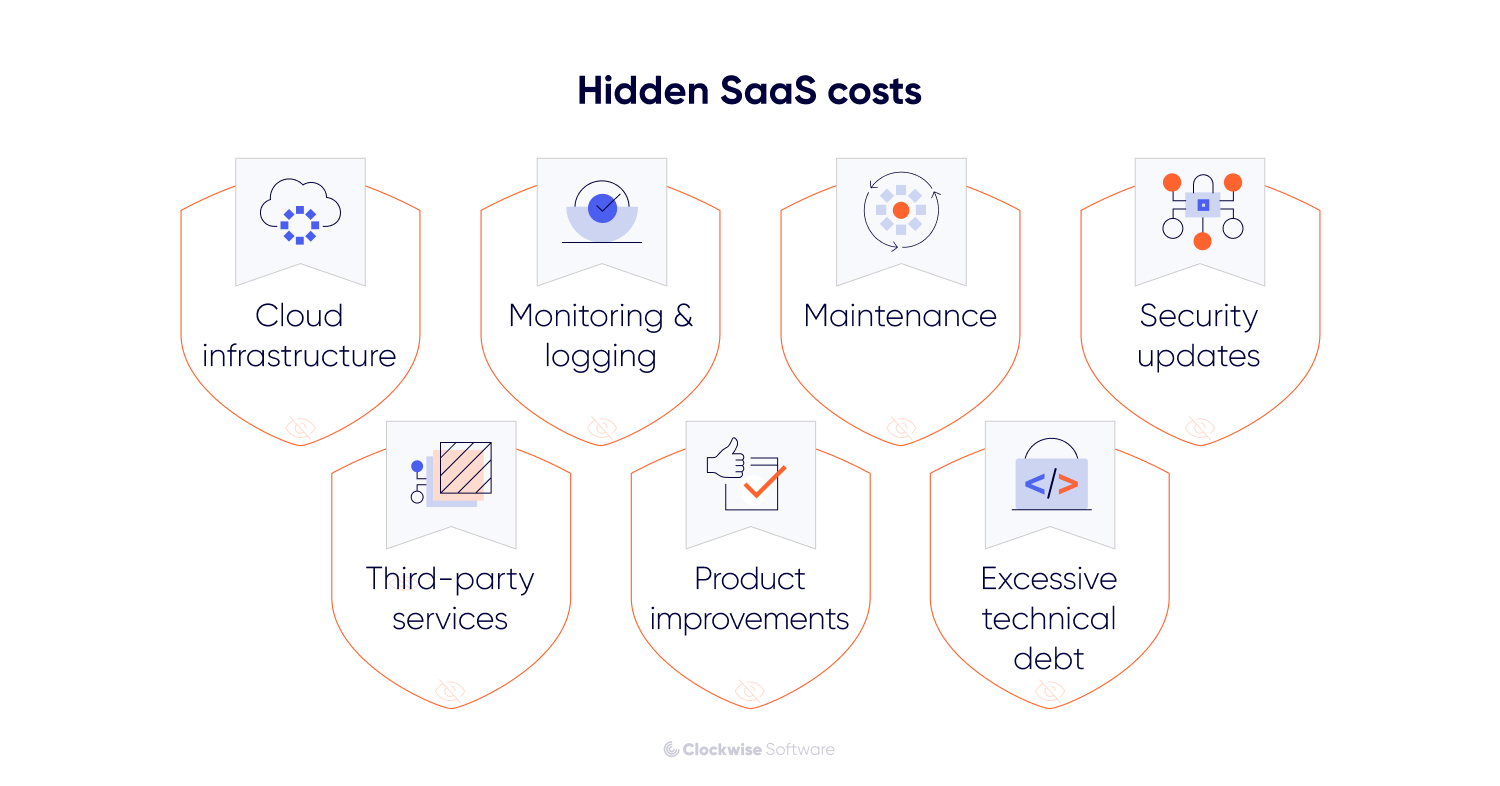
Cloud expenses include application hosting, databases, storage, data transfer, backups, content delivery, queues, search, and serverless services.
These costs usually start small and grow with usage. They are predictable when usage drivers are known and monitored. But control becomes difficult when the product has no cost attribution by tenant, workflow, or service. That’s why a team should make costs visible and know which components will require attention as demand grows.
Monitoring tools collect application errors, infrastructure metrics, traces, logs, and user-impact signals.
These services often charge based on data volume, storage period, users, or monitored resources. The cost is predictable when log levels, retention periods, and alerting requirements are defined. It becomes wasteful when the team sends high-volume, low-value data to expensive tools.
SaaS maintenance cost includes more than fixing defects. A live product usually needs:
Maintenance grows with product size and complexity. A platform with several integrations requires continued work when providers update APIs, authentication methods, or data formats.
This is a predictable expense. It should be included in the post-launch operating model rather than treated as an unexpected failure of the original build.
Security work continues after release because vulnerabilities, attack methods, dependencies, and compliance requirements change.
The budget depends on data sensitivity and market requirements. A regulated product needs a more formal security program than a low-risk internal tool.
Security becomes an avoidable emergency cost when basic controls were omitted during architecture and development. Retrofitting tenant isolation, audit logs, or access management after launch can require major changes (and costs).
Most SaaS products rely on external providers for payments, email, SMS, analytics, maps, customer support, data enrichment, or AI. These services often use consumption-based pricing. The monthly expense may grow with:
The initial development estimate should identify critical vendors and their pricing models. It should also note usage thresholds that may require a different plan or technical approach.
A low integration cost can hide a high operating cost. Vendor selection should consider both implementation effort and long-term unit economics.
A SaaS product needs continued improvement after launch. Customer feedback, analytics, sales conversations, and support data will expose new priorities.
These costs are not hidden when the company treats SaaS development as a continuous product function. The key is to connect budget to a prioritized roadmap, because funding every customer request creates scope growth without a clear product direction.
Technical debt includes shortcuts, outdated dependencies, missing tests, duplicated logic, weak documentation, and architecture that no longer fits the product.
Some debt is a deliberate trade-off. An MVP may use a simpler approach to reach the market sooner. The decision should be documented, and the team should know when it becomes a constraint.
Technical debt becomes expensive when it remains invisible. So, your development team should maintain a technical debt register and reserve regular capacity for remediation.
The safest way to reduce SaaS development costs is to remove unnecessary work.
Lowering rates, reducing testing, or skipping architecture may decrease the initial quote. It can also create defects, rework, security problems, and operating costs that exceed the original savings.
Effective cost reduction starts during product discovery. The team identifies which product assumptions need evidence, which workflows create customer value, and which technical decisions must be made before development begins.
Every untested assumption creates financial risk. The company may misunderstand the user, overestimate demand, choose the wrong workflow, or build a feature customers do not value.
The validation method should match the risk. User interviews can clarify workflows but cannot prove that an integration is technically feasible. A technical prototype can test an API but cannot confirm that customers will pay for the product.
During SaaS discovery, each major assumption should have an evidence level. Confirmed requirements can move into planning. Uncertain assumptions should receive a validation activity. Low-priority assumptions can wait.
This prevents the team from funding a complete solution before it knows whether the underlying problem, workflow, or technology is viable.
A focused MVP reduces the initial investment and shortens the path to real user feedback. But reducing scope does not mean producing an incomplete or unreliable product. Features should be prioritized according to the assumption they help test and the customer value they create.
For each proposed function, ask:
A feature may be useful without belonging in the first release. Deferring it keeps the budget available until the market provides stronger evidence.
Overengineering occurs when the team builds for complexity or scale the product does not currently need.
Microservices architecture for a small initial product, infrastructure designed for millions of users, advanced automation before the manual process is validated — those all are examples of overengineering. These choices increase development, testing, infrastructure, monitoring, and maintenance costs.
The opposite approach is also risky. Building only for the first demo may force an early rewrite when real customers arrive.
The team should design for the next realistic stage. Architecture should support the expected MVP and leave clear extension points for likely growth. It does not need to solve every possible future requirement.
A modular monolith, for example, may provide enough separation for an early product without the operational cost of microservices. The decision should follow product needs, team capacity, and growth evidence.
Not every part of a SaaS product creates competitive value. Authentication, billing, notifications, file storage, analytics, and standard interface elements can often use established services or components.
Custom development remains appropriate when the function defines the product, creates a competitive advantage, or requires behavior that standard tools cannot support.
The team should evaluate total cost rather than implementation speed alone. A managed service may reduce initial development but create recurring fees or vendor dependency. An open-source component may be free to license but expensive to maintain.
Integrations often create estimated variance because their complexity is discovered after development starts.
Before including an integration in the budget, the team should confirm:
If the API is unavailable or incomplete, the product may need a different workflow. Discovering this during architecture planning costs less than redesigning completed functionality.
The MVP should include only integrations required for the core value. Lower-priority integrations can follow customer demand.
In some cases, a temporary CSV import, controlled manual process, or middleware service can validate the workflow before the team funds a complete integration.
The delivery model affects more than the hourly rate. It changes hiring time, management overhead, technical ownership, delivery risk, and the company’s ability to scale the team.
The right option depends on the product stage, internal expertise, roadmap stability, and level of control the company needs.
| Model | Cost structure | Speed to start | Main risks | Scalability | Best fit |
| Freelancers | Hourly or task-based | Fast for individual roles | Coordination gaps, availability, weak ownership | Limited for full products | Defined tasks and specialist support |
| In-house team | Fixed salaries and operating costs | Slow | Hiring delays, fixed capacity, skill gaps | Strong after the team is established | Validated long-term products |
| SaaS development company | Project, sprint, or team-based | Days to weeks | Vendor dependency, partner selection | High | MVPs, new products, major modules |
| Hybrid model | Internal fixed cost plus external capacity | Moderate | Coordination and ownership gaps | High | Scaling products with an internal core |
Freelancers can be effective for isolated tasks with clear boundaries. A company may hire a designer for a prototype, a DevOps specialist for infrastructure review, or a developer for a defined integration.
This model offers flexibility and may reduce the cost of individual tasks. It becomes harder to manage when several freelancers must deliver one connected product.
A SaaS platform needs coordinated decisions across product analysis, architecture, frontend, backend, QA, security, and infrastructure. If every specialist works independently, the client becomes responsible for:
Freelancers are best suited to companies with strong internal technical management. They are less suitable when the client needs a complete accountable product team.
An in-house team provides direct control, long-term product knowledge, and close alignment with the company.
It can be the right model when:
The full cost includes salaries, benefits, recruiting, onboarding, equipment, management, retention, and periods when specialist capacity is underused.
Building the complete team can also take months. One developer does not provide the full set of skills needed for a production SaaS product. The company may need product management, architecture, UX/UI, frontend, backend, QA, DevOps, and security expertise.
An internal team becomes more economical when the product needs continuous development and the company can maintain the required skill coverage.
A SaaS development company provides a coordinated team and an established delivery process. The partner can support discovery, architecture, design, development, testing, launch, and continued growth.
This model can reduce the time required to assemble the team. It also gives the client access to specialists who may only be needed during certain phases.
For example, a solution architect may lead early technical planning. A DevOps engineer may configure environments and delivery pipelines. QA capacity may increase before release. The client does not need to hire every role permanently.
The model works well for:
The lowest agency quote is not always the least expensive option. A reliable partner should show how the scope was estimated, which roles are included, how risks are managed, and what the client will receive.
At Clockwise Software, we combine product discovery, architecture, delivery, QA, and DevOps within one process. The same team that defines your requirements and reviews the architecture also estimates, develops, and tests the product, so the knowledge gathered in discovery carries straight into delivery. Estimates stay accurate because the people who made them are accountable for meeting them.
A hybrid model combines an internal core team with external specialists or a dedicated delivery team.
The internal team may own product strategy, architecture, or the core platform. The external team may deliver new modules, increase release capacity, support modernization, or provide missing expertise.
This model works well when the company wants to preserve internal ownership but cannot hire fast enough to meet its roadmap.
Responsibilities must be explicit. Both teams should know:
Without this clarity, the hybrid model can create duplicate work and slow decision-making. With clear ownership, it provides strong control and flexible capacity.
A development company can produce a more useful estimate when it receives clear business and product context.
You do not need a complete technical specification before the first conversation. You should be able to explain what the product must achieve, who will use it, and which requirements are already known.
Use the checklist below to prepare for discussions with a SaaS development company.
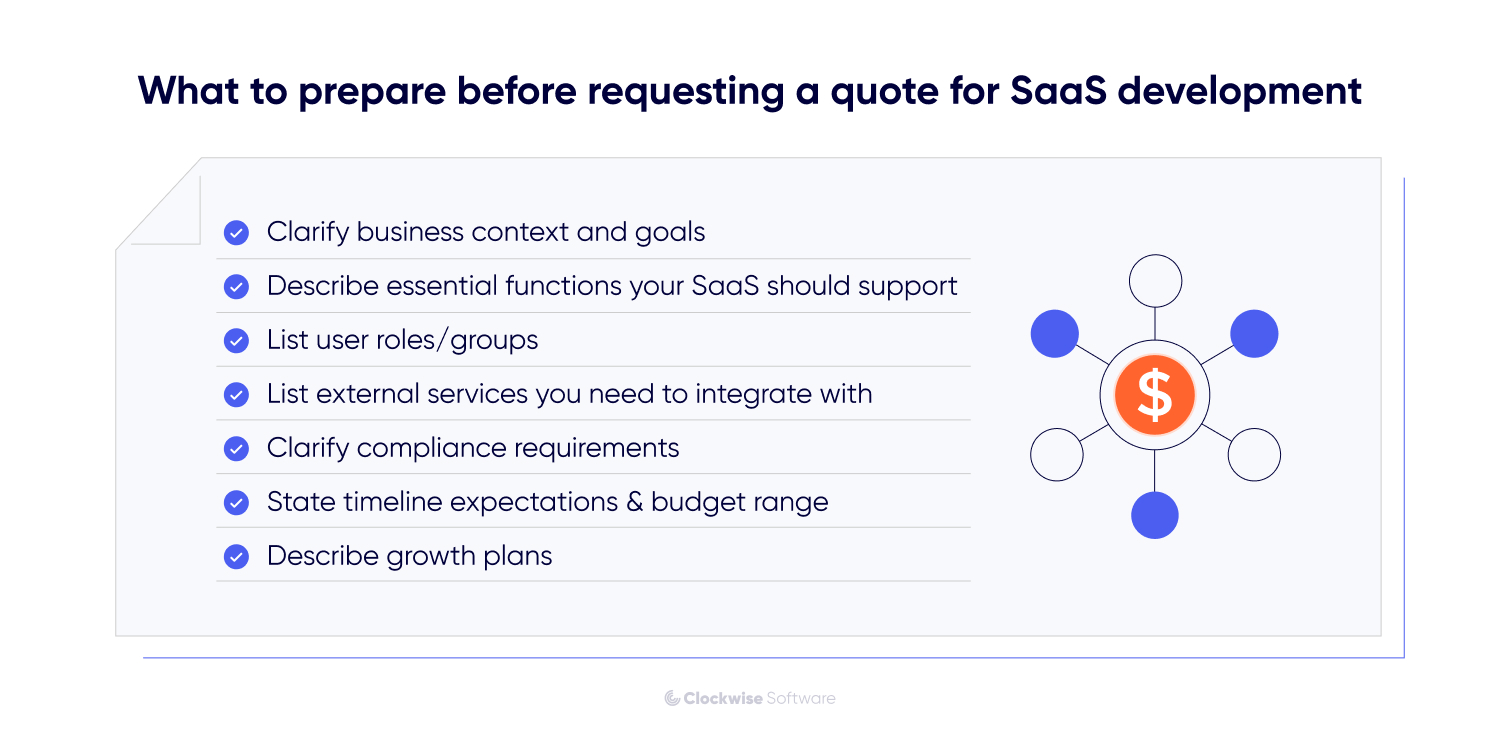
Define the result the company expects from the product.
What business problem should SaaS solve? Is it a new revenue stream, an internal platform, or a legacy replacement? How will success be measured? Which budget range is available?
Answers to these questions helps the vendor recommend an appropriate scope rather than estimate every possible feature.
Describe the primary user journey from beginning to end, mentioning essential functions for the first release, important data flows, and manual processes that the product will replace.
Separate requirements into essential, important, and later. This makes the estimate easier to adjust without rebuilding it from the beginning.
List the people and organizations that will interact with the product. If you want to give as much clarity as possible from the beginning, you can also outline for each role information they can access, actions they can perform, and needed administrative controls,
Or, you can clarify it during discovery calls, when discussing the project with a business analyst — they will help to define and structure requirements for each user role.
List all external services and classify them by priority. Mention the purpose of each integration and any specifics if they’re known, like expected usage.
If API documentation or access is unavailable, the estimate will identify the integration as a risk or discovery task.
Explain which data the product will process and where it will operate.
Start with the data types. Personal data, health information, financial records, payment data, and children's data each come with their own protection requirements. Location matters too, since some regions require data to be stored and processed within their borders. Then list the regulations and standards that apply to your product.
Compliance affects architecture, infrastructure, development, testing, documentation, and operating procedures. It should not appear for the first time before launch.
State the desired launch date and explain why it matters.
The vendor needs to know:
A shorter timeline may require a smaller scope, a larger team, or more delivery risk. The estimate should make that trade-off visible.
Describe the next realistic product stage. Expected initial users and customers, expected growth over the next 12–24 months, typical data volume, planned regions — they all matter.
The product does not need to be fully engineered for every future scenario. But the development team should avoid decisions that block credible growth.
Our estimation process draws on 200+ delivered software projects, including 25+ SaaS products. We've estimated everything from discovery phases and focused MVPs to market-ready platforms, legacy modernization, and enterprise systems with budgets above $1.5 million.
The goal is a budget you can plan around and track throughout delivery. Here's how we get there.
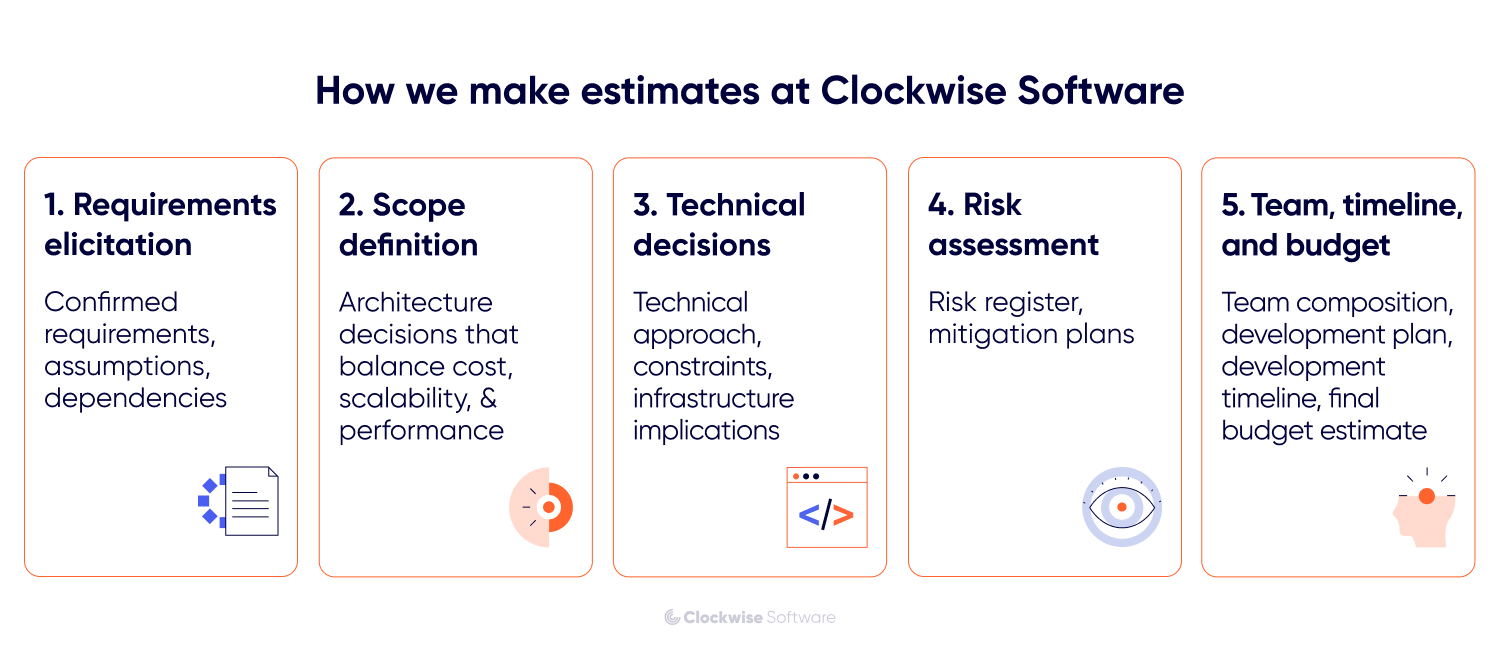
Estimation starts with defining project requirements. Business analysts and technical specialists work with client stakeholders to understand the product goal, target users, core workflows, constraints, and any evidence the client already has, such as customer feedback or usage data. We also research users and the market, and analyze the workflows the product needs to support.
From there, we prioritize features, research the integrations the product depends on, and start early UX work. Throughout this work, the team separates confirmed requirements from assumptions.
The approved product concept is converted into a structured scope.
We use a work breakdown structure to divide large features into smaller, estimable tasks. A general requirement such as “subscription management” becomes a set of specific workflows covering plans, trials, payments, upgrades, failed transactions, invoices, and cancellation.
Each task receives a realistic and pessimistic estimate. The realistic figure reflects expected delivery under normal conditions. The pessimistic figure accounts for known uncertainty and tasks that may require more effort.
This range is more useful than one optimistic number. It shows where the SaaS development budget is stable and where additional discovery may be needed.
Technical decisions affect both the initial development effort and the long-term cost of running the product.
That's why our technical team defines technical requirements as part of the estimate. We look at how the product should handle data, external integrations, expected load, and availability requirements. We also consider what comes next, such as data migration needs and the growth the product has to support over the next few years.
The review helps to define architecture and tech stack that fit the product's current stage. It also flags decisions that could become expensive constraints as the product grows.
For an existing product, our team first reviews the codebase, infrastructure, database, deployment process, and technical debt. That review gives the estimate a reliable baseline, since the condition of the current system often shapes how much the next stage of work will cost.
Every estimate includes assumptions and risks. We always record risks related to scope, integrations, architecture, security, data migration, third-party vendors, performance, and client dependencies.
For each risk we assess probability and potential impact, and align on a mitigation plan, responsible person, and review points. Some risks can be resolved before development through technical research or a proof of concept. Others remain active and require contingency in the plan.
The team is selected according to the work, not a standard template.
A SaaS project usually involves:
Not every role needs to be full-time throughout the project. Architecture and design may require more involvement early. QA responsibilities may increase as the product approaches release.
The timeline accounts for task dependencies, available capacity, reviews, client approvals, integrations, and testing. Adding developers does not always shorten delivery because some work must happen in sequence.
The final SaaS development estimate shows:
Estimation does not end when the contract is approved. We track Cost Performance Index and Schedule Performance Index during delivery to make sure everything goes according to the plan. CPI shows whether completed work aligns with the approved budget. SPI shows whether delivery aligns with the schedule.
These indicators are reviewed with scope changes, dependencies, and actual project conditions. Regular monitoring helps identify variance while our team still has practical options to correct it.
This workflow has helped us maintain cost and schedule variance within 10% across our projects.
A SaaS development budget usually exceeds its plan because teams delay important decisions, treat assumptions as facts, or let changes enter development without financial control.
The following mistakes appear repeatedly across SaaS projects.
Skipping discovery does not remove planning work. It moves product and architecture decisions into development, where changes cost more.
Without discovery, the team may estimate an undefined scope, overlook technical constraints, or build workflows that users do not need.
A focused discovery phase should clarify the product goal, MVP scope, integrations, architecture, risks, and estimate assumptions. It may represent a smaller part of the budget, but it protects the larger development investment.
An integration is not only a connection to an API. It may require authentication, data mapping, synchronization, error handling, retries, webhooks, logging, and recovery from partial failures.
Documentation may be incomplete. Access may require approval. The vendor may impose rate limits or provide a limited sandbox. That’s why you should review critical integrations before finalizing the estimate. If access is unavailable, the estimate should identify the integration as a risk rather than assume ideal conditions.
A lower quote may exclude discovery, architecture, QA, DevOps, documentation, or post-launch preparation. It may also rely on a smaller or less experienced team.
When comparing estimates, review:
The lowest initial quote can become the most expensive option if the product requires rework or cannot support real customers.
A useful estimate should be transparent enough to explain why it differs from other proposals.
New ideas are normal during SaaS development. Adding them to active work without evaluating their impact is not. A change request does not need to be bureaucratic. It needs to make the trade-off visible. A controlled backlog allows the product to evolve without hiding budget growth inside ordinary development.
A useful SaaS development budget should tell you what you are funding, what results to expect, and where the main risks remain.
At Clockwise Software, we help companies move from an early product concept to a defined scope, reviewed architecture, delivery plan, and transparent estimate. Our team has worked on 25+ SaaS products and manages the complete process from discovery through launch and post-release growth.
If you need a realistic plan for an MVP, a new SaaS platform, or the next stage of an existing product, we can assess the current scope and show which decisions should be made before development begins.