AI solutions
What we do
Services
Experts in
How we work


If your app depends on knowing the location of people, vehicles, or assets, you need a team that has shipped that kind of functionality before. And this article is going to help you find the team.
We prepared a list that covers 10 development companies for teams in the US, UK, and Europe that need to build location features like live tracking, geofencing, route planning, or proximity alerts. Each vendor here has delivered apps where location is the core feature, so you can start the conversation with a team that already knows this work.
For each company, you'll find the location projects it has shipped, its Clutch rating, its rates, and the type of product it fits best. Disclosure: Our company, Clockwise Software, is on this list. We evaluated ourselves by the same criteria as every other vendor here.
The best location-based app development companies are Intellectsoft, Clockwise Software, ScienceSoft, Zco Corporation, TechAhead, Fueled, ArcTouch, Simform, Hyperlocal Cloud, and Vincit. The right pick depends on what your app tracks and who uses it:
Every company on this list met 4 criteria:
Here are all 10 companies compared side by side on Clutch rating, price, and their location.
| Company | HQ | Clutch rating | Hourly rate | Min. project | Best for |
| Intellectsoft | Miami, FL, US | 4.9 | $50–99 | $50,000+ | Enterprise location systems |
| Clockwise Software | Edinburgh, UK | 4.9 | $50-99 | $50,000+ | Logistics and B2B tracking platforms |
| ScienceSoft | McKinney, TX, US | 4.8 | $50–99 | $5,000+ | Enterprise location systems |
| Simform | Orlando, FL, US | 4.8 | $25–49 | $25,000+ | Logistics and B2C tracking platforms |
| Fueled | New York, NY, US | 4.9 | $150–199 | $75,000+ | Consumer apps for large audiences |
| ArcTouch | San Francisco, CA, US | 4.9 | $100–149 | $100,000+ | Consumer apps for large audiences |
| Vincit | Irvine, CA, US | 4.8 | $150–199 | $50,000+ | GPS trackers and connected hardware |
| Zco Corporation | Nashua, NH, US | 4.8 | $25–49 | $10,000+ | GPS trackers and connected hardware |
| Hyperlocal Cloud | New York, NY, US | N/A | <$25 | $1,000+ | On-demand delivery and ride-hailing |
| TechAhead | Agoura Hills, CA, US | 4.9 | $25–49 | $25,000+ | Consumer apps and B2C tracking apps |
HQ: Miami, Florida, US
Founded: 2007
Team: 50–249
Clutch: 4.9
Rate: $50–99/hr
Min. project: $50,000+
Intellectsoft is a digital transformation and engineering company with offices in Miami, London, and Oslo. Its client list includes Ernst & Young, Harley-Davidson, Eurostar and Ford, and most of its Clutch reviews come from projects in the $200,000–999,999 range.
Location-based projects: Intellectsoft delivered two location-based social apps: Dropix, a photo and video app that went live globally, and Buddy, an HD video app built around finding friends nearby. It also developed a hospital asset tracking solution for an identification solutions provider and worked with a San Francisco geolocation platform on its infrastructure.
Best for: Companies in the US and Europe that need location features inside a consumer social product or asset tracking in an enterprise environment.
HQ: Edinburgh, UK
Founded: 2014
Team: 50–249
Clutch: 4.9
Rate: $50–99/hr
Min. project: $50,000+
We're a custom software development company with engineers, designers, and business analysts in the EU and Ukraine, and 200+ delivered products behind us. We've shipped 11+ geolocation apps, and Clutch named us a Top IT Services Company for GPS Navigation and GIS in 2025 & 2026.
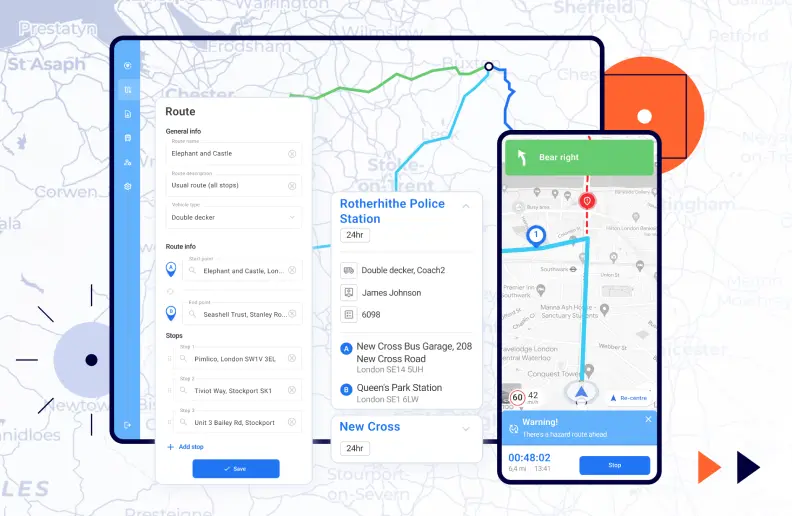
Location-based projects: For Foresolutions, a UK technology company, we developed a route planning solution for public transport in London: a driver app with turn-by-turn navigation and hazard alerts, and a web platform for live vehicle tracking and route editing on a map. Routes are calculated with Azure Maps and filtered by vehicle type and size, so a double-decker bus driver gets a route that avoids low bridges.
Best for: Logistics, fleet, and B2B companies in the US, UK, and Europe that need a tracking or dispatch platform delivered on a predictable budget.
HQ: McKinney, Texas, US
Founded: 1989
Team: 250–999
Clutch: 4.8
Rate: $50–99/hr
Min. project: $5,000+
ScienceSoft is an IT consulting and software development company with more than 35 years of delivery history and a dedicated fleet management practice. It holds ISO 9001 and ISO 27001 certifications and works with enterprises in logistics, healthcare, finance and retail.
Location-based projects: For a transportation and logistics client, ScienceSoft developed an Azure-based mobile app for real-time fleet tracking that collects raw GPS data from vehicles and automatically turns it into optimized commercial routes. The app sends business data to the client's ERP system in real time. Its portfolio also includes an AWS-based IoT system for automated fleet management.
Best for: Enterprises that need location tracking connected to their ERP and other business systems, delivered under formal security and quality processes.
HQ: Orlando, Florida, US
Founded: 2010
Team: 1,000–9,999
Clutch: 4.8
Rate: $25–49/hr
Min. project: $25,000+
Simform is a digital engineering company focused on product engineering, cloud and data services, with most of its delivery team based in Ahmedabad, India. Its Clutch reviews cover 16 industries, including logistics and supply chain, where clients highlight its cloud and backend work.
Location-based projects: According to a verified Clutch review, Simform developed a customer-facing mobile app for vehicle tracking, turned the product discovery results into a complete backend, and iterated on the UI/UX and features together with the client.
Best for: Companies that need a large engineering team at mid-range rates for a tracking product with heavy cloud and backend work.
HQ: New York, NY, US
Founded: 2007
Team: 250–999
Clutch: 4.9
Rate: $150–199/hr
Min. project: $75,000+
Fueled is a digital product agency with offices in New York and London that designs and develops apps for consumer brands. Its clients include Warby Parker, The New York Times, Google, Mayo Clinic, and MGM Resorts.
Location-based projects: Fueled developed the Ikon Pass app, which skiers use across 43 mountains with dozens of different owners and backend systems. The app combines lift tickets, on-mountain dining, and personal stats with social features, and Fueled limited location sharing between friends to on-mountain use only, which made users far more willing to turn it on.
Best for: Consumer brands that need a polished, high-traffic app with location features and have the budget for premium US rates.
HQ: San Francisco, California, US
Founded: 2009
Team: 250–999
Clutch: 4.9
Rate: $100–149/hr
Min. project: $100,000+
ArcTouch is a mobile app design and development studio that works with Fortune 500 companies and startups. Its clients include 3M, Audi, Honeywell, Salesforce, McCormick, and Lucid Motors, and its most common Clutch project size is $50,000–199,999.
Location-based projects: A geo-based social media platform hired ArcTouch to take over development of its iOS and Android apps, according to a verified Clutch review. In the review, the client reports that the feature ArcTouch delivered was well received by users and attracted media attention. ArcTouch's client list also includes Tile, the Bluetooth item-tracking company.
Best for: Companies with a live location app that need a team to take over, modernize, and grow it.
HQ: Irvine, CA
Founded: 2007
Team: 250 - 999
Clutch: 4.8
Rate: $150–199/hr
Min. project: $50,000+
Vincit is a Finnish software development and design company with a separate US business in California. It creates digital services from idea to market for clients such as Logitech, Yamaha Watercraft and Urban Armor Gear.
Location-based projects: Vincit developed the core of Yepzon's business: the mobile app and the server behind its GPS trackers. Yepzon builds consumer location services, and its tracker ranked among the top 3 best-selling GPS trackers on Amazon.
Best for: Hardware companies in Europe and the US that need the mobile app and backend for a GPS tracker or another connected device.
HQ: Nashua, New Hampshire, US
Founded: 1989
Team: 250–999
Clutch: 4.8
Rate: $25–49/hr
Min. project: $10,000+
Zco Corporation is one of the longest-running app development companies in the US, delivering mobile apps, enterprise software, games, and AR/VR products since 1989. Its clients include the BBC, Microsoft, Verizon, Liberty Mutual and Dartmouth College.
Location-based projects: Zco keeps a dedicated GPS section in its portfolio. One of its case studies covers In Range Contacts, a location-based networking app that connects people nearby. Zco also develops apps that integrate directly with clients' proprietary hardware.
Best for: US companies that want an established onshore partner for a location app paired with GPS devices or custom hardware.
HQ: New York, NY, US
Founded: 2020
Team: 50–249
Clutch: N/A
Rate: <$25/hr
Min. project: $1,000+
Hyperlocal Cloud is an on-demand app development company focused on products for local markets, from grocery delivery to community ride services. Its offer is built around fast launches, with custom and white-label options for each product type.
Location-based projects: Location is at the center of Hyperlocal Cloud's work. For a California delivery startup, the team rebuilt a legacy on-demand delivery app for iOS, Android, and the web and expanded it into a multi-merchant local marketplace. It upgraded GPS tracking, improved route finding for drivers, and added AI-driven dispatch that assigns each order to the nearest available driver.
Best for: Startups that want to launch an on-demand delivery or ride-hailing app quickly and on a lean budget.
HQ: Agoura Hills, California, US
Founded: 2009
Team: 50–249
Clutch: 4.9
Rate: $25–49/hr
Min. project: $25,000+
TechAhead is a mobile and web app development company with its US headquarters in California and a delivery team in India. It works with startups and enterprises on iOS, Android, and cross-platform apps, with growing work in AI and cloud.
Location-based projects: For Boxlty, a real estate discovery platform in Pennsylvania, TechAhead developed an IoT and mobile solution for property visits: Bluetooth smart locks that owners can operate remotely, real-time visitor verification, and a redesigned app with live visitor tracking.
Best for: Startups launching consumer apps with tracking features that want offshore rates with a US point of contact.
Most mobile development teams can add a map and a few pins to an app. Things change when location becomes the core of your product: couriers, drivers, or field teams rely on it all day, and the business runs on the data it produces. At that point, the team's past experience with location-based apps affects the success of your product, along with the development estimate, the timeline, and the monthly maintenance bill. A company with location-based apps in its portfolio gets from idea to working functionality faster and spends your budget more efficiently.
Here's what that experience looks like in practice.
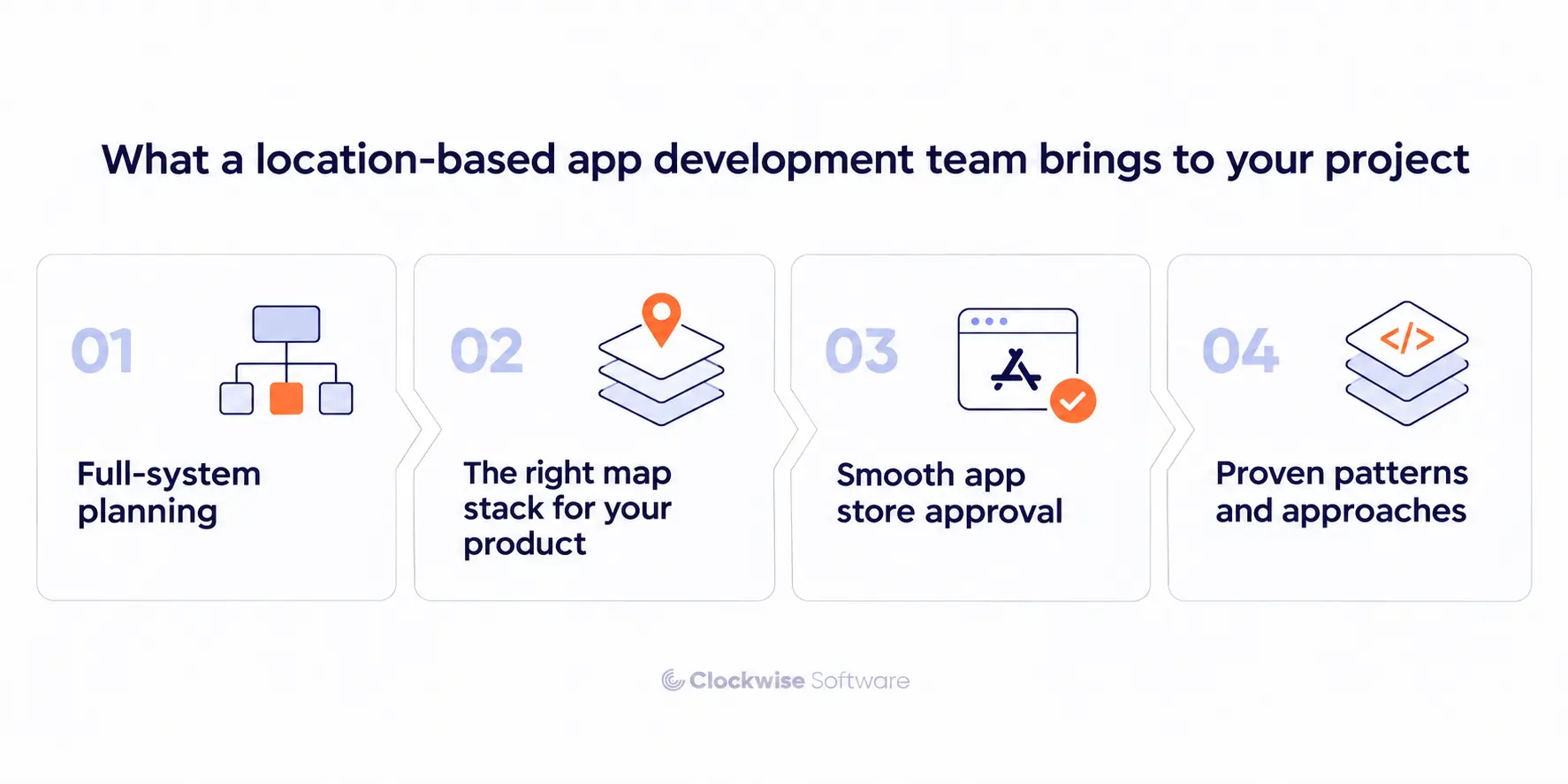
A location-aware feature typically spans four parts: the mobile app, the backend that stores and processes location data, the map provider, and a web dashboard for dispatchers or admins. A team with little experience in location-based functionality can overlook tasks in some of these parts, and the gaps tend to surface mid-project, adding time and budget. Teams that have shipped such apps account for these decisions from the first call, so you get a realistic estimate from the start and functionality that works as planned in the first release.
Google Maps Platform, Azure Maps, Mapbox, HERE, and other mapping services differ in coverage, features and pricing. A team that has shipped products on several of them can match the provider to your goals, app type, existing business tools, and expected usage.
A company already running on Microsoft Azure, for example, can connect Azure Maps to its current setup with little extra work, and a logistics product with heavy routing needs may get more value from HERE's routing services. Plus, a specialist can give you a realistic estimate of the monthly map API bill early in the project, letting you plan these expenses from the start.
Apple and Google review location access closely, especially when an app tracks users in the background. Google Play, for instance, asks for a declaration form, a video of the feature, and a clear in-app explanation before it approves background location (Google Play policy). Specialists know these requirements and design the permission flow around them, so the app passes store review on schedule and users see a clear reason to allow location access.
A team that has implemented location-based functionality before (live tracking, geofencing, route optimization, arrival time estimates, location history, etc.) brings proven approaches and often ready components it can adapt to your product. That shortens development and lowers the chance of problems surfacing late in the project, when fixes cost the most.
Based on platforms we’ve delivered in the last 3 years, a location-based app costs from $50,000 for a focused MVP to $250,000 and more for a full tracking and dispatch platform. Map provider fees add on as a monthly operating cost that grows with usage, so it pays to plan for both numbers from the start.
| App type | Functionality example | Development cost | Timeline |
| MVP with basic location-based features | One user role; map with the user's location, nearby search, place markers or check-ins; admin panel to manage locations | $50,000–100,000 | 3–5 months |
| Full-featured app | Two or more user roles (for example, customer and courier); live tracking, geofencing, arrival time estimates, status notifications; web dashboard for dispatchers | $100,000–250,000 | 5–9 months |
| Complex location-based app | Everything above, plus multi-stop route optimization, GPS hardware or IoT tracker data, analytics on location history, ERP or TMS integrations | $250,000+ | 9+ months |
The cost depends on multiple factors: vendor’s hourly rate, number of user roles, app type (cross-platform or native), how close to real time the location updates need to be, whether the product calculates or optimizes routes, and number of integrations.
Vendors can provide a more precise estimate after getting more details on your project and the goal for the first release.
Map providers bill per request or per active user, so this line in the budget depends on how the app is used. For example, since March 2025, Google Maps Platform gives each API its own monthly free allowance in place of the old $200 monthly credit. Displaying a map in a native mobile app through the Maps SDK costs nothing, while the services around it are billed per request: route calculation is free for the first 10,000 requests a month, then costs $5 per 1,000 requests and $4 per 1,000 above 100,000 (check Google Maps Platform pricing for more detailed info). Mapbox bills mobile maps by monthly active users, with the first 25,000 free, and includes 100,000 free Directions requests a month, then $2 per 1,000.
Let’s look at a more precise example. Here's what that means for a delivery business with 500 drivers, each requesting 40 routes per working day over 22 days: 440,000 route requests a month. On Google's Routes API, that comes to about $1,810 a month. The same workload on Mapbox Directions comes to about $680 a month, and the driver map stays within Mapbox's free user allowance.
This is why we estimate map provider costs during discovery and design the app to cache results and group requests. The right provider choice and a few architecture decisions can cut this bill by half or more for the life of the product.
A 30-minute call with each shortlisted vendor tells you more than any rating. Alongside the usual questions about process, communication, team and contract terms, which help you judge whether the partnership feels reliable and comfortable, these six questions show whether a team has shipped location products and how it would approach yours.
| Question to ask | What a strong answer includes |
| Which location-based apps have you shipped, and can we see them live? | Named apps in the App Store or Google Play, or demo access, plus clarity on what the team was responsible for in each |
| Which map provider would you recommend for our product, and why? | A recommendation tied to your markets, app type, requirements, and expected usage, with an estimate of the monthly map bill |
| How will you handle background location and app store review? | A plan for permission requests, in-app explanations and the review requirements of both stores |
| How do you test location features before release? | Simulated routes plus testing on real devices outdoors, with checks for battery use and accuracy |
| What happens when a user loses connection? | Location data stored on the device and synced in the right order once the connection returns |
| How will the system handle growth from 100 to 10,000 active users? | Specific architecture choices for real-time data and a clear view of how hosting and map costs scale |
Some answers suggest a team will learn location development on your budget:
The right location-based app development company depends on what your product needs to do with location. Store locators and city guides need a team that ships polished consumer apps. Delivery and field service products need hands-on experience with real-time tracking. Fleet and logistics platforms need a partner that has worked with route optimization, tracker hardware, and enterprise integrations. In every case, look for named location projects, ask how the team would choose your map provider, and plan map fees into your budget from day one.
Use this list as a starting point for your shortlist.
Ratings, review counts, rates, and team sizes reflect what we recorded when assembling this list. Vendors grow, change pricing, and collect new reviews, so check each company's current Clutch profile before your first call.