AI solutions
What we do
Services
Experts in
How we work


If you've ever thought about adding AI to your martech stack, you've probably realized pretty quickly that the decision goes way beyond choosing the right model. Data availability and how ready that data is for AI processing matters just as much. So does having a clear use case, solid identity resolution, and a plan for wiring outputs back into the tools your team already uses. A lot of moving pieces need to line up before AI starts delivering real value. As a team that provides martech development services and has shipped 10+ martech platforms since 2014, we've seen these patterns repeat across every engagement.
When the founder of Releasd, a PR reporting product, asked us to add AI without breaking their platform, we started with exactly that approach. We scoped a proof of concept first: a dual-model LLM architecture with GPT-4 and Gemini working together inside their reporting workflow to analyze media coverage at scale. The PoC shipped in one month, which gave us enough signal to validate the concept and spot the gaps early. It opened a $11.6B market and increased profitability by 10%, with major global brands lining up to adopt it.
That's what a structured approach to martech AI actually looks like: start with the data layer and a clear use case, build a PoC to test fast, then scale what works. Built on a customer data platform, real-time data pipelines, and predictive analytics that reach revenue. In this article, we share where it pays off, where it stalls, and how to implement it.
AI improves the parts of a martech stack that were always weakest: segments that go stale fast, content priced in human hours, customer journeys that branch on a few fixed rules, and dashboards that report the past without pointing to a next move.
Here's what changes, function by function.
Without AI, segmentation is a snapshot. Someone writes rules ("enterprise accounts in EMEA who opened two emails"), exports a list, loads it into the campaign tool, and the segment starts decaying immediately. You learn who matched a filter last Tuesday. Who's about to convert or cancel stays invisible.
With AI, the segment becomes a prediction. Propensity modeling scores each contact on likelihood to buy; churn prediction flags accounts that are pulling away before they cancel; and lookalike modeling finds new prospects who resemble your best customers rather than your loudest ones. Predictive lead scoring then ranks the pipeline so sales work the accounts most likely to close. Few teams do this yet: a Forrester study found only 14% of marketers use AI for marketing segmentation, even though it's one of the higher-impact uses, so the capability is sitting available while adoption stays the real constraint.
Before, content moved at the speed of human hours. One landing page, 5 ad variants, a nurture sequence, each one a ticket waiting in someone's queue. More volume meant more headcount.
With generative AI, the cost curve changes. LLMs draft copy variants; a recommendation engine decides which creative each segment sees; and image or video models produce assets that used to require a studio. A common pattern is a small team producing campaign-grade variety across channels without a corresponding rise in cost or time, with editors reviewing AI drafts rather than writing each one from scratch.
The old journey was a flowchart drawn once. If a user did X, send email Y, wait two days, branch again. It worked until the user did something the flowchart never anticipated, which was often.
AI lets the journey respond as behavior changes. Real-time data pipelines and event-driven architecture pick up what someone just did and adjust the next step in the same session, rather than acting on activity from weeks back. An adaptive optimization algorithm shifts traffic toward the winning variant instead of waiting for a manual A/B readout. The same logic applies to your email marketing service layer: instead of sending the same drip to everyone, the system adjusts timing, content, and sequencing per contact based on live engagement data. The journey shifts from a fixed map to one that updates mid-session, which makes personalization more noticeable to the person on the other end.
A typical analytics setup answers "what happened." You open a dashboard, read the numbers, and decide what to do, often days later. Attribution turned into a standing argument over which channel got credit.
AI predictive analytics moves the function toward "what to do next." Forecasting where spending will pay off before the quarter closes. Multi-touch attribution and marketing mix modeling stop being either-or and run together, one for the granular customer path, the other for the macro budget split. The metric that moves most is time-to-insight: the lag between something happening and someone acting on it drops from days toward real-time, and that compression is where a lot of the quiet ROI shows up.
AI marketing technology on a martech roadmap usually means 4 or 5 different technologies doing different jobs. A churn model and a content generator share almost no engineering. Match the wrong technology to a use case, and the budget drains fast, so here's what each one is, what it's good at, and where it fits.
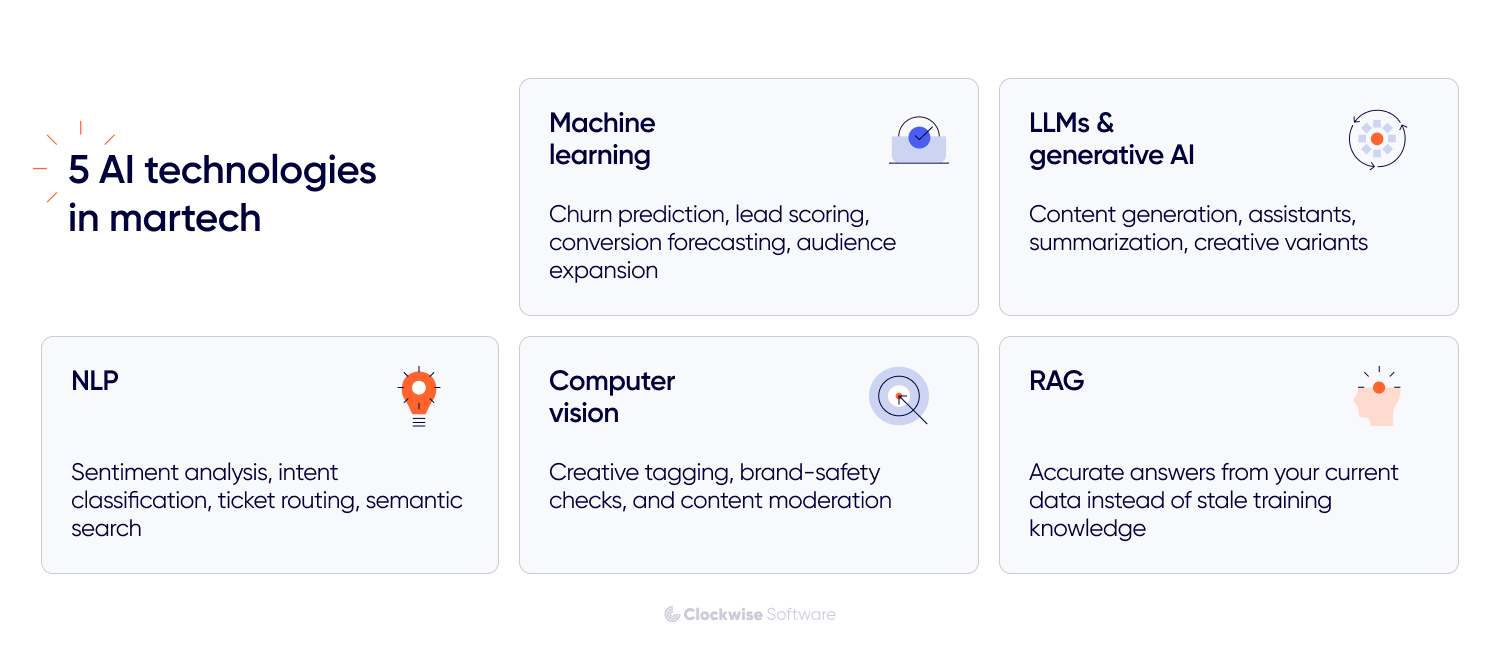
Classical machine learning covers predictive tasks that don't require a language model. You train a model on historical data, and it outputs a score or a class label. Propensity modeling estimates are likely to buy, churn prediction flags accounts drifting toward cancellation, predictive lead scoring ranks the pipeline, and lookalike modeling expands an audience from your strongest customers. These models are cheaper to run than LLMs, easier to explain to a skeptical CFO, and fast enough for real-time scoring once a feature store keeps their inputs consistent across training and production.
The strength is precision on structured data: numbers, events, transactions.
The weakness is that they need clean, labeled history, so a brand-new product with no behavioral data has nothing to learn from yet.
Best for: churn prediction, lead scoring, conversion forecasting, and audience expansion when you have historical data to train on.
Large language models like GPT, Claude, Gemini, and Llama handle language and generation. They draft copy, summarize long documents, answer customer questions, and power assistants that work across your data. On the creative side, generative AI tools such as Midjourney and Stable Diffusion produce images and video variants. For production reliability, teams add prompt orchestration to manage multi-step calls and model fine-tuning when a model needs your brand voice or domain language.
The strength is flexibility across unstructured text and creative tasks.
The weakness is cost per call and a tendency to invent confident answers, which is why grounding them in real data (covered below) matters before they touch a customer.
Best for: content generation at scale, customer-facing assistants, summarization, and creative variant production.
Natural language processing reads and classifies text without necessarily generating it. It tags incoming messages by intent, scores sentiment across reviews and support tickets, extracts entities from documents, and powers semantic search that matches meaning rather than exact keywords. NLP often runs as the quiet layer feeding the flashier tools, routing a support ticket to the right queue or labeling it, which leads to sound, ready-to-buy.
The strength is turning messy free text into structured signals other systems can act on, at high volume and low cost.
The weakness shows up with sarcasm, mixed languages, and domain slang, where accuracy falls without tuning.
Best for: sentiment analysis, intent classification, ticket routing, and search that understands phrasing.
Computer vision handles images and video. In martech, it automatically tags creative assets, checks brand compliance across thousands of ads, analyzes which visual elements correlate with engagement, and moderates user-generated content before it goes live. For DTC and e-commerce teams with large image libraries, this makes the catalog searchable and measurable.
The strength is processing visual volume that no human team could review.
The weakness is that good models need labeled image data and clear visual rules, and edge cases (unusual angles, poor lighting) still slip through.
Best for: creative tagging, brand-safety checks, visual content moderation, and engagement analysis on image-heavy channels.
Retrieval-augmented generation connects an LLM to your data so it can answer based on facts. The system converts your documents into vector embeddings, stores them in a vector database like Pinecone, Weaviate, or pgvector, and retrieves the relevant pieces at query time so the model responds from real source material. Frameworks such as LangChain and LlamaIndex wire this together.
The strength is accuracy and freshness: the model cites your current product docs or campaign data rather than stale training knowledge, which cuts the hallucination risk that keeps LLMs out of customer-facing roles.
The weakness is that retrieval quality depends on how well your data is chunked and indexed, so a sloppy data layer produces confident wrong answers.
Best for: customer-facing assistants, internal knowledge tools, and any LLM use case where a wrong answer carries a real cost.
Plenty of AI ideas look great on a roadmap, only to take at least 2 years to reach users. The 4 below differ because each has a contained scope, a clear data input, and a measurable output.
Here's what each does, a realistic timeline, and real examples from our own experience.
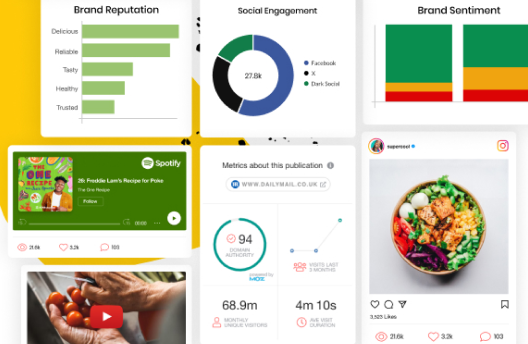
PR and comms teams drown in coverage: someone has to read every article, pull the relevant mentions, judge sentiment, and assemble a client report. An LLM layer changes the economics of that work by reading coverage at scale, summarizing each piece, scoring tone, and drafting a structured report a human can review and send. Pairing 2 models and comparing their output reduces the odds of a confident wrong summary slipping through. A focused version of this reaches a working proof of concept in about a month, with production hardening over the next 2 to 3.
Our case
Our aforementioned UK PR reporting client asked us to add AI into their existing platform. We embedded a dual-model architecture (GPT-4 and Gemini) directly into the reporting workflow to analyze media coverage, then built a dashboard that combined the models' outputs and produced a slide-style report that users could export to PDF. We shipped the proof of concept in just one month. The result opened a US$11.6B market, increased profitability by 10%, and brought in 2 enterprise clients right after launch. The stack stayed lean: Vue, Node.js, PostgreSQL, plus the two model providers.
A lead-qualification chatbot does the first-pass work a sales development rep would do: greet an inbound visitor, ask qualifying questions, capture the answers, and route the result. The value depends entirely on the CRM connection. A bot that collects answers and drops them nowhere creates excessive work, so the chatbot development centers on a clean REST API or webhook sync into HubSpot, Salesforce, or Microsoft Dynamics, with the conversation mapped to real contact and deal fields. NLP handles intent detection, so the bot understands a free-form answer rather than forcing a menu. A well-scoped version of this setup can reach production within 1 to 3 months.
Our case
We built one of these for a service company. The AI assistant syncs with HubSpot and it saves the team more than 40 hours a month. That number matters more than a flashy demo, because it comes from daily production use, and it reflects the part teams underestimate: the value shows up once the assistant is wired into the system of record.
A predictive reporting dashboard estimates what the audience will do next: which segments are growing, which content will land with which demographic, when engagement is likely to peak. This combines machine learning models for the prediction with strong data visualization software, so a marketer can act on the forecast without reading a model output. The visualization layer here serves a functional role, since an uninterpretable prediction usually goes ignored. A production build typically runs 3 to 6 months, depending on data readiness.
Our case
For Sparrow Charts, a social media marketing analytics software that gathered data from Facebook, Instagram, and X and used machine learning to predict user demographics and behavior, our team brought in the visualization layer on which their product depended. We rebuilt the charts with D3.js and React, added a custom report constructor that generated PDFs server-side with Puppeteer, and made the interface fully customizable. After beta, the product passed 1,500 users, won a 2022 Scale-Up Minnesota grant, and was acquired in 2024.
The lesson that carries over: predictive models earn their keep only when the output is legible enough to drive a decision.
Manual segmentation is slow and goes stale. An automated audience segmentation engine sorts leads by behavior and attributes using data science, then pushes those segments back into the tools sales and marketing actually use through CRM sync.
This type of AI-powered automation removes the manual list-building step entirely. Two engineering realities decide whether it works in production: segmentation math is compute-heavy, so it needs parallel processing to stay fast, and the segments are worthless until they reach the CRM. That second part is where reverse ETL (Extract, Transform, Load) comes in: it takes processed data from your warehouse and pushes it back into operational tools like Salesforce or HubSpot, so segments actually land where teams can act on them. A focused segmentation feature runs 3 to 6 months; a full product is longer.
Our case
One of our clients had a Python data science module for sorting leads but needed a real product built around it. We built the React frontend and a Laravel backend on AWS, containerized the tricky dependency setup with Docker, and synced results into Salesforce with other CRMs to follow. The data-science module was slow because the computations were heavy, so we split them into parallel processes using queues, which increased segmentation speed enough to make the app usable in real time. The product reached the market in about 11 months, and the parallel-processing decision is what kept segmentation fast under load.
Why starting small protects the budget and the outcome

The pattern we see again and again is teams trying to automate 5 workflows at once and ending up with none of them in production. On every project I've managed, the ones that shipped on time and got used started with one workflow and one metric. With the segmentation product, we scoped it to a single pipeline synced to Salesforce. Once that worked under real load, expanding to other CRMs was straightforward. A PoC that proves one thing is worth more than an ambitious plan that proves nothing.
Every AI implementation in martech follows the same path: business problem first, data layer second, live integration last. Skip a step, and the whole thing stops. McKinsey's work on AI personalization reports it can raise customer satisfaction by 15% to 20%, raise revenue by 5% to 8%, and cut cost-to-serve by up to 30%. The same research found that nearly 8 in 10 organizations report no significant bottom-line gains from AI, largely due to fragmented pilots, weak data, and thin governance. Companies use the same technology and get opposite outcomes — because results are determined by the foundation underneath.
Here's how that path looks step by step.
The fastest way to waste a quarter is to start from "we want AI" and look for somewhere to put it.
We start the other way, with a discovery phase where we name the business problem and the metric associated with it. "Analysts spend 2 days a week assembling coverage reports" is a problem. "Add AI to reporting" is a wish. The first one gives the team enough context to choose the right solution, define how to measure it, and know when to stop.
In martech, that metric is usually one you already track: CAC, churn rate, conversion rate, or time-to-insight. Anchoring to an existing number does 2 things: it keeps the project honest, because you can prove the lift or admit there wasn't one, and it tells you which AI capability fits, since a churn problem and a content-throughput problem need completely different things. Discovery is also where we catch the cases where AI is the wrong tool and a rules-based automation would do the work for a tenth of the cost.
This step decides whether everything you build on top of it actually works. Marketing data is scattered across a CRM (Salesforce, HubSpot), a CDP (Segment, mParticle), analytics (GA4, Amplitude, Mixpanel), ad platforms (Meta Conversions API, Google Ads), and usually a warehouse (Snowflake, BigQuery). Each one names things differently, and a model trained on inconsistent inputs learns the inconsistency.
Why does data cleanup decide the timeline before the model does

Every time a client comes to us saying “we need AI,”' the first thing we do is look at their data. 9 out of 10 times, the same customer exists as 3 different records across their CRM, analytics, and ad platforms. You can pick the perfect model, but if it trains on that mess, it will confidently produce wrong outputs. We've learned to budget more time for identity resolution and event mapping than for model selection itself. That boring cleanup phase is what makes everything after it work.
Before any model customization is worth doing, the data layer needs cleanup work that's unglamorous and non-negotiable:
Teams that skip this and go straight to the model get confident, wrong outputs, then blame the model. The identity graph, in particular, tends to be where the real effort goes, and underestimating it is the most common reason a martech AI timeline slips.
Structured prediction (churn, lead scoring) points to classical machine learning. Language and generation point to an LLM. Often, the right answer is more than one model doing different jobs, which is hybrid AI orchestration: a large model for the hard reasoning, a smaller or rules-based component for the cheap high-volume work, and a fallback for when confidence drops. Getting this decision right is where the intersection of martech and AI strategy matters the most.
Releasd is a clean example of matching models to functions. Instead of forcing one LLM to do everything, we ran a dual-model architecture with GPT and Gemini, each handling part of the media analysis work, with their outputs combined in the reporting layer. Two models cross-checking each other lowered the risk of a single model's confident mistake reaching a client report, which mattered because the output went straight to paying customers. The lesson generalizes: in customer-facing martech, the cost of a wrong answer often justifies a second model.
There's a ladder of customization, and the rule is to climb only as high as the problem requires, because cost and effort rise fast at the top:
A practical pattern: most language use cases get solved at the prompt or RAG level, and reaching for fine-tuning early is a common way to spend money you didn't need to spend.
A PoC exists to answer one question: does this move the metric from step 1, on real data, before anyone commits to a full build? Two rules keep it useful: scope it to a single workflow, and run it against actual marketing data rather than a clean sample, because production data is messier and that mess is exactly what you need to learn now instead of after launch.
The Releasd PoC took one month and validated the dual-model approach against real coverage before the team invested in the full product. That sequencing is the point of a PoC: a contained, time-boxed test that either earns the next phase or saves you from it.
This is the step that separates AI integration in the martech stack from a standalone AI demo. The model's output has to land where work already happens. A churn prediction score is inert in a warehouse and useful inside the CRM where a rep sees it, so reverse ETL pushes scores and segments back into Salesforce, HubSpot, Braze, or Marketo. Event-driven hooks allow the model to respond to real-time behavior via webhooks and APIs. And a fallback path keeps the workflow running when the model is unsure, so a low-confidence prediction defers to a rule instead of stalling a campaign.
The mindset that works here is enhancement. Marketers keep the tools and flows they know, and the AI feeds better inputs into them: a cleaner segment, a ranked lead list, a drafted report waiting for review. Break the existing workflow and adoption dies regardless of how good the model is.
Launch is not the finish. Two things need to be watched after go-live: business impact and model health. Business impact ties back to step 1's metric, whether that's a lower CAC, a higher conversion rate, or a shorter time-to-insight. Model health is its own track, because customer behavior drifts and a model trained on last year's patterns slowly loses accuracy. MLOps tooling like MLflow or SageMaker handles versioning, monitoring, and scheduled retraining.
The honest part most roadmaps leave out: this step gets skipped, and then someone notices 6 months later that the predictions have degraded and trust has eroded. Budgeting for monitoring and retraining from the start costs less than rebuilding confidence after a quiet failure.
A working demo and a product you can trust in production are different things. The gap between them is where custom AI martech automation projects either earn their budget or quietly fall out of use. These factors decide which way it goes, split across the technical build and the business case.
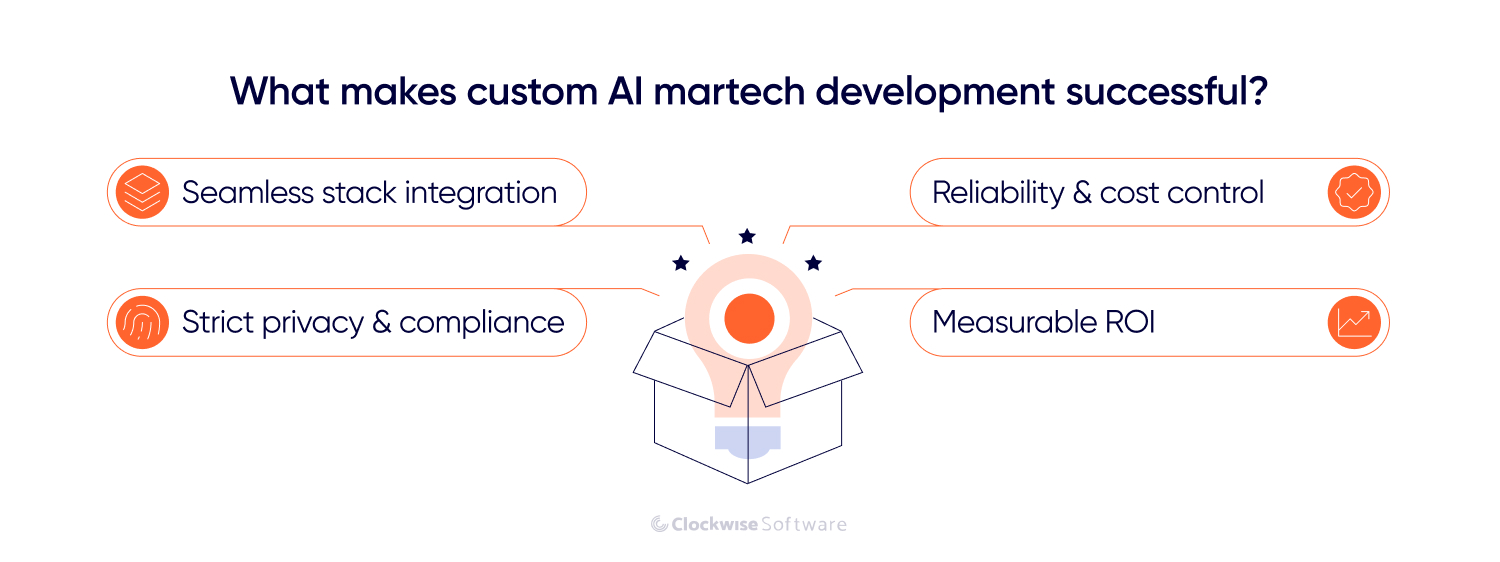
Custom AI only delivers when it disappears into the tools a team already runs. Marketers live in their CRM, their marketing automation platform, and their analytics, so an AI feature that requires a separate login or a manual export competes with their existing workflow and loses. The build target is the opposite: the model's output shows up inside Salesforce, HubSpot, Braze, or Marketo as a field, a score, or a segment that's already there when they open the tool.
Underneath, that means integration engineering. Clean REST API and GraphQL connections, webhooks for live events, OAuth 2.0 for secure auth, and reverse ETL to move model output from the warehouse back into the activation tools. The data direction matters as much as the model. A churn prediction score that never leaves Snowflake changes nothing, while the same score written into the CRM contact record changes what a rep does that morning.
Integration is the difference between a model that informs decisions and one that sits unused.
In martech, the AI runs on personal data, which puts compliance in the architecture rather than in a legal review at the end. Regulations like GDPR, CCPA / CPRA, and the EU AI Act shape what you can collect, what you can feed a model, and what the model is allowed to do with the output. Privacy by design means building those limits into the system from the outset, since retrofitting them after launch is slower and riskier than designing for them up front.
In practice, this involves several layers working together.
There's a second risk that's easy to miss: the model learning something it shouldn't. A model trained on historical data can absorb and then repeat biased or discriminatory targeting patterns hidden in that history. Catching that takes deliberate testing of model outputs for disparate treatment. The EU AI Act raises the stakes here, since certain forms of automated decision-making now carry documentation and oversight obligations. Building first-party data discipline early, rather than relying on third-party data of uncertain provenance, makes each of these problems smaller.
A model that works on a sample and a model that holds up against millions of users and high-volume data are different engineering problems. Reliability comes from infrastructure built for load: Docker and Kubernetes for scaling, Redis for caching, and parallel processing so heavy computation stays fast under pressure, which is exactly the decision that kept Segment AI's segmentation usable in real time once data volume grew.
Cost control deserves equal attention because LLM calls priced per token add up fast at marketing scale. This is the case for hybrid AI orchestration: route the cheap high-volume work to smaller or rule-based models, reserve the expensive large model for the cases that need it, and cache aggressively. A design that ignores per-call cost can post great accuracy numbers and still be too expensive to run on real traffic, which is a failure mode that only shows up after launch.
The business side of success is proving that the work paid off in numbers that leadership already cares about. That means deciding before the build which metric the AI is accountable for, then measuring against a real baseline. Depending on the use case, that's a lower CAC, a higher conversion rate or LTV, improved ROAS, reduced churn rate, or shorter time-to-insight. A well-built data analytics solution ties these metrics directly to the model's output, keeping the connection between AI activity and business results visible.
This is also where AI projects most often disappoint. Tying a build to one metric and one baseline is what separates a project that can demonstrate its value from one that produces activity nobody can connect to revenue. A modest, measurable lift on a single metric beats an impressive demo that no one can attribute.
Cost tracks one decision: how much of the model you build versus how much you borrow. Four paths, with prices that climb fast.
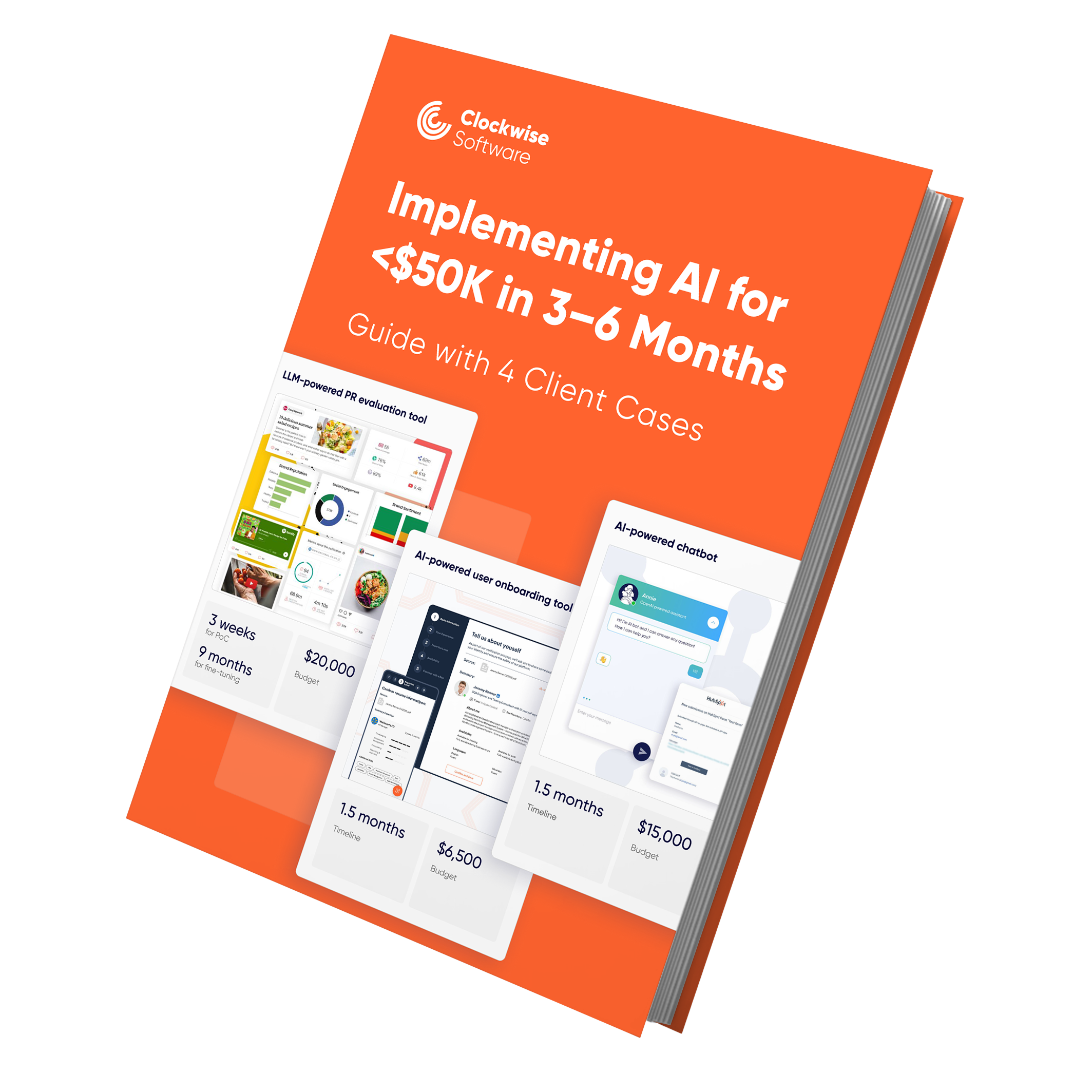
The first 2 cover the majority of AI marketing software projects. Our projects delivered during the last 2 years show the range: an LLM onboarding tool at $6,500, a GPT chatbot with HubSpot sync at ~$15,000, and the Releasd dual-model PR tool at ~$20,000.
We hold CPI and SPI variance under 10%, so we can commit to a number at the model-selection stage and keep it. AI-assisted development shortens the build itself, with human review keeping that speed under control.
No in-house AI team? Partnering with an external AI martech software development services provider can take 3 shapes, depending on how far along your idea is and how much you can carry internally.
Full-stack development team. We build the whole system end to end: the data pipeline, the model, the CRM and martech stack integration, the compliance layer, and the interface marketers actually use. This works when you want one team accountable for the entire build and a predictable route to production, instead of stitching together a separate vendor for each layer.
Dedicated development team. If you already have engineers but lack depth in AI or martech integration, we slot specialists into your team: ML engineers for the model, data engineers for the pipelines, and people who have worked with CRM sync, identity resolution, and PII handling before. You keep the direction and close the specific skill gaps slowing you down.
Discovery phase. If the use case or its feasibility is still an open question, start here, which is where most of our AI software development projects begin. We map the goal, assess your data, scope the compliance and integration work, and put real numbers against the build. You leave with a defined scope, an architecture diagram, a risk list, and an estimate you can take to your own team or to ours. It's the cheapest way to learn what the project actually is before committing a budget to it.
If you take one thing from this, make it the order of operations. Before scoping a model, run a quick audit of your own data: can you resolve one customer across email, web, and ad platforms, do your events mean the same thing everywhere, and can a score actually reach your CRM? Keeping up with AI martech industry trends analysis helps, but the reality is simpler: pick a single metric worth moving, start with the cheapest path that could move it, and prove it on real data before committing to a full build. Smaller and honest beats ambitious and unproven.