AI solutions
What we do
Services
Experts in
How we work


















We build custom automation around your business processes, reducing manual work and helping your teams handle day-to-day operations faster.
We bring your core processes and data together in one custom ERP, replacing disconnected tools with a shared view of your business.
We build consistent data flows and business logic to reduce errors, avoid disputes, and support confident decision-making.
We connect your ERP with the tools your business relies on and make it easy to extend the system as your needs evolve.
We design your ERP architecture to handle growing workloads and user volumes without sacrificing performance.
We build role-based access, audit trails, and security controls into your ERP to protect sensitive business data.
Look for a team that takes time to understand your business before proposing a solution. A good ERP partner should be able to work through your processes, roles, integrations, data, and reporting needs and turn them into a clear development plan.
Experience with similar ERP complexity matters too. Check whether the team has handled multi-module systems, data migration, third-party integrations, user permissions, and phased rollouts.
At Clockwise Software, we start ERP projects with discovery and AS-IS / TO-BE process mapping, drawing on our experience with 10+ ERP systems and 100+ integrations to identify risks early and make practical technical decisions.
Ask about the team’s experience with ERP projects similar to yours, including the business processes, integrations, and level of complexity involved. Find out how they approach discovery and estimation, who will work on your project, and how they handle changes when requirements evolve.
It’s also worth asking what you’ll get throughout development and after launch: how progress is reported, how the code and documentation are handed over, and what support is available after release.
At Clockwise Software, we always start with a structured discovery process and offer transparent delivery with regular demos, full access to project boards and docs, and ongoing support services after release.

Each industry brings different constraints, hidden dependencies, approval chains, and operational risks. Having built ERPs in these environments, we don’t rely on assumptions. We recognize patterns early, anticipate edge cases, and design systems that match how your operations actually function day to day.

We take time to understand how your business works, where your data comes from, and what teams need day to day. When that clarity is in place, shaping the right functionality gets easier for everyone. This ERP discovery process is the reason why our work acceptance rate sits at 99.89%. There are fewer surprises, fewer revisions, and the final system matches what was agreed from the start.

Each sprint delivers a working increment and includes a demo, giving you a clear view of what’s been built and a chance to adjust priorities when needed. We also tailor the communication plan to your preferred update intervals and tools, so communication is predictable and convenient for you.

After managing complex ERP projects for years, we have learned that predictability comes from steady tracking. Throughout development, we track CPI and SPI week by week — across our projects, we consistently keep cost and timeline variance under 10%. We also use AI-assisted workflows to speed up routine tasks, so they move faster while senior engineers stay focused on high-value, critical tasks around architecture, business logic, and delivery risk management.

When the same team stays involved for years, you don’t have to re-explain decisions, trade-offs, or historical constraints every time something changes. That accumulated context makes upgrades and extensions much safer.
That’s why many clients work with us for 5+ years, and our first ERP client returned after 10 years to upgrade the system to match their new workflows.
You get a team of specialists to cover the entire process, avoiding being the person connecting the dots between separate vendors for design, development, and QA.
Plus, we offer faster delivery with AI-assisted workflows that speed up development while maintaining — and often improving — the quality of the final product. With AI, we surface 10–15% more edge cases during planning and speed up legacy module deep dives from 2 days to 4 hours.
We’ve delivered custom ERP systems for manufacturing, logistics, retail, supply chain, and service businesses.
Each industry brings different constraints, hidden dependencies, approval chains, and operational risks. Having built ERPs in these environments, we don’t rely on assumptions. We recognize patterns early, anticipate edge cases, and design systems that match how your operations actually function day to day.
ERP success depends on decisions made before development starts. That’s why we treat discovery as a critical phase.
We take time to understand how your business works, where your data comes from, and what teams need day to day. When that clarity is in place, shaping the right functionality gets easier for everyone. This ERP discovery process is the reason why our work acceptance rate sits at 99.89%. There are fewer surprises, fewer revisions, and the final system matches what was agreed from the start.
We make ERP development easier to manage with a delivery workflow built around clear communication, predictable sprints, and regular feedback.
Each sprint delivers a working increment and includes a demo, giving you a clear view of what’s been built and a chance to adjust priorities when needed. We also tailor the communication plan to your preferred update intervals and tools, so communication is predictable and convenient for you.
We plan ERP projects around realistic timelines and budgets, using our previous ERP delivery experience to make estimates as accurate as possible.
After managing complex ERP projects for years, we have learned that predictability comes from steady tracking. Throughout development, we track CPI and SPI week by week — across our projects, we consistently keep cost and timeline variance under 10%. We also use AI-assisted workflows to speed up routine tasks, so they move faster while senior engineers stay focused on high-value, critical tasks around architecture, business logic, and delivery risk management.
We build ERP platforms with long-term stability in mind and stay involved as partners, helping clients extend, modernize, and upgrade their systems without disruption.
When the same team stays involved for years, you don’t have to re-explain decisions, trade-offs, or historical constraints every time something changes. That accumulated context makes upgrades and extensions much safer.
That’s why many clients work with us for 5+ years, and our first ERP client returned after 10 years to upgrade the system to match their new workflows.
We support the full ERP lifecycle, from discovery and development to rollout and long-term improvements.
You get a team of specialists to cover the entire process, avoiding being the person connecting the dots between separate vendors for design, development, and QA.
Plus, we offer faster delivery with AI-assisted workflows that speed up development while maintaining — and often improving — the quality of the final product. With AI, we surface 10–15% more edge cases during planning and speed up legacy module deep dives from 2 days to 4 hours.









Our ERP systems deliver tangible operational gains. In one project, we reduced errors by 75%, increased delivery efficiency by 104%, and saved a client over $100K in the first year after launch. Results like these turn ERP into a direct driver of operational and financial performance.
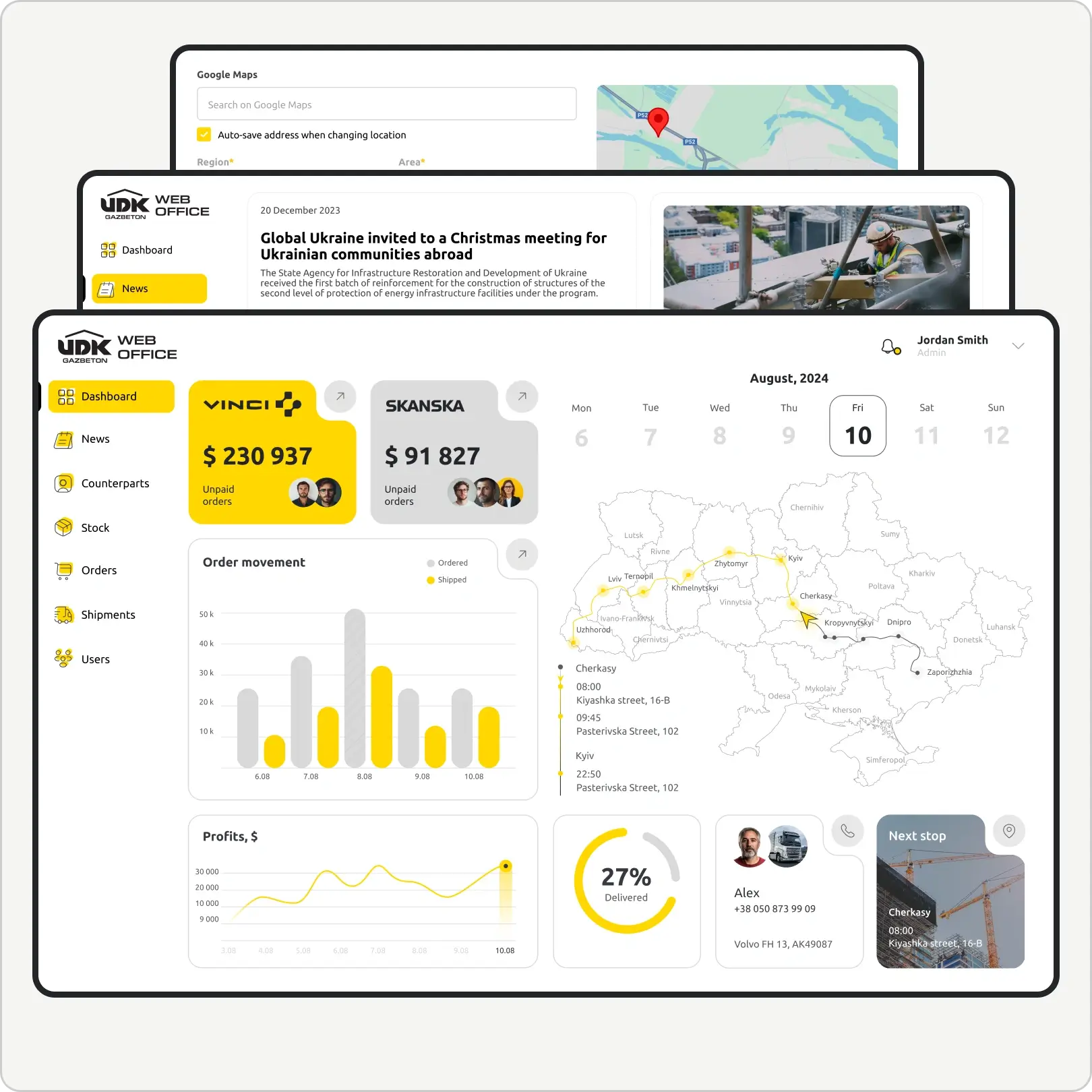
We’ve built 120+ analytics dashboards for operations, finance, logistics, procurement, and leadership teams. These dashboards surface the right metrics, reveal trends early, and turn complex operational data into clear, decision-ready insights.
With 50+ mobile interfaces delivered and NPS above 85%, we design ERP interfaces that teams can adopt easily, whether they’re working at a desk, on the shop floor, or on the move. Web, iOS, and Android interfaces are designed for everyday operational work, with layouts optimized for large datasets and frequent tasks.
Over the past decade, we’ve delivered 100+ integrations connecting ERPs to CRMs, accounting systems, payment providers, mapping services, and internal tools. Every integration is designed to be stable, disruption-free, and resilient to change.
When a client needed a full replacement for a Salesforce-based ERP in 15 months, we delivered a complete, scalable platform in under 14 months. The system launched fully integrated, stable, and within the agreed scope.
We’ve built ERP systems supporting over 3 million users and managing 30+ GB databases. These platforms remain fast and stable under high load, large data volumes, and multi-location operations.
Solution architect

Scattered data, slow legacy tools, manual handoffs — your challenges probably aren't new to us. We'll map the solution and create a plan you can budget against.

In ERP, one change almost never affects just one module. An order update can touch stock, invoices, approvals, and reports at once. AI helps us check these chains faster and catch more edge cases, but engineers are still the ones who decide on and implement the changes in a way so that every dependent process reacts correctly after changes.
In ERP, one change almost never affects just one module. An order update can touch stock, invoices, approvals, and reports at once. AI helps us check these chains faster and catch more edge cases, but engineers are still the ones who decide on and implement the changes in a way so that every dependent process reacts correctly after changes.
In ERP, one change almost never affects just one module. An order update can touch stock, invoices, approvals, and reports at once. AI helps us check these chains faster and catch more edge cases, but engineers are still the ones who decide on and implement the changes in a way so that every dependent process reacts correctly after changes.
In ERP, one change almost never affects just one module. An order update can touch stock, invoices, approvals, and reports at once. AI helps us check these chains faster and catch more edge cases, but engineers are still the ones who decide on and implement the changes in a way so that every dependent process reacts correctly after changes.
In ERP, one change almost never affects just one module. An order update can touch stock, invoices, approvals, and reports at once. AI helps us check these chains faster and catch more edge cases, but engineers are still the ones who decide on and implement the changes in a way so that every dependent process reacts correctly after changes.
We start ERP software development services with AS-IS and TO-BE process mapping: how work happens now, where data gets duplicated, which steps slow teams down, and what the optimized flow should look like. This is where we challenge assumptions, document exceptions, and align stakeholders before development starts. AI helps surface 10–15% more edge cases during planning, so hidden workflow risks are easier to catch early.
In ERP, one change almost never affects just one module. An order update can touch stock, invoices, approvals, and reports at once. AI helps us check these chains faster and catch more edge cases, but engineers are still the ones who decide on and implement the changes in a way so that every dependent process reacts correctly after changes.
Legacy system replacement rarely happens in one switch. Some tools need to stay for a while, some modules can move first, and some data should be touched only after the logic is fully clear. Our ERP software development company plans this transition layer before migration starts. AI helps speed up legacy module deep dives from days to hours, so we understand old logic before working with financial records, client data, inventory, or other critical information.
In ERP, one change almost never affects just one module. An order update can touch stock, invoices, approvals, and reports at once. AI helps us check these chains faster and catch more edge cases, but engineers are still the ones who decide on and implement the changes in a way so that every dependent process reacts correctly after changes.
ERP logic connects approvals, inventory, finance, production, reporting, and customer records. Our ERP development company builds it with reliable transactions and event-driven flows, so one failed action doesn’t block the whole operation or create inconsistent data.
In ERP, one change almost never affects just one module. An order update can touch stock, invoices, approvals, and reports at once. AI helps us check these chains faster and catch more edge cases, but engineers are still the ones who decide on and implement the changes in a way so that every dependent process reacts correctly after changes.
Before development, we map every system your ERP needs to connect with: banking APIs, tax services, GPS tracking, IoT sensors, CRMs, accounting tools, payment providers, and internal software. For each integration, we define sync frequency, error handling, permissions, data ownership, and fallback logic. We use AI to review API documentation faster, while engineers focus on shaping the final integration approach. That way, planning stays thorough without stretching the timeline.
In ERP, one change almost never affects just one module. An order update can touch stock, invoices, approvals, and reports at once. AI helps us check these chains faster and catch more edge cases, but engineers are still the ones who decide on and implement the changes in a way so that every dependent process reacts correctly after changes.
A custom ERP system rollout is close to changing the engine while the business is moving. We release modules in phases, validate critical flows, run controlled data migration, and prepare rollback plans before switching teams to the new system. When needed, we use canary releases or blue-green deployment to reduce disruption. The goal is simple: improve operations without interrupting them.
In ERP, one change almost never affects just one module. An order update can touch stock, invoices, approvals, and reports at once. AI helps us check these chains faster and catch more edge cases, but engineers are still the ones who decide on and implement the changes in a way so that every dependent process reacts correctly after changes.
Automatically extract SKUs, quantities, supplier details, dates, and totals from invoices, purchase orders, and delivery documents. Reduce manual entry, speed up approvals, and minimize human error using proven LLMs like GPT and Claude.

Generate clear daily or weekly summaries for logistics, inventory, production, or finance. Teams get a concise view of what changed, what needs attention, and where risks are emerging, without digging through dashboards or raw data.
Replace rigid filters with natural-language search. Ask questions like “show items below safety stock” or “orders stuck in approval” and get instant, accurate results. This removes friction from everyday ERP use and speeds up decision-making.
Automatically detect unusual stock movements, delivery delays, financial inconsistencies, or supplier issues. AI flags patterns that don’t match historical behavior, giving teams early signals to act before small issues escalate.

Extract vendor details, dates, line items, and totals from PDFs or images and create draft records directly in the ERP. This reduces processing time, improves data consistency, and keeps financial workflows moving without bottlenecks.

Yes, if AI is used for extraction rather than making unchecked decisions. AI can read invoices and other documents, extract fields, and pass the results into your ERP, while validation rules and human review handle anything uncertain or high-risk.
We typically design this as a controlled workflow: AI extracts the data, the system checks it against business rules and existing records, and exceptions are flagged for review. This lets you automate high-volume data entry while keeping financial data accurate and giving your team control over what actually gets posted to the ERP.
We migrate in stages, checking each data set against the source before starting the next one. Row counts, field values, and dependencies get checked automatically, and every stage has a rollback plan. If something doesn't reconcile, we catch it in the dry run.
We plan the cutover down to the hour: what moves when, who's on call, and what the rollback trigger is. The old system stays available until the new one has run a full cycle without issues. The switch itself happens outside working hours, in a window we agree on together.
We inventory every connected system before migration starts: payment providers, warehouse tools, accounting, whatever else your ERP talks to. Each one gets reconnected and tested against the new system before it takes over, so data keeps flowing in both directions the whole way through.
We stay on after go-live, with the same engineers who built it. The first weeks are when edge cases surface, like an unusual order type or a report that doesn't match. We are there to handle the fixes, tune everything needed, and answer the questions your teams might have in the first weeks.
A challenge we frequently face is data quality. Legacy systems carry duplicates, orphaned records, and fields people repurposed years ago for something else. That’s why we profile the data before designing the new structure and clean it at the start of the project.
Another common challenge is undocumented processes that only surface when someone tries to do their job in the new system. We handle it with a proper discovery stage at the start. Our business analyst and designer go through all workflows with you, document them, and then create an interactive prototype to make sure nothing is missed.
Every migration runs as a rehearsal first. We move the data into a staging environment, reconcile it against the source field by field, and fix what doesn't match. That repeats until a run completes cleanly. Only then do we schedule the real migration, with a rollback path and the legacy system kept available after launch of your new ERP system.
Yes. Your teams stay on the old system while we migrate and verify in parallel. It switches to read-only at cutover so no new records land in a system you're retiring, then stays available afterward as a reference until you've confirmed everything transferred.
You get a defined support period after launch with agreed response times, handled by the same team that handled the migration. During that window we monitor the system, fix issues as they surface, and keep the legacy system available for reference.
After the support period, we can stay on for ongoing support under a maintenance agreement, handling fixes and building whatever you want to add to your ERP next.
What we pay attention to during migration planning is dependencies between features in the ERP. Every field you move is load-bearing for something else — one custom status field can drive approval routing, three reports, and an integration. We trace these chains fast and efficiently with AI, it helps a lot with catching more edge cases. But engineers still decide and implement the logic that accounts for all dependencies and edge cases.
$15,000 to $50,000
Refine your idea and validate it with a small-scale prototype.
$150,000 to $200,000
Start building your ERP software with minimal initial investment.
$350,000 to $500,000
Launch an ERP with a solid set of features for your business
$500,000+
Create a next-level system with advanced capabilities
About 6 months for a first working release — core modules, critical integrations, live for one or two user groups. 9–12+ months for a full ERP with multiple modules, complex role structures, and data migration from a legacy system.
An accurate estimate comes after we understand the full scope and map out your workflows. Before that, any number is only a rough range because the effort behind a feature depends on what happens under the hood: "approval workflow" can mean one manager clicking yes, or a four-step chain with conditional routing, delegation rules, and an audit trail that finance signs off on.
Once we have the full picture, we can estimate the time needed to build it based on our experience delivering similar functionality.
Head of Client Relations

Ranges only go so far. Share your scope, and we'll break it into modules, price each one, and flag risks that could affect the budget.
We work with enterprise teams that need custom ERP platforms built around complex, real-world operations. Our focus is on end-to-end systems that support large data volumes, multi-team workflows, and long-term evolution without disrupting live operations.
Typical enterprise ERP projects include multi-module platforms, deep integrations with existing systems, and high-load stable architectures.
We help SMBs replace manual work and scattered tools with focused ERP functionality tailored to their core operations. The goal is to automate key workflows, improve visibility, and bring structure without overengineering the system.
We prioritize practical ERP modules, faster delivery, and a clean foundation that can scale as the business grows.