AI solutions
What we do
Services
Experts in
How we work


Many AI product development services projects are still framed as more complicated than they need to be. Companies often come in with the same request: “We need to add AI.” But that can mean very different things. An AI assistant inside a SaaS product. A reporting workflow powered by LLMs. A document automation feature. A predictive analytics module. Each of these requires a different scope, budget, data setup, and delivery process.
Since 2014, we’ve delivered 200+ software projects, including 5 AI solutions in the past year. We realized that most businesses do not need to start with custom model development or a long R&D cycle. They need a focused use case, reliable integrations, and a practical path from idea to production.
That is where AI outsourcing can work well. A strong external team can help you validate the right use case, choose the simplest implementation path, and build AI features that fit your product or workflow without turning the project into an open-ended experiment.
In this article, we will walk you through how AI outsourcing works today, what drives the cost, and how companies can approach implementation in a practical way.
AI outsourcing is the practice of contracting an external engineering team to design, build, deploy, or maintain AI capabilities — instead of staffing the work internally.
It's distinct from "having a few ML freelancers on Upwork." AI development outsourcing means the vendor brings architecture decisions, a structured development process, security review, and integration depth. The difference shows up the moment a model needs to scale or the data pipeline breaks at 2 a.m.
Companies usually turn to AI outsourcing because of a specific gap between what the team can build in-house and what the business actually needs to move forward.
Sometimes it's a skills gap — no one on the team has shipped an AI feature before. Sometimes it's lack of integration experience, or a scope that's too fuzzy to hand off internally. And sometimes it's simpler than that: the engineering team is already stretched, and adding AI exploration on top isn't realistic. That's when the build-vs-outsource question actually matters.
Outsourcing vs. in-house isn't a preference call. It comes down to 3 things: how central AI is to what you're building, how fast you need to move, and how much control you need to keep. Most companies are better off outsourcing, but there are cases where building internally is the smarter long-term move.
Artificial intelligence outsourcing works best when the goal is to ship AI features fast and well, not to build an internal AI capability you'll own and grow long-term. This typically applies when:
In these scenarios, a decision to outsource software development is a practical shortcut to value: you launch faster and iterate based on real usage.
In-house development becomes relevant when AI is not just a feature, but a core part of your competitive advantage. This usually applies when:
In these cases, outsourcing can get you moving, but the long-term value comes from building internal expertise and infrastructure that the business actually owns.
Most companies don't make a single clean decision here. We often see that companies start with outsourcing, get traction, and gradually shift toward a hybrid or in-house model as AI becomes more central to how the business operates. Here’s a simple way to evaluate your needs:
| Factor | Outsourcing | In-house |
| Time-to-market | Fast (weeks to months) | Slow (months to year+) |
| Initial costs | Lower, predictable | High upfront investment |
| Flexibility | High | Medium |
| Expertise access | Immediate (2-4 weeks) | Requires hiring |
| Control | Limited | Full |
| Best for | AI features, MVPs, fast validation | Core AI products, regulated domains, sensitive data |
If your goal is to launch AI features quickly and validate their impact, artificial intelligence outsourcing is usually the most effective path. If AI is a core differentiator that requires deep control and continuous development, building in-house starts to make more sense. Most companies don’t need to choose one forever, they can start with outsourcing, prove the value, and only then decide whether it’s worth building internally.
Context shapes the use case. Here's where AI outsourcing shows up across industries.
AI outsourcing looks different depending on the industry. The use cases, data constraints, and integration complexity vary a lot, but the underlying logic is the same: find the workflow where AI adds the most value, scope it tightly, and build from there. Here's what that work actually looks like across the sectors where we see it most.
SaaS companies are usually adding AI to an existing product, not rebuilding around it. They need one well-placed feature that makes their product noticeably better. That might be an assistant that helps users navigate complex functionality, summarize activity, generate reports, or recommend what to do next based on product data.
A B2B platform sitting on large volumes of operational data is a good example. Instead of making users dig through dashboards, you add an AI layer that lets them ask questions and get answers fast. An outsourced team scopes the use case, connects the data sources, builds the retrieval or analytics layer, and wires it into the product UI.
MarTech and sales platforms are sitting on exactly the kind of data AI handles well: leads, CRM records, campaign results, audience segments, media coverage. The manual work of processing it is where the ROI lives.
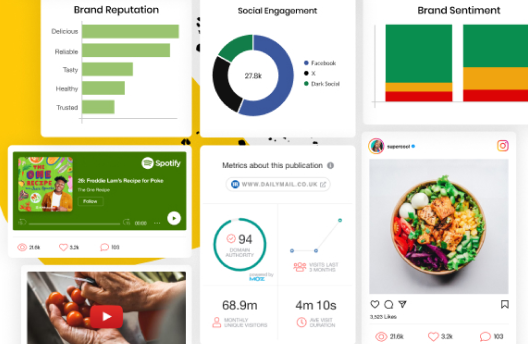
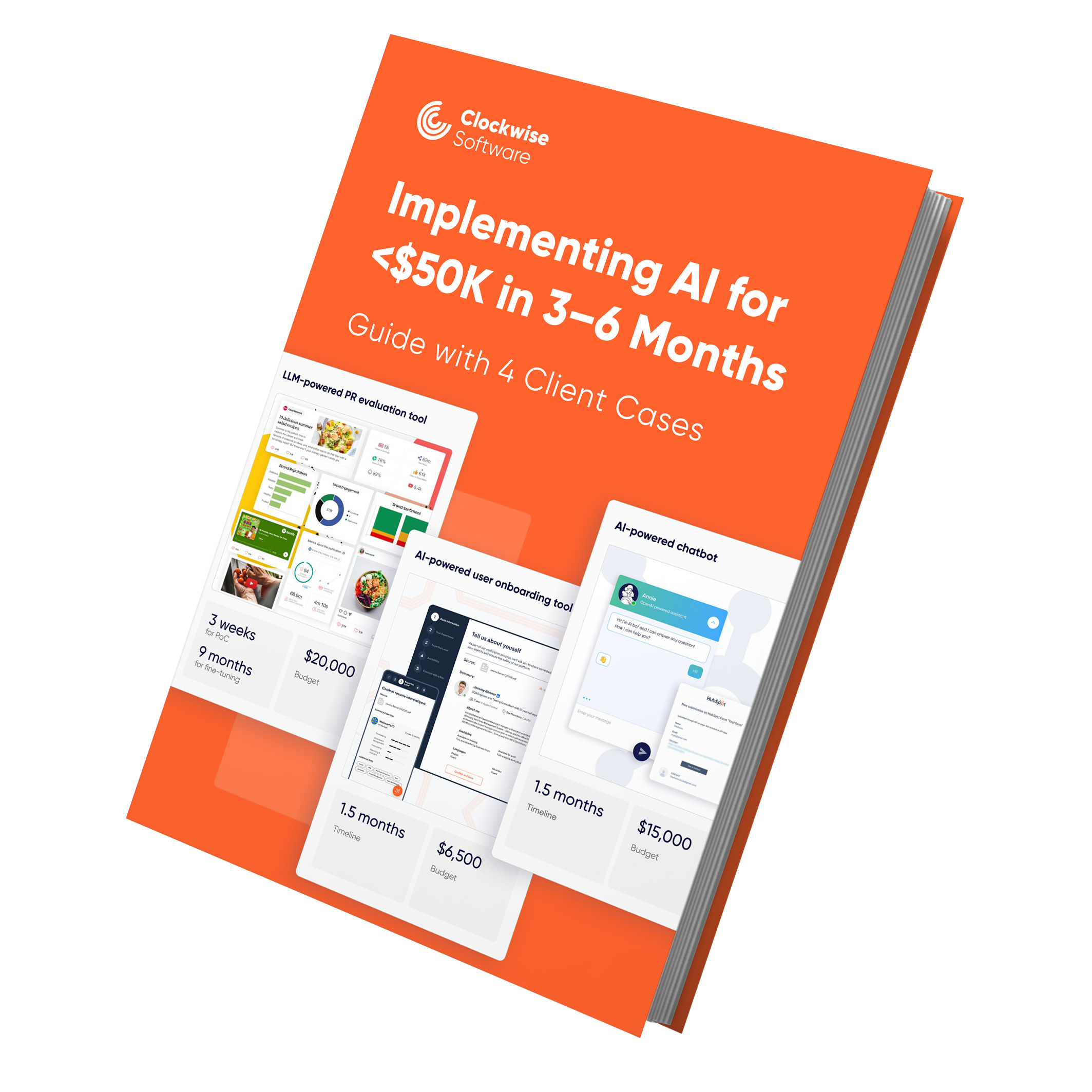
A good example is our work with Releasd, a PR reporting platform. We integrated GPT-4 and Gemini to automate media evaluation and turn coverage data into clear, actionable insights inside the product workflow. The PoC took 3 weeks, followed by 9 months of fine-tuning on a $20,000 budget. After launch, Releasd strengthened its position in the $11.6B media intelligence market, projected 10% profitability growth, and signed two enterprise customers in the first month.
A sales platform can do the same with CRM data: review records, identify gaps, enrich lead profiles, and use AI-powered matching solutions to connect the right leads to the right accounts automatically. A MarTech tool can automate campaign summaries, flag what changed in conversion rates, and prep recommendations before the next planning call.
Here, AI outsourcing usually stays narrow and deliberate: anomaly detection, forecasting, reporting automation, transaction categorization, document processing, analyst tooling. Not a broad transformation. Specific workflows with measurable output.
That could look like a system that flags suspicious activity for human review, extracts structured data from financial documents, or helps analysts search across large datasets in seconds instead of hours. Regulated environments add a layer of constraint, but outsourcing still fits, as long as core decision logic stays internal and the external team works with anonymized data during discovery and prototyping.
These platforms usually outsource AI work that sits closest to the customer: search, matching, personalization, recommendations, support. The closer AI gets to the buying decision, the more impact a well-scoped feature can have.
The most common starting point is search. Keyword matching breaks fast when product descriptions are inconsistent, or users don't know exactly what to type. An AI-powered search layer handles natural language queries, messy catalog data, and user intent, and returns results that actually make sense. Matching works the same way: instead of filtering by category, AI compares customer preferences against catalog data, pricing, availability, and seller profiles to surface what's actually relevant.
Healthcare and wellness platforms have a clean artificial intelligence outsourcing lane: operational workflows, not clinical ones. Appointment support, intake processing, internal knowledge assistants, document classification, admin automation. High manual load, clear inputs and outputs, real-time savings.
An AI assistant that summarizes intake data, routes requests, and surfaces internal protocols fast — that's a realistic, low-risk starting point. Regulated workflows and sensitive patient data need internal control. But the tooling that supports them? That's exactly where an external team earns its keep.
The pattern holds across all of them: the best candidates have a clear input, a clear output, and someone accountable for the result. Where it gets more complex (sensitive data, decisions that matter) is where the in-house vs. outsource boundary needs to be defined before the project starts.
Most companies think about AI outsourcing as a skills gap fix. Need AI expertise, don't have it, bring someone in. That's valid, but it undersells what a good external team actually does. Faster delivery, lower risk, less internal overhead, and a team that's focused entirely on shipping the feature instead of managing everything around it.
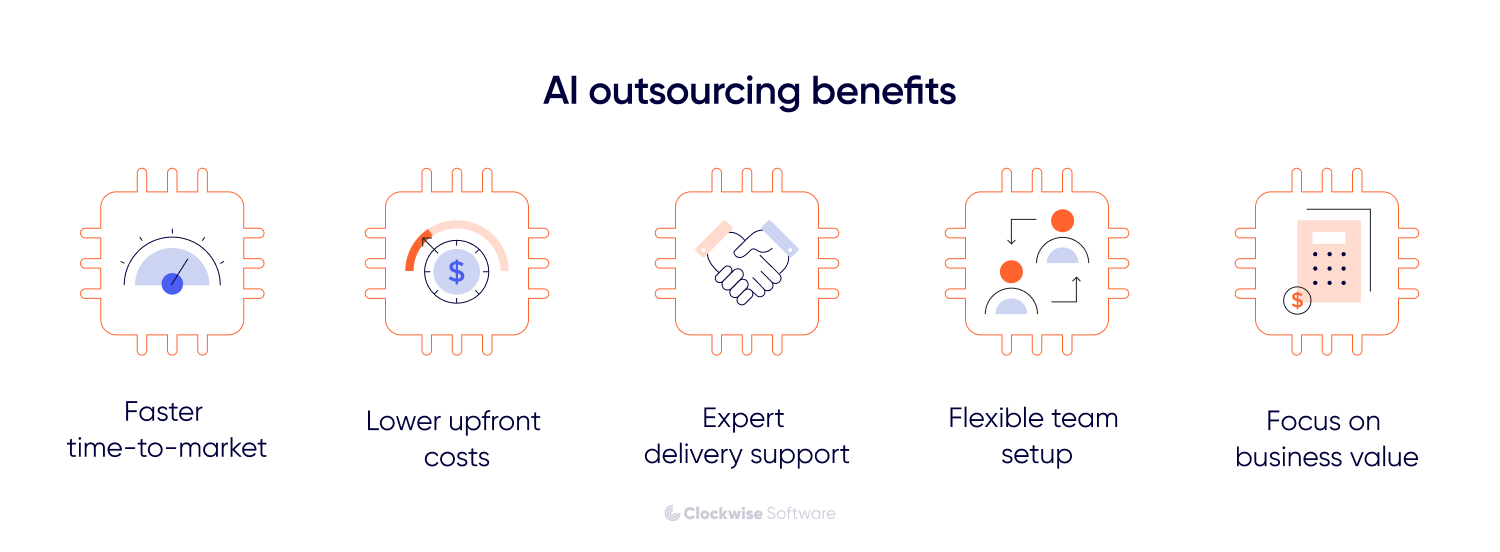
Building AI in-house typically starts with hiring, setting up infrastructure, and experimenting with different approaches before any real feature reaches users. This process can take months, and in many cases, the outcome is still uncertain.
Outsourcing changes this dynamic. Instead of starting from zero, you work with teams that already have proven implementation patterns, tested integrations, and clear delivery workflows. This makes it possible to move directly to execution and bring AI features to production much faster.
A good example is a marketplace platform, Workerbee, where we created an AI-powered onboarding flow. By integrating GPT-4 into the existing product and designing the right parsing logic, we reduced onboarding time from ~2 minutes to ~40 seconds, with the feature built and prepared for production rollout in 1.5 months.
The biggest barrier to AI adoption usually isn't technology. It's the uncertainty around what it'll cost and what you'll actually get back. Building an internal AI team means committing budget upfront: hiring, infrastructure, tooling, experimentation. And most of that spend happens before you have any real signal on outcomes. That's a hard sell internally, and a risky position to be in when the results aren't guaranteed.
With outsourcing, this risk is significantly reduced. AI implementation becomes a step-by-step process, where you can avoid large upfront commitments, validate ideas early, and estimate costs more accurately. And if you go with an offshore software development team, you can save even more money.
AI development is more than connecting APIs or choosing a model. It involves prompt design, data handling, integration into existing systems, the right selection of AI frameworks, UX alignment, and ensuring consistent, reliable outputs in real conditions.
With outsourcing, you get easy access to teams that already understand how to turn AI capabilities into production-ready features, avoiding common pitfalls and reducing trial-and-error.
AI projects often evolve as you move from planning to real product usage. Once real users touch the feature, assumptions shift. New use cases surface, priorities get reordered, and some ideas you were confident about turn out to be the wrong ones to build first.
Outsourcing gives you room to adapt to that without being locked into a fixed team structure or long-term headcount commitments. You adjust scope when the direction changes, iterate faster when something's working, and scale only what's actually proving value, which matters a lot in the early stages, when you're still figuring out what's worth doubling down on.
Perhaps the most underestimated benefit of outsourcing AI is the ability to stay focused on what actually matters. Instead of investing time in infrastructure, model training, and internal coordination, your team can concentrate on defining the right use cases and driving product growth.
With outsourcing, AI doesn’t become another technical project your internal team has to squeeze in between existing priorities. It becomes a focused solution to a specific business problem, delivered by a team that already has the expertise, process, and capacity to implement it.
The cost of outsourcing AI depends more on what you are building and how complex it is than on AI itself. In most cases, companies are not outsourcing full AI systems from scratch, but specific features or modules. That usually makes the investment lower and more predictable.
Most projects fall into three broad categories.
AI feature integrations: $5,000–$15,000. These include AI chatbot development, content generation, AI-assisted search, simple automation, and other lightweight features added to an existing product. They are usually the fastest to launch and the most cost-efficient.
AI-powered modules with data integration: $15,000–$50,000. This includes AI-powered predictive analytics tools, assistants connected to internal knowledge, RAG-based systems, reporting automation, and other features that require more backend work, data handling, and deeper product integration.
Custom AI systems or advanced pipelines: $50,000+. These require more engineering, infrastructure, testing, and long-term refinement. Examples include complex workflow automation, multi-step AI pipelines, domain-specific decision-support tools, or systems that need several integrations across internal products.
That is why AI projects can have very different budgets. One company may need a lightweight feature on top of an existing product, while another may need a more complex system with deeper integrations and custom workflows.
Several factors shape the final number. Scope and complexity matter most, a simple API-based feature sits in a completely different budget range than a system with custom data pipelines, model orchestration, and multiple integrations.
How deeply AI is embedded in your product plays into it too. A standalone feature is straightforward; something integrated with multiple systems or product modules, such as a CRM, ERP, IoT devices, analytics tools, internal databases, or user-facing workflows, takes more effort to build and maintain.
Data requirements add another layer. Using pre-trained models keeps costs down. The moment you bring in proprietary data, RAG setups, or fine-tuning, the scope grows. Same with customization and accuracy needs: the more tailored the outputs have to be, the more work goes into prompt design, evaluation, and iteration cycles. And finally, team composition and location. Expertise level, team size, and outsourcing region all move the number significantly.
The most effective way to approach outsourcing AI is not to start with a large budget, but with a focused use case. Instead of building a complex system upfront, you can:
This approach keeps costs in check and ties AI investment directly to measurable outcomes.
But cost is only part of the equation. Even well-scoped AI projects can run into trouble if data, delivery, or vendor expectations aren't handled carefully from the start.
AI outsourcing can help you move faster and avoid the cost of building everything in-house, but it also can bring risks that need to be managed early.
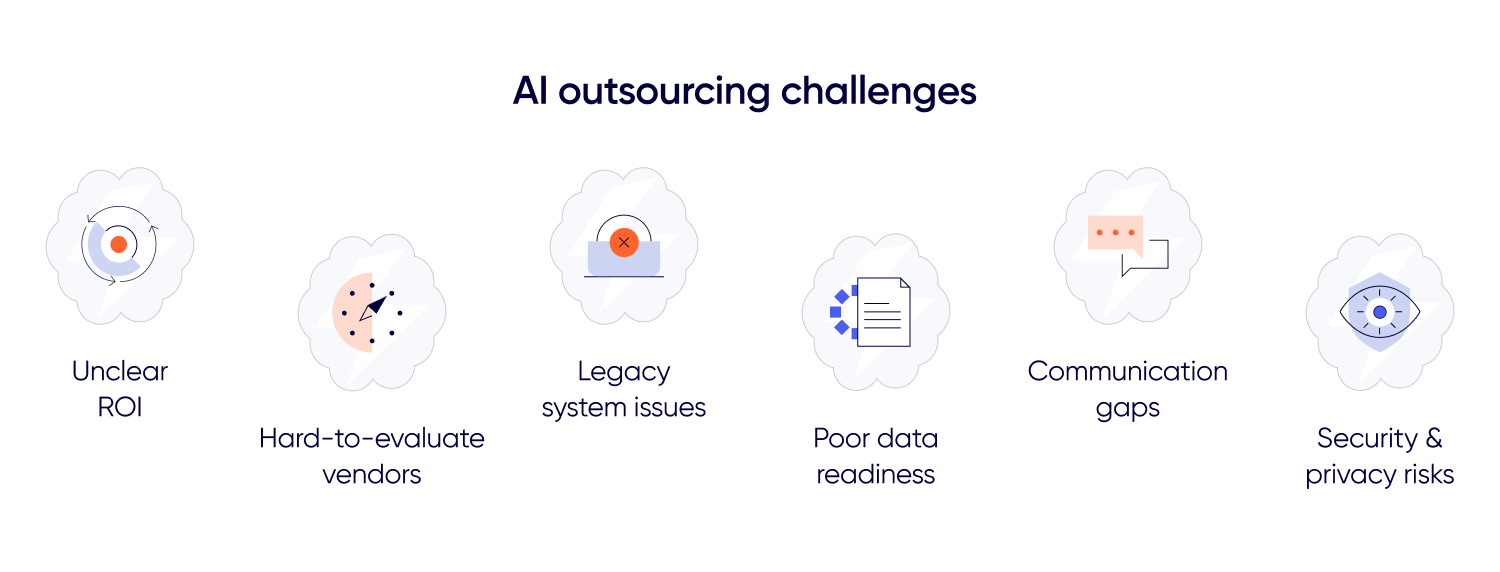
One of the most common concerns is whether the investment will actually pay off. AI often sounds promising at a high level, but the expected business impact is not always easy to estimate in advance. If the use case is too broad or success criteria are vague, the project can quickly drift into experimentation without a clear return.
How to manage this: start with one specific use case, define what success looks like before you build, and treat AI as a business tool rather than an innovation initiative in search of a problem.
Some companies don’t have enough in-house AI expertise to confidently assess outsourcing partners. That makes it genuinely hard to know whether a proposed solution is technically sound, appropriately scoped, or more complicated than it needs to be.
What we recommend: vendor selection can't rely on AI claims alone. The right partner should be able to explain the trade-offs clearly, justify the proposed technical approach, and connect each decision to actual business outcomes. They should also be ready to walk you through similar projects they have already delivered: what options they considered, which constraints shaped the solution, why they chose one implementation path over another, and what they would do differently based on the results.
Most AI features have to fit into existing platforms, internal tools, legacy systems, and work with business data that may be fragmented or poorly structured. In many cases, that turns out to be a bigger challenge than the model itself.
The fix: check data readiness and integration constraints before development starts, instead of treating them as secondary technical details.
Outsourcing comes with its own operational challenges, including time-zone gaps, slower feedback loops, and less day-to-day visibility. AI projects can be especially sensitive to this because they often need frequent iteration, testing, and scope adjustments.
How to avoid this: choose a vendor with clear ownership, regular syncs, transparent progress tracking, and early risk management. For example, at Clockwise Software, we tailor the communication plan to your preferences, factor known risks into initial estimates and keep an up-to-date risk register, share demos with you throughout development, and track actual progress against the delivery plan to keep timelines and spending under control.
For many companies, this is the most sensitive part of outsourcing AI. The concern is not only who builds the feature, but also what happens to corporate data, customer information, and proprietary business logic along the way. You may worry that internal data could be exposed, mishandled, or used to train public models.
Solution: these risks need to be addressed directly in the delivery model. From our experience, that usually means signing proper NDAs and data processing agreements, limiting what data is shared with external services, using enterprise-grade AI providers with clear privacy terms, and anonymizing or masking sensitive data where possible. It is also important to define data access rules, retention policies, and responsibility boundaries early, especially when the solution involves sensitive workflows or regulated environments.
The good news is that most of these issues can be addressed early, as long as the project is approached in a structured way.
A good AI outsourcing process should cover the full delivery cycle. It starts with defining the use case and choosing the right approach, then continues through development, integration, testing, launch, and further improvements based on real usage.
The process starts with defining what AI outsourcing is actually improving, in the product or in the business. At this stage, the focus isn't on models or architecture. It's on identifying a concrete use case, understanding the workflow around it, and getting clear on what a successful outcome looks like.
That usually means pinpointing the bottleneck or opportunity, aligning on business goals and expected value, agreeing on success metrics, and narrowing the scope down to a realistic first implementation.
This step matters more than most teams expect. AI projects get expensive and vague fast when the use case is too broad. A focused starting point leads to faster delivery, clearer priorities, and ROI that's actually visible, not something you're trying to reverse-engineer at the end.
The next step is to look at the environment where the AI feature will need to work. In many projects, this is where the main constraints start to show up. Our team reviews the current tech stack and product architecture, the integration points across backend, frontend, and third-party tools, the available data sources and the quality of data itself, as well as any privacy, compliance, or access constraints.
Tech experts also look at workflow dependencies that could affect output quality or user experience. At this stage, the key question is whether the feature is feasible in its current form or whether the approach needs to be adjusted before development starts.
At this point, the team can determine how much AI infrastructure the use case actually needs. It's one of the most consequential decisions in the process, it directly affects budget, timeline, and delivery risk.
In most implementations, the choice comes down to one of three paths.** Prompting with custom logic** works well for faster, lower-cost builds: chatbots, summarization, classification, parsing, simple copilots. The core work is prompt design, backend orchestration, response handling, and UX integration.
Prompting with RAG comes in when the model needs access to company-specific knowledge, internal documents, or proprietary data. You can outsource machine learning development and add retrieval logic, vector storage, indexing, and context injection, but avoid the cost of full model training.
Prompting with fine-tuning or personalization makes sense when the use case demands stronger domain precision, output consistency, or adaptation to specialized data patterns. That path requires more labeled data, more validation, and a larger overall delivery scope.
By the end of this stage, you should have a clear enough picture of what's technically feasible, what the implementation will realistically cost, and which approach is actually justified by the business case.
Before moving into full development, it's worth building a lightweight proof of concept using real data and actual target workflows.
A PoC answers the questions that matter at this stage: whether the model produces useful results in this specific context, whether output quality is high enough for the intended workflow, what edge cases didn’t show up during planning, and whether the feature actually justifies deeper investment.
In AI projects, most risks don't surface in theory. They show up when prompts, data, logic, and product context start interacting in practice. That's exactly why this stage is so important.
Once the approach is validated, the feature moves into production development. At this stage, the team turns the tested concept into something users can actually work with: connects it to the interface, backend, data sources, permissions, and product workflows.
That means turning the tested concept into a reliable product feature. Our team connects the model to the right data sources and user workflows, builds the logic that keeps responses relevant, and integrates the feature into the interface. We also make the solution ready for real-world use by controlling access, monitoring how it performs, validating outputs, and ensuring it handles errors and unusual cases properly.
Before launch, we test the feature against the agreed requirements to make sure it works as expected across key scenarios and handles errors and edge cases properly. You also get access to the staging version, so you can try it yourself and confirm that the workflow and outputs feel right.
AI features usually need ongoing adjustment after launch. They have to be reviewed based on real usage, output quality, and changing context. That means monitoring response quality and failure patterns, refining prompts and business logic, improving retrieval where needed, adjusting the user experience based on how people actually use the feature, and expanding scope only after the initial workflow proves useful.
But even the best process on paper depends on who is actually running it. That makes vendor selection a critical part of the outcome.
Choosing the right AI outsourcing partner has a big impact on whether the project creates actual value or turns into a long and expensive detour. It comes down to how well the team understands your domain, chooses the right approach, and delivers it in practice.
When evaluating vendors, focus on factors that directly affect delivery and look beyond just technical claims.
Our approach to AI development is built around one principle: deliver business value quickly without unnecessary complexity.
Instead of defaulting to long R&D cycles or costly custom ML pipelines, we choose the implementation path that fits the use case. Many business needs can be covered by adapting prebuilt models and AI services, while more complex cases may require custom ML. In both scenarios, we keep the scope, timeline, and expected value clear from the start.
Our AI development company focuses on choosing the right use case through a solid discovery process, selecting the simplest approach that can do the job well, and integrating it into your product and workflows in a way that feels natural. One project turned a website chatbot into a 24/7 customer touchpoint connected to HubSpot. Another helped campaign managers shortlist influencers 40% faster and pay back the initial investment in less than 3 months. The goal is always the same: reduce manual work, speed up decisions, and make AI useful inside the workflows your team already relies on.
From AI-powered onboarding and chatbots to analytics and predictive systems, each solution was built to solve a specific problem and deliver measurable impact.
AI doesn't have to be a big, expensive bet before it proves anything. For most companies, the right move is one focused use case. Validate it, measure it, then decide how far to take it.
That means starting with a practical implementation path and a clear problem to solve, not a custom model or a full internal AI team. In most cases, a small dedicated software development team can implement the feature, supported by a unified frontend, backend, and AI setup, without communication gaps or unnecessary overhead.
A good outsourcing partner doesn't push AI for the sake of it. They help you scope the right thing, use existing tools where they do the job, and build something that fits your product without overengineering it.
That's the approach we take, from the first scoping call to a feature your users actually rely on. If you want to move from idea to working implementation with a focused, business-driven approach, we can help you get there.