AI solutions
What we do
Services
Experts in
How we work


Choosing a team for a B2B marketplace usually starts with a long list of names and a few practical questions. Has this company delivered a marketplace for business buyers? Which ERP did it connect to? How did it handle quotes, custom pricing, and invoices?
We asked those questions about every company in this guide and checked the answers against public case studies. Ten marketplace development companies made the cut: Elogic Commerce, Clockwise Software, McFadyen Digital, Brainvire Infotech, FATbit Technologies, Net Solutions, Emerline, ScienceSoft, Syndicode, and DBB Software.
Note: Clockwise Software is the publisher of this article and appears on the list. Our position is scored by the same evidence rules as every other company, and the rules are published below.
In this guide, you’ll find:
Let’s start with the short answer.
If you're shortlisting a team for a B2B marketplace, start with the scenario you're in:
ScienceSoft, Syndicode, and DBB Software work as generalist partners. All three are full-cycle software companies with marketplace projects in their portfolios.
We ranked companies by documented B2B marketplace delivery. Every company was checked against its own case studies, its Clutch profile, and platform partner directories. Each company then landed in one of two categories:
Named B2B marketplace project. A public case study names a B2B or B2B2C marketplace client and describes B2B mechanics: quotes, account pricing, payment terms, supplier portals, or ERP sync.
Documented B2B capability. The company publishes B2B marketplace services, B2B commerce work, or adjacent projects, and its named marketplace cases are B2C, services, or single-seller B2B commerce.
Most B2B marketplaces add a layer that consumer platforms rarely need: company accounts with several users, prices negotiated per client, payment by invoice, and integration with the operator’s ERP and, often, the buyers’ procurement systems. How much of that layer a project needs depends on its market and the size of its buyers. The five areas below set B2B marketplace projects apart, and they’re the criteria every company is judged against.
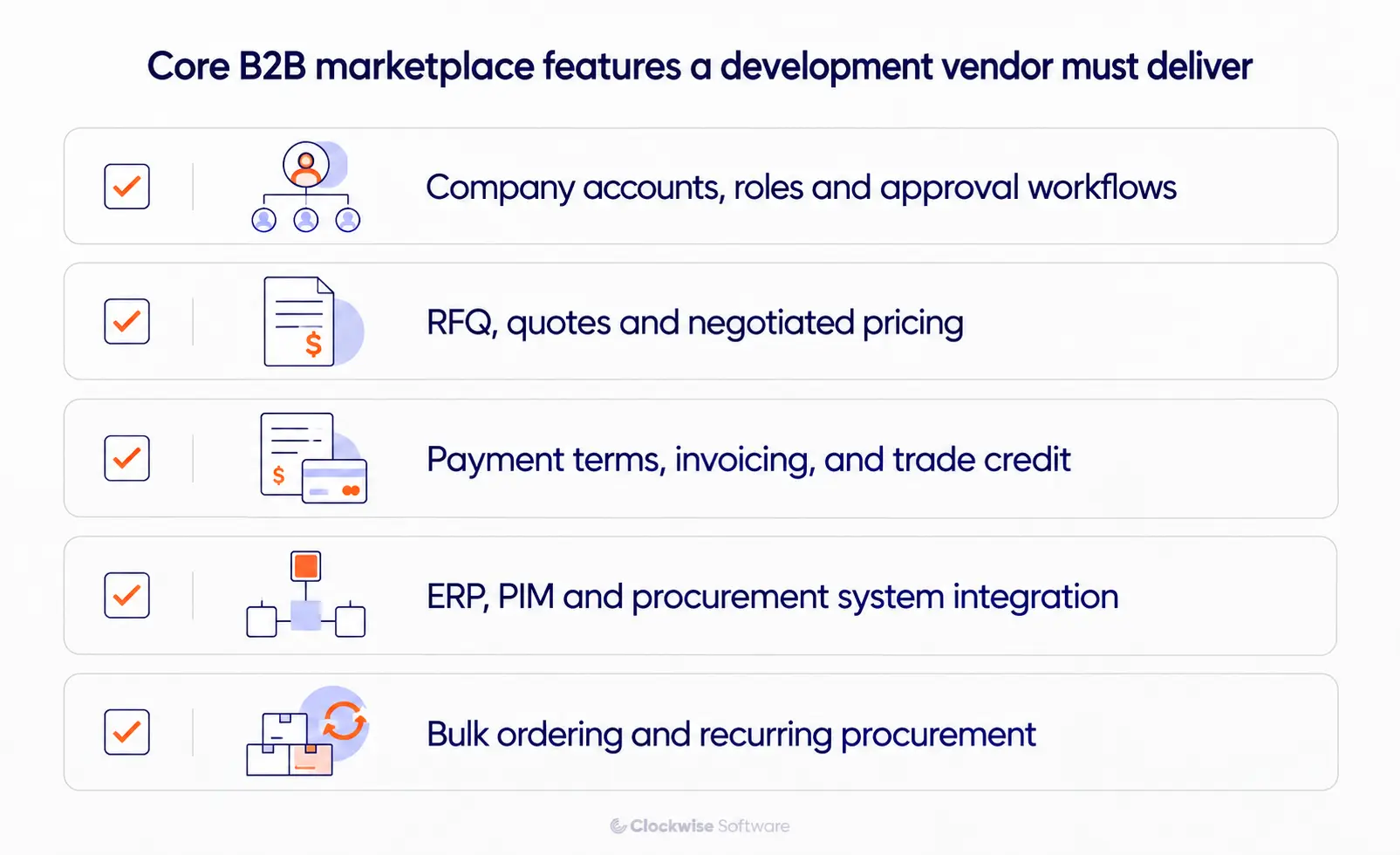
Unlike B2C marketplaces, where purchases are typically made through individual customer accounts, B2B marketplaces must support multiple users operating under a single company account. A B2B marketplace development company builds corporate account structures with role-based access, purchasing permissions, spending limits, and multi-level approval workflows.
For example, a procurement specialist may select products and submit a purchase request, while a department manager approves the order and the finance team handles payment. Developers must ensure that each user can access the appropriate catalogs, negotiated prices, order histories, and purchasing functions based on their role.
Unlike B2C marketplaces, where products typically have fixed prices, B2B marketplaces often involve customized quotes and price negotiations. Developers build request-for-quote (RFQ) systems that let buyers specify requirements, request offers from suppliers, and negotiate terms before placing an order.
These workflows may include supplier bidding, counteroffers, volume-based discounts, and customer-specific pricing. B2B marketplace developers also implement quote management tools that track negotiations and convert approved quotes into orders.
B2B marketplaces often support deferred payments, trade credit, and invoice-based transactions. Developers build payment workflows that accommodate net 30, net 60, or net 90 terms, credit limits, and partial payments.
B2B marketplace developers also implement automated invoice generation, payment tracking, and accounting system integrations. These capabilities help businesses manage complex payment arrangements and streamline financial operations between buyers and suppliers.
In B2B, the ERP owns prices, stock, and customer data. The marketplace reads from it and writes orders back. That’s why developers need the skills to integrate platforms with solutions like SAP, Oracle, Microsoft Dynamics, or custom ERPs to synchronize inventory, pricing, purchase orders, and financial data.
Large buyers also expect procurement integrations that automate purchasing workflows, reduce manual data entry, and keep information consistent across business systems. These connections help buyers and suppliers manage transactions within their existing enterprise infrastructure.
B2B marketplaces must support large-volume orders and repeat purchasing. Developers build bulk ordering features such as SKU uploads, quantity-based pricing, minimum order quantities (MOQs), and quick order forms.
B2B marketplace developers also implement recurring procurement workflows, including saved order templates, scheduled purchases, and one-click reordering. These features help businesses streamline routine purchasing, reduce manual work, and manage high-volume transactions more efficiently.
The table compares all 10 companies on delivery location, Clutch rate band, minimum project, rating, and B2B evidence tier. Rates and minimums come from public Clutch profiles. Use it to cut the list to three, then read those three cards in full.
| # | Company | HQ / delivery | Rate | Min project | Clutch |
| 1 | Elogic Commerce | Tallinn, Estonia; offices in EU, US, UK | 50–99/hr | $25,000 | 5.0 |
| 2 | Clockwise Software | Edinburgh, UK;
Ukraine |
50–99/hr | $50,000 | 4.9 |
| 3 | McFadyen Digital | Vienna, Virginia; US, Brazil, India | Custom/ quote-based | N/A | N/A |
| 4 | Brainvire Infotech | Irving, Texas; India, UAE | 25–49/hr | $25,000 | 4.8 |
| 5 | FATbit Technologies | Mohali, India | 25–49/hr | $1,000 | 4.8 |
| 6 | Net Solutions | Chandigarh, India; New York, LA, Toronto, London | 25–49/hr | N/A | 4.7 |
| 7 | Emerline (LeverX) | Miami, US; delivery in Poland and Central Europe | 50–99/hr | $25,000 | 4.9 |
| 8 | ScienceSoft | McKinney, Texas; US, EU | 50–99/hr | $5,000 | 4.8 |
| 9 | Syndicode | Lisbon, Portugal; San Francisco | 50-99/hr | $50,000 | 4.8 |
| 10 | DBB Software | Kraków, Poland | 50-99/hr | $25,000 | 5.0 |
Located at: Tallinn, Estonia, with offices in Stockholm, Brooklyn, Dresden, Prague, and London
Team size: 50–249 employees
Rate: 50-99/hour
Project budgets: Starting at $25,000
Named B2B work: Nxtby, Whola
Elogic Commerce specializes in B2B ecommerce and marketplace development, with a strong focus on Adobe Commerce (Magento). The company builds and customizes multi-vendor platforms, integrates enterprise systems, and helps businesses improve existing marketplace functionality.
One example is Nxtby, a B2B2C marketplace where Elogic resolved issues with vendor onboarding, order routing, and commission calculations. According to the company's case study, these improvements reduced transaction failures from 6% to 0.4%, achieved 99.5% order-routing accuracy, and shortened vendor activation time by 74%.
Another project, Whola, is an Australian wholesale fashion marketplace where Elogic implemented custom purchasing rules, minimum order requirements, and performance optimizations. The company reports a fivefold improvement in website performance.
Elogic is a strong fit for businesses building or modernizing Adobe Commerce marketplaces, particularly those requiring complex customization and integrations. Companies considering other technology stacks should verify the team's relevant experience.
Located at: Edinburgh, Scotland, and Dnipro, Ukraine
Team size: 50–249 employees
Rate: 50–99/hour
Project budgets: $50,000 to $1.5M+
Named B2B work: Workerbee
Clockwise Software provides custom marketplace development services, including B2B service platforms, multi-vendor systems, and marketplaces with complex purchasing and payment workflows. The company builds tailored solutions rather than relying on off-the-shelf marketplace engines, with experience in ERP-related products, SaaS platforms, and AI-powered functionality (e.g., smart recommendation engines, automated onboarding, and AI assistants).
One example is Workerbee, a B2B marketplace connecting businesses with consultants specializing in HRM, CRM, and ERP integrations. Clockwise developed functionality for matching businesses with suitable consultants, managing service requests, and coordinating transactions between buyers and providers.
As the platform evolved, the team introduced net 30 payment terms, purchase order management, and enterprise invoicing to accommodate corporate buyers. It also developed a lead management workflow that allows partners to review requests and route them to consulting agencies based on priority.
Another project, Whitelance, involved transforming an existing freelancer marketplace into a multi-tenant white-label platform. Clockwise redesigned its architecture to let businesses launch branded marketplaces with dedicated databases, customizable interfaces, and shared backend functionality. According to the company, the platform now serves businesses in more than 150 countries.
Clockwise Software is particularly relevant for businesses planning custom B2B service marketplaces with specialized matching, multi-party workflows, and flexible payment arrangements. Across projects, Clockwise has maintained cost and timeline variance under 10% and a 99.89% work acceptance rate. ERP and logistics are core verticals, which matters for B2B marketplaces where the ERP owns prices and stock.
Located at: Vienna, Virginia, USA, with operations in Brazil and India
Team size: 201–500 employees
Rate: Custom pricing, not publicly disclosed
Project budgets: Custom quotes for enterprise projects
Named B2B work: ChemDirect, ABB Electrification eMart
McFadyen Digital specializes in enterprise marketplace strategy, development, and implementation, particularly for distributors, manufacturers, and wholesalers. The company works with platforms such as Mirakl, Adobe Commerce, and commercetools, helping businesses launch multi-vendor marketplaces and integrate them with existing commerce systems.
One example is ChemDirect, a B2B chemical marketplace connecting buyers with suppliers for direct-ship orders. McFadyen supported its redesign and implementation, introducing a composable architecture and a streamlined purchasing experience tailored to the chemical industry.
Another project is ABB Electrification eMart, a B2B/B2C marketplace developed with Adobe Commerce and Mirakl. The platform launched with more than 6,000 products and was designed to support third-party sellers and future catalog expansion.
McFadyen Digital is particularly relevant for established distributors and manufacturers planning enterprise marketplace implementations. Smaller businesses with limited initial budgets should confirm whether their project fits the company's typical engagement scope.
Located at: Irving, Texas, USA, with offices in India, the UAE, and other locations
Team size: 250–999 employees
Rate: 25–49/hour
Project budgets: Starting at $25,000
Named B2B work: Juman Industrial
Brainvire Infotech develops B2B and multi-vendor marketplaces, with expertise in Adobe Commerce, Magento, and Odoo. The company works on large-scale commerce platforms, including solutions that require supplier management, ERP integrations, and complex product catalogs.
One example is Juman Industrial, a Saudi Arabian B2B marketplace for construction materials. Brainvire developed a multi-vendor platform with dedicated interfaces for buyers, suppliers, and administrators. The solution includes payment gateway integrations, shipping management, automated notifications, and customized marketplace functionality.
Brainvire also developed a Kuwait-based marketplace serving more than 2,000 sellers across nine Middle Eastern countries. Although consumer-focused, the project demonstrates the team's experience with large seller networks, multi-country operations, and ERP integration.
Brainvire is particularly relevant for businesses planning regional B2B marketplaces with extensive catalogs, multiple suppliers, and back-office integrations. Companies seeking a dedicated SaaS marketplace engine should confirm whether Brainvire's commerce-platform approach fits their requirements.
Located at: Mohali, India
Team size: 50–249 employees
Rate: 25–49/hour
Project budgets: Starting at $1,000
Named B2B work: Procurenet, UNI Diamonds
FATbit Technologies develops custom marketplace software, including Yo!Kart for multi-vendor ecommerce and Yo!Rent for rental marketplaces. Unlike marketplace development companies focused primarily on custom development, FATbit offers ready-made platforms that businesses can adapt to their requirements, reducing the need to build standard marketplace functionality from scratch.
One example is Procurenet, a B2B healthcare marketplace built on Yo!Kart. FATbit implemented a global request-for-quote (RFQ) module, buyer-supplier messaging, document management, and payment workflows. The platform supports catalog data for more than two million products.
Another project, UNI Diamonds, is a B2B diamond trading marketplace featuring negotiated pricing, bidding, advanced product search, and logistics integrations. FATbit customized Yo!Kart to support specialized trading workflows and complex diamond specifications.
FATbit is particularly relevant for businesses looking to launch a B2B marketplace using an established software foundation. Companies requiring highly specialized architecture or extensive customization should evaluate the platform's technical limitations and support terms before committing.
Located at: Chandigarh, India, with offices in the US, Canada, and the UK
Team size: 250–999 employees
Rate: 25–49/hour
Project budgets: Typically $50,000–200,000
Named B2B work: Euro Car Parts, GSF Car Parts, Hancocks
Net Solutions specializes in B2B ecommerce marketplace development, particularly for wholesalers, distributors, and automotive parts suppliers. The company builds custom commerce platforms and works with Adobe Commerce, Shopify Plus, and headless architectures, focusing on complex product catalogs, enterprise integrations, and trade purchasing workflows.
One example is Euro Car Parts, a major UK automotive parts distributor. Net Solutions developed and continuously modernized its ecommerce platform, introducing real-time inventory synchronization, vehicle-specific product search, and omnichannel ordering. The company reports a 30-fold increase in annual online revenue over the partnership.
Another project, GSF Car Parts, involved rebuilding an existing ecommerce platform with Adobe Commerce Cloud. The improvements reduced checkout time from 15 seconds to under four seconds and doubled daily order volumes. Net Solutions also modernized** Hancocks**, a confectionery wholesaler, with B2B-specific pricing and account-based ordering.
Net Solutions is particularly relevant for distributors modernizing trade commerce platforms or expanding toward marketplace models. However, its published projects primarily demonstrate single-seller B2B commerce, so businesses requiring multi-vendor functionality should verify relevant implementation experience.
Located at: Miami, Florida, USA, with delivery offices in Poland, Germany, and Lithuania
Team size: 250–999 employees
Rate: 50–99/hour
Project budgets: Starting at $25,000
Named B2B work: Professional-services marketplace, sales analytics platform for distributors
Emerline specializes in custom software and marketplace app development, with additional enterprise integration expertise through its parent company, LeverX Group. This combination is particularly relevant for businesses building B2B platforms that need to connect with SAP and other enterprise systems.
One example is a professional-services marketplace where Emerline developed web and mobile applications connecting customers with service providers. The platform includes professional directories, virtual offices, appointment scheduling, online payments, and video consultation integrations.
Another relevant project is a sales analytics platform for distributors, designed to streamline operations through reporting, data visualization, and workflow management. The project demonstrates Emerline's experience with distribution-specific business processes, while LeverX brings broader SAP implementation expertise.
Emerline is worth considering for businesses developing custom service marketplaces or platforms requiring complex enterprise integrations. However, companies planning multi-vendor product marketplaces should request additional references demonstrating supplier management, order routing, and marketplace-specific payment workflows.
Located at: McKinney, Texas, USA, with offices in Poland, Latvia, Lithuania, and the UAE
Team size: 750+ employees
Rate: 50–99/hour
Project budgets: Starting at $5,000; most commonly $50,000–200,000
Named B2B work: Online marketplace platform for AI training datasets
ScienceSoft specializes in enterprise software development, including B2B marketplaces, customer portals, and ecommerce platforms. The company works with Adobe Commerce and custom technologies, helping businesses build purchasing portals and integrate them with existing ERP, CRM, and other enterprise systems.
One example is an online marketplace for AI training datasets, developed for a company selling data to businesses building machine learning solutions. ScienceSoft created the platform using Adobe Commerce, with product catalog functionality and lead generation capabilities. According to its case study, the marketplace became a profitable channel for attracting potential customers.
ScienceSoft is particularly relevant for businesses that need a B2B marketplace or purchasing portal connected to enterprise infrastructure. However, companies planning multi-vendor marketplaces should request specific references involving supplier management, order routing, and marketplace payment workflows.
Located at: Lisbon, Portugal, with an office in San Francisco, USA
Team size: 50–249 employees
Rate: 50–99/hour
Project budgets: Starting at $50,000
Named marketplace work: ThredUP, HLPRS, Fuzu
Syndicode specializes in custom marketplace development, with strong expertise in Ruby on Rails and third-party integrations. The company offers B2B marketplace development services covering procurement workflows, quote requests, contract negotiations, and automated invoicing.
One of its most notable projects is ThredUP, a large online fashion resale marketplace. Syndicode contributed to the platform's development over a six-year partnership, supporting its growth from a Series B startup toward its IPO. The project demonstrates experience with large product catalogs, seller operations, and marketplace scalability.
Other projects include HLPRS, a home services marketplace, and** Fuzu**, an employment platform connecting job seekers with employers. While these aren't direct examples of B2B procurement marketplaces, they demonstrate experience building multi-sided platforms with matching and transaction workflows.
Syndicode is relevant for businesses planning custom marketplaces with complex integrations and scalable backend systems. However, companies requiring specialized B2B procurement functionality should request additional references involving corporate purchasing, ERP synchronization, and negotiated pricing.
Located at: Kraków, Poland, and Dnipro, Ukraine
Team size: 50–249 employees
Rate: 25–49/hour
Project budgets: Starting at $25,000
Named marketplace work: Bookis
DBB Software specializes in custom software and marketplace development, with experience in multi-vendor platforms, payment integrations, and scalable ecommerce systems. The company also offers product discovery and build-vs-buy planning to help businesses evaluate development costs and decide which components to build or integrate.
One example is Bookis, a Norwegian marketplace connecting book buyers and sellers. DBB developed and improved its web and mobile platforms, integrating Stripe and Vipps payments, BankID verification, and third-party logistics services. According to the company's case study, Bookis reached over 450,000 active users and generated $4 million in gross merchandise value.
DBB Software is relevant for businesses evaluating custom marketplace development and seeking structured technical planning. However, its published Bookis case is consumer-focused, so companies requiring B2B procurement workflows should request additional project references.
B2B marketplaces fall into four working types: wholesale and distribution, vertical industrial, services and procurement, and B2B2C hybrids. Each type comes with distinct technical requirements and development challenges. Match the company to the type first, and treat industry overlap as secondary.
Wholesale and distribution marketplaces let a distributor add third-party suppliers next to its own stock. The hard part is unifying catalogs and keeping ERP stock and pricing in sync across sellers. Elogic's Whola work and Net Solutions' Euro Car Parts and Hancocks projects sit here.
Vertical industrial marketplaces serve one industry with spec-heavy catalogs: chemicals, construction materials, medical supplies. Search on technical attributes and RFQ flows carry the weight. McFadyen's ChemDirect, Brainvire's Juman Industrial, and FATbit's Procurenet are the named examples.
Clockwise’s UDK project also demonstrates relevant industry experience. It’s a custom ERP system for one of Ukraine’s largest construction materials manufacturers that includes customer-side functionality with a product catalog and a workflow for ordering construction materials. This functionality helped UDK cut the ordering process from 5 calls to zero, as everything now happens on the platform.
Services and procurement marketplaces sell expertise or capacity to businesses. Here, matching, purchase orders, and invoicing on terms decide whether the platform is valuable and convenient. Clockwise's Workerbee project and Emerline's professional-services marketplace fit this type.
B2B2C hybrids serve trade and consumer buyers on one platform, with different prices, payment methods, and checkout rules per buyer type. Elogic's Nxtby and Net Solutions' GSF Car Parts both handle mixed buyer types.
Most B2B marketplace projects fit one of six scenarios. The table gives a first pick for each, an alternative from the list, and the risk to check in the first call. The first pick is the company with the closest named project; the alternative is the closest match with different trade-offs.
| Scenario | First pick | Alternative |
| Distributor adding third-party sellers next to its own stock | McFadyen Digital | Net Solutions |
| Live Adobe Commerce, Shopify Plus, BigCommerce, etc. marketplace with failing orders or payouts | Elogic Commerce | Brainvire Infotech |
| B2B services or procurement marketplace with net terms | Clockwise Software | Emerline |
| Industrial niche with spec-heavy catalog and RFQ | Brainvire Infotech | FATbit Technologies |
| E-commerce marketplaces | Emerline | ScienceSoft |
| Fast first launch on a limited budget | FATbit Technologies | DBB Software |
Building a B2B marketplace doesn't always mean developing every feature from scratch. Ready-made marketplace platforms such as Mirakl, Marketplacer, and CS-Cart provide much of the core infrastructure, including seller management, product catalogs, order processing, and marketplace administration.
The alternative is custom marketplace software development, where a software development company builds a platform around your specific business requirements. This gives you greater flexibility over purchasing workflows, integrations, and platform architecture, but usually requires more development time and a higher initial investment.
Choosing an off-the-shelf platform doesn't necessarily eliminate the need for a development partner. Businesses often hire marketplace developers to configure the software, customize the storefront, connect ERP systems, and implement B2B functionality the platform doesn't support out of the box.
| Choose an off-the-shelf marketplace platform when... | Choose custom B2B marketplace development when... |
| Your marketplace follows a relatively standard multi-vendor selling model. | Your business model requires unconventional buyer-supplier interactions. |
| You want to launch faster using existing functionality. | Your core purchasing workflows require customization. |
| Your budget favors lower upfront development costs. | You're prepared to invest more upfront for greater flexibility and control. |
| Most requirements can be handled through configuration, extensions, and available APIs. | Critical features depend on complex business rules or integrations the platform cannot support adequately. |
| You're comfortable working within the vendor's architecture and product roadmap. | You need substantial control over the architecture and long-term product roadmap. |
For many businesses, a hybrid approach makes sense: use an existing marketplace engine for standard functionality and hire a development company to build the integrations and workflows that differentiate your platform.
Mirakl is an enterprise marketplace platform designed for businesses expanding into third-party selling. It provides infrastructure for seller onboarding, catalog management, order processing, and marketplace operations.
Marketplacer is a managed marketplace platform that helps businesses add third-party sellers and expand their product assortment without developing the underlying marketplace infrastructure from scratch.
CS-Cart Multi-Vendor provides marketplace software with source-code access, allowing businesses to customize the platform and manage their own infrastructure. Unlike managed SaaS solutions, it offers greater control over the underlying application.
The right choice depends on how much of your marketplace's core functionality an existing platform can support without extensive modifications.
Start by identifying your essential B2B workflows: RFQs, negotiated pricing, corporate purchasing accounts, payment terms, and ERP integrations. Then check which capabilities each platform supports natively, which require customization, and which would need to be developed from scratch.
Compare the total cost of ownership, not just the software license or initial development estimate. Include implementation, integrations, maintenance, platform fees, and future feature development.
If an off-the-shelf solution covers most of your requirements, customizing it may be faster and more cost-effective. If your marketplace depends on highly specialized procurement processes or complex business logic, custom development may provide greater flexibility and reduce reliance on workarounds.
A custom B2B marketplace costs more than a consumer one with the same feature count, because integration, pricing logic, and invoicing carry most of the effort. The scope is the main cost driver, so here are estimate examples for marketplaces of different sizes:
| Scope | What's in it | Typical effort, hours | Cost at $50/hr |
| B2B MVP | One buyer type, seller onboarding, catalog, RFQ, card and invoice payments, ERP export | 1,500–2,500 | $125,000 |
| Mid-market B2B marketplace | Account hierarchies, contract pricing, approval workflows, net terms via a trade credit provider, two-way sync with one ERP | 3,500–6,000 | $300,000 |
| Enterprise B2B marketplace | PunchOut, multiple ERPs, multi-region VAT and e-invoicing, B2B2C storefronts | 8,000+ | $400,000+ |
Running costs sit on top of development. For example, Stripe Connect charges per active connected account and per payout. Trade credit providers take a fee per financed invoice. KYB providers charge per business check. E-invoicing networks charge per document in some countries. Ask marketplace development companies to list these lines next to the development quote.
A strong portfolio doesn't always prove that a company can handle complex B2B marketplace development. During your first call, ask about a specific project and how the team approached its technical challenges. Look for concrete examples of implemented features, integrations, and problems solved rather than general claims about B2B expertise.
These five questions can help you evaluate a potential development partner:
Beyond asking questions, request a demonstration of relevant B2B functionality. Depending on your marketplace requirements, this might include converting an approved quote into an order, applying customer-specific pricing, processing a partial shipment, or synchronizing an order with an ERP system.
The goal isn't to find a developer who has implemented every possible B2B feature. It's to verify that the team understands your marketplace's business model and has practical experience solving similar technical challenges.
The ten marketplace development companies featured in this guide bring different strengths, technical expertise, and project experience to B2B marketplace development. Choosing the right partner starts with understanding your own requirements: the type of marketplace you're building, the enterprise systems it needs to integrate with, and the purchasing workflows it must support.
Use these requirements to shortlist two or three companies with relevant projects in their portfolios. Then, schedule an introductory call with each to discuss their experience, technical approach, and challenges they've solved on similar projects. Look for specific examples rather than broad claims of expertise. The right B2B marketplace development partner should not only understand your business model but also demonstrate the ability to turn its requirements into a reliable, scalable platform.


![Top B2B Marketplace Development Companies: 10 Vendors Compared [Case Studies Mentioned]](/img/blog/top-marketplace-development-companies/header-background-mid.webp)