AI solutions
What we do
Services
Experts in
How we work


While some SaaS products are large and aim at millions of users, other SaaS tools serve very specific purposes for small, defined audiences — and their chances for success are equally good.
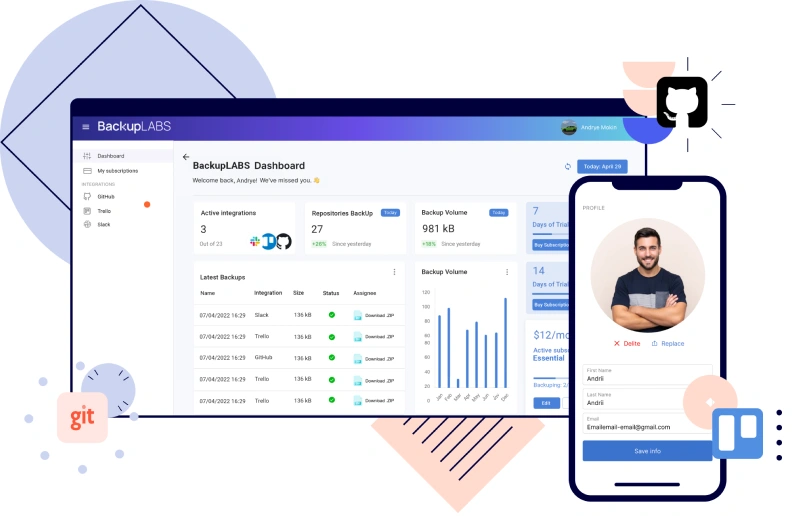
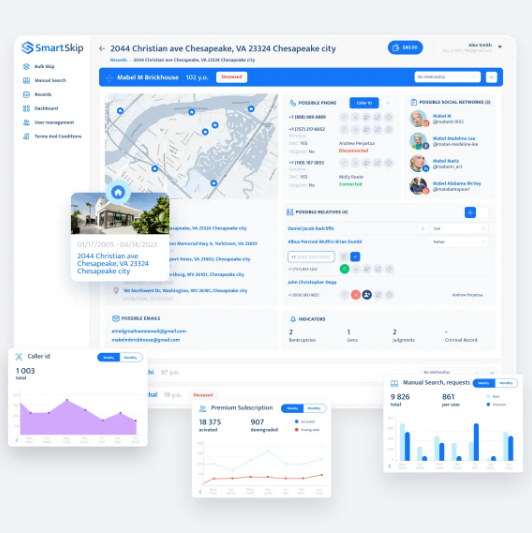
Look at these two micro SaaS examples from our own work: A tool we built for a real estate company tracks down contact details for property owners. It reached the market in 7 months, and it had paying users in the first month. A data backup product we built for another client took 11 months and now protects files for more than 1,000 companies.
That is what micro SaaS products do: they solve a narrow problem, and they know exactly who their users are.
Most writings about micro SaaS stop at the idea. In this guide, we want to cover what comes next: how to test that people will pay, when a no-code tool is enough and when you need custom development, how to price a product with a small audience, and what changes when the product outgrows its first version.
As a SaaS development company, we've delivered 25+ SaaS products since 2014. Some were large platforms. Others were small, sharply focused tools built to solve one narrow problem — and those are the ones called micro SaaS. That’s the experience we based this guide on.
A micro SaaS product is a small software tool that solves one specific problem for one specific group of users, and it earns money through subscriptions under the SaaS business model. It covers a single task instead of many, so it takes much less time to build than a traditional SaaS product.
Niche-specific SaaS products appeared because large SaaS providers frequently overlook certain users' needs. Functionality that meets these needs may not be relevant to most users, so it doesn't seem rational for software providers to offer it in a one-size-fits-all solution. Micro SaaS products provide this missing functionality, catering to the underserved needs of businesses and average users. Such products can come as extensions to existing products or standalone apps, depending on their purpose.
Anyone asking what is micro SaaS usually wants to know how these products differ from the SaaS tools they already pay for. The differences show up in scope, team size, funding, and how fast the product reaches its market, so the comparison below sets both models side by side.
Both models run in the cloud and charge a subscription, so the real difference is in scale and strategy.
A micro SaaS product solves one problem for one narrow audience, and a single person or a small team can build and fund it.
A traditional SaaS product covers many tasks, needs a larger team and outside investment, and competes in a crowded market.
Scope is the first thing that decides which model fits. Everything else follows from how narrow or broad you go. Here's how they compare in detail:
| Micro SaaS | Traditional SaaS | |
| Scope | Addresses a single problem or meets one particular need. The feature set stays focused on accomplishing one task | Provides broad functionality for multiple tasks and a wider audience |
| Development team | One person or a small development team builds the product | Requires a more extensive software engineering team structure to finish in a reasonable time frame |
| Funding | The development doesn't require massive resources | Costs more, and frequently requires funding from third-party investors |
| Time to market | Shorter, because developing and testing small-scale solutions takes less time | Longer, because the scope is wider |
| Competition | Usually low. These products serve niches that are untapped by other startups | Usually high. Every industry already has many feature-rich SaaS solutions |
| Profitability | Revenue potential is lower because the audience is limited, but operating expenses are lower too and there is no reliance on external funding | Higher revenue potential, with larger operating expenses and pressure to grow quickly. |
The foundations look the same in both cases. Both types scale, both run in the cloud, and both may use a multi-tenant architecture to serve many customers from one codebase. What differs is ambition. Micro SaaS founders often prioritize business sustainability over quick growth and expansion, and that choice is what makes a limited audience workable in the first place.
So in what cases does building a micro SaaS product become the better option? That depends on why you are building it at all.
Building a micro SaaS product makes sense when you already know a niche well enough to name a specific problem inside it, and when the people with that problem are reachable without a marketing budget. The model works because a small audience can be served with a handful of features and charged properly for them. It stops making sense when you can't say who pays, or when the problem is mildly annoying instead of expensive.
The following 4 scenarios are where we most often see founders build micro SaaS products that hold up.
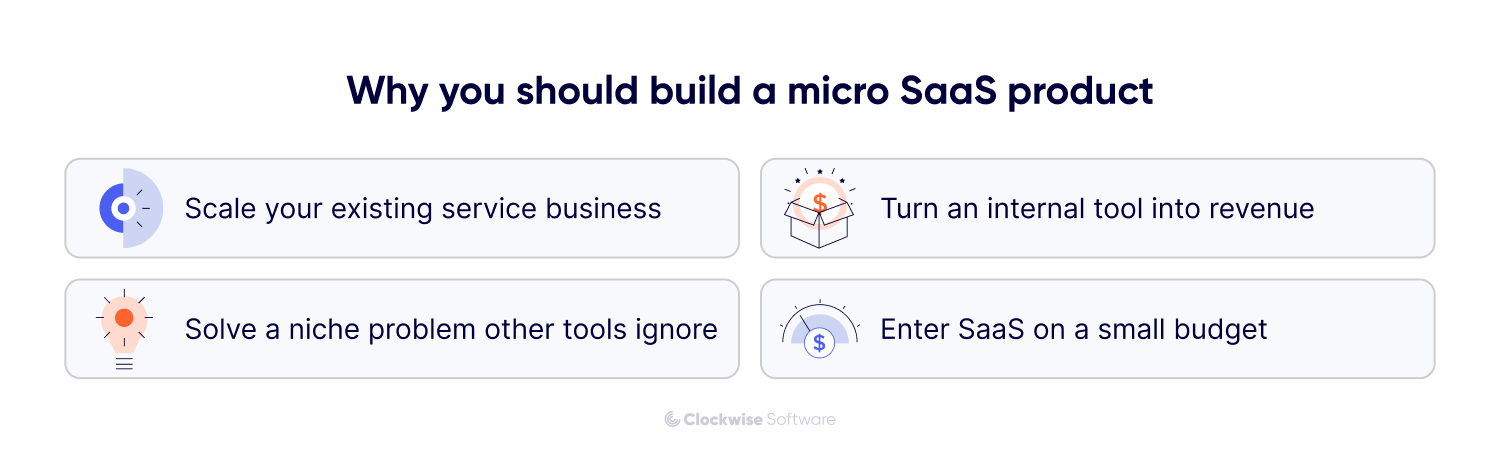
If you run a service business, micro SaaS can help you provide better services or scale your services. For example, a marketing agency that helps with managing social media accounts can create a micro SaaS app for scheduling and managing content publishing. By offering this app, the agency can scale its services and reach a new audience that isn't yet interested in customized services.
BackupLABS, one of our clients, started from that position. They were running the operational side of a data backup business on top of a third-party platform, and that platform only covered a few sources, such as Salesforce and Microsoft 365. Their customers kept asking about the tools nobody backed up at all.
So we built them their own platform, and the first decision was which service to support first. We started with a single GitHub integration and designed the data layer so that adding the next source wouldn’t mean reworking the core. GitLab and Trello came in quickly after that, then Jira and Notion. It took 11 months to launch, and the product now serves more than 1,000 corporate clients and protects over 4.5 million assets.
That first integration choice is more important than it looks. Pick a source with an unusual API and you build a one-off. Pick a representative one and the second and third integrations cost a fraction of the first.
When we use certain tools or work in a certain industry for a long time, we can sometimes notice use cases that aren't covered by existing solutions. If you identify an unmet need or unsolved problem, building a micro SaaS app can help you both solve a problem for yourself and others and get a new revenue stream.
One of the cleanest micro SaaS examples out there is Hypefury, a social media automation tool.
The idea for Hypefury came to founder Samy Dindane when he was using Twitter (now X) and asked a simple question: “Is it possible to schedule threads?” It turned out there were no tools for this, so Samy decided to create one. It took him 3 days to build a pilot project with functionality for scheduling threads, and he further improved his product based on users’ feedback and requests.
Samy found a niche problem and solved it, and now Hyperfury brings almost $300,000 yearly to him and his team.
You can also build a micro SaaS product simply to add a revenue stream. The small scale keeps development affordable, and subscriptions bring in recurring and predictable revenue.
One route is a standalone product in the same domain as your business that doesn't directly augment your services. The other starts with something you already have. If you use a custom app internally and think it could be valuable to others, you can begin a SaaS migration and turn that app into a micro SaaS product. The advantage is real evidence: the tool already works, and you already know which parts of it people rely on daily.
Whichever route you take, one condition holds. The product has to solve a specific problem in a specific niche.
If you're not ready to invest a large amount of resources in software product development but would like to enter the SaaS market, a micro SaaS app is the most practical way in. Along with low upfront investment, a short time to market, and little to no competition, this option has another benefit: you can scale your product later and reach the same results as a traditional SaaS product.
Smartskip is a good example. The founder needed a tool that finds current contact details for property owners, a task real estate investors were doing manually. We ran a discovery phase first to cut the feature list down to what the first customers would pay for, then built it with 7 specialists over 7 months. The product had paying users within the first month after launch and passed 2,000 of them in the first year.
The small budget worked because we decided what to leave out before development started.
An AI earns its place in a micro SaaS product when you want to automate repetitive work that users are still doing by hand: writing the same kind of report every week, copying fields out of documents, or sorting incoming items. Each of these becomes a micro SaaS opportunity when it targets a niche that general-purpose tools ignore: one industry's report format, one field's document types, or industry-specific routing rules. The four micro SaaS examples below are the patterns that show up most often.
Document-heavy reporting. Users assemble the same report from scattered material every cycle. The model drafts the narrative from data the user already entered, then the user edits it. This fits micro SaaS products well because the format repeats, so a handful of prompts covers most of what your users need.
Unstructured data extraction. Your users receive invoices, contracts, or emails and retype the contents into a form. AI-powered micro SaaS can automate it. An LLM model reads the document and returns typed fields, and your application validates those fields against its own rules before saving anything. The validation layer matters more here, because a wrong number that passes silently into a database costs more than a failed extraction.
Classification and routing. Incoming items (support tickets, leads, emails, form submissions) need a label, a priority, or an owner. The model assigns one along with a confidence score, and anything below your threshold goes to a human queue instead of straight into the workflow. That threshold is a product decision, and it usually needs tuning with real data after launch.
Drafting workflows. Product descriptions, replies, outreach messages. The model produces the first version and the user rewrites it. This is the cheapest pattern to ship and the easiest to get wrong, because a draft takes longer to fix than to write from scratch.
For most of these, you call a hosted model through an API such as OpenAI or Claude, keep the prompts and post-processing in your own backend, and train nothing. When answers have to reflect your customers' own material, you add retrieval: documents go into a vector database, an ingestion job keeps that index current, and the retrieval layer runs permission checks so one customer's data never appears in another customer's results.
A micro SaaS product without AI has a mostly fixed cost base: hosting, a database, some monitoring. Those bills stay roughly flat across a wide range of usage — until you cross a tier and jump to a bigger instance. Add an AI, and every request costs money. Your cost now scales with usage per customer, and the customer who uses the product hardest is also the one who costs you the most.
A flat $29 monthly plan handles that badly. One heavy user can consume more in tokens than they pay in subscription fees, and in a niche with 400 potential customers you can't average that away across a large base.
Adding AI also raises the development floor, but less than people expect when the product is small. An AI micro SaaS built on an existing model isn't a from-scratch development. Against a micro SaaS without AI, that's a modest bump in project cost, plus a monthly API bill that a fixed-cost product doesn't carry. Before you commit, it's still worth checking whether a rules-based version would satisfy your first users, because that version costs less to build and less to run.
Before development starts, you have to choose how you build the product, and that choice directly affects your budget, your timeline, and how far the product can grow before it needs reworking.
There are 3 options, and the honest answer is that all 3 are correct in different situations. No-code is the right choice while you're still finding out if anyone will pay for using your product. Custom development earns its cost once the product needs something the templates don't cover, like unique logic, unusual load, compliance requirements, or AI features that reach customer data. Low-code is between the two: more room to customize than no-code, less effort and cost than building from scratch.
The comparison below covers 7 areas, from time and cost through to what happens when the product outgrows the choice you made.
| No-code | Low-code | Custom development | |
| Best for | Testing whether anyone wants the product, and simple products that stay simple | Products needing a custom logic without infrastructure work | Confirmed demand and requirements the platforms can't meet |
| Time to a working version | Days to 3 weeks | 2 to 6 weeks | 1 to 6 months for a first release |
| Cost pattern | Low upfront, plus platform fees that grow with workflow runs and database size | Platform fees plus development time | High upfront, predictable hosting afterwards |
| Complex integrations | Fine for one or few APIs. Limited once you need 2-way sync, retries, and rate limit handling | Workable. You can write custom logic if you need | No ceiling. You own the sync, retry, and reconciliation logic |
| Security and compliance | The platform decides how data is protected and where it's stored. You can't change either | More control, still bounded by the platform | Full control over data location, access, and audit trails |
| AI with access to customer data | Simple prompting works. No control over the retrieval permission layer | Prompting and basic retrieval work. Permission checks need care | Full control, including permission checks inside retrieval |
| When you outgrow it | Rebuild, with live customer data to migrate | Partial migration. The API layer often survives, the frontend gets rebuilt | Depends on the architecture you chose at the start. Plan for growth early and you extend the product easily |
A few situations push a product off a no-code platform, and they tend to show up together once the product starts working:
The opposite mistake costs more. If you choose custom development before you can say who pays for the product and why they would leave the tool they use now, you end up with a well-made product for a market nobody has confirmed. It’s cheaper to test the idea on a platform, get your first paying customers, and let their behavior show you which of those 4 situations applies to you. Rebuilding at that stage is a good outcome, and some founders plan for the rebuild before they even launch.
Micro SaaS products are much faster to develop than regular SaaS apps, but to succeed, you still need the right approach to development. This process splits into 6 stages:
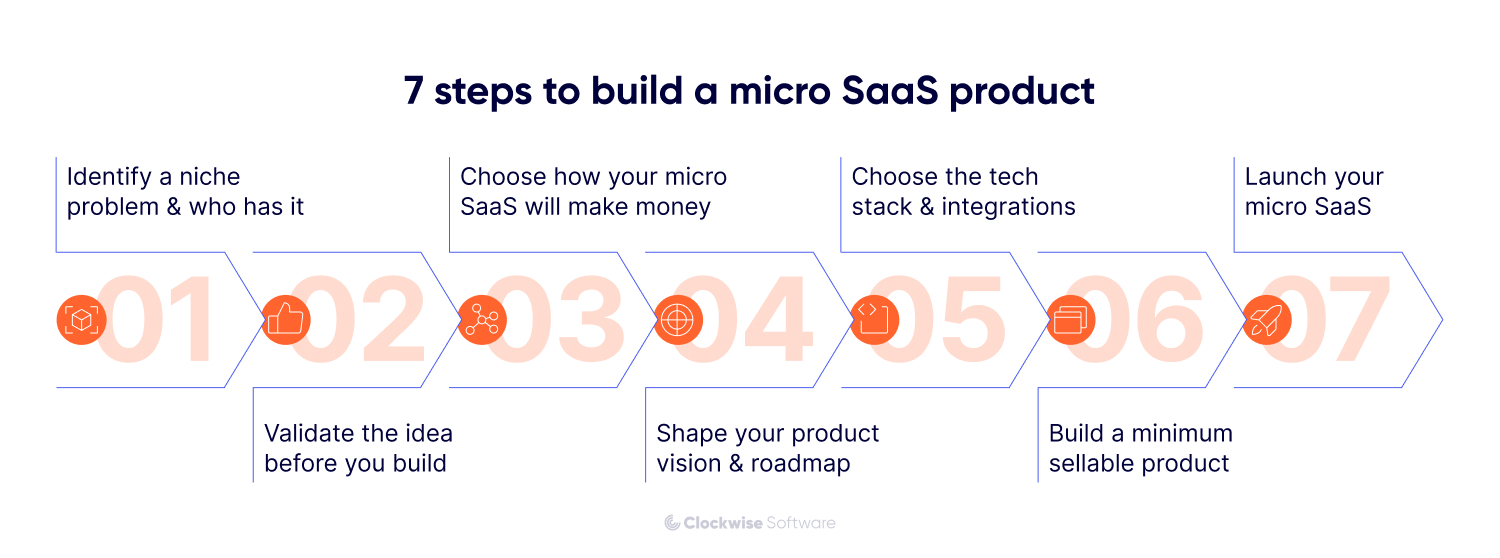
To create a profitable product, you need to make sure it can bring value to users. Thus, to come up with micro SaaS ideas, you should start by defining unmet needs and wants.
If you work in a certain niche and have an unsolved issue that slows down your workflow, try to research if other niche players have the same issue. Chances are, your problem will resonate with other businesses too, in which case it makes sense to think about how to solve this problem through a micro SaaS product.
Another way is to focus on your clients' requests or feedback on your services. Do clients have needs you aren't currently covering? By analyzing feedback and customer interactions with your business or conducting interviews and surveys, you can identify commonly underserved needs.
Naming the problem gets you halfway. The other half is naming the people who have it, and this is where micro SaaS ideas usually come apart.
A label like "freelancers" covers too many people to be useful. "Freelance video editors who bill by project and chase late payments" works, because you can find 200 of them in 2 afternoons and ask them questions.
The size of that group also sets a ceiling on your revenue, so it deserves a rough number before you go further. A product for 400 companies paying $200 a month has a different shape from a product for 40,000 people paying $15 a month, and the difference shows up in your pricing, your support load, and how you reach the first customers.
A problem that annoys people is a different thing from a problem people pay to remove. Slow-loading dashboards annoy everyone, but few will pay to fix them. A freelancer who keeps missing invoice deadlines and losing money will pay the day you show them a tool that stops it. Plenty of micro SaaS products are built on a real complaint that nobody ever budgeted for.
A few days of testing here saves you the months you would otherwise spend building something nobody buys. The tactics below cover most of what you need to do to validate the demand:
Be honest about what these tell you. A landing page with 80 signups proves interest at $0, and it says little about whether those people will still pay in half a year.
Pre-selling is the only tactic here that tests real willingness to pay, and it’s also the hardest to run, because you have to describe the product convincingly while it exists only as a plan.
Pricing decides more about a micro SaaS business than the feature set does, and setting it thoughtfully at the start is easier than changing it later. These models cover most niche products, and each asks something different of you:
Flat subscription. The simplest to build and the easiest for buyers to understand: one price, one plan, and monthly recurring revenue you can forecast. It works when usage per customer stays roughly even, and it breaks when one customer uses 30 times more than another, since your costs follow that usage while your income stays flat.
Usage-based pricing. What you charge tracks what customers consume: records processed, reports generated, documents read. Your margin holds as usage grows and small customers get a low entry price. The cost is complex, because you need metering you can defend when someone questions their bill, and your revenue gets harder to forecast month to month.
Freemium. A limited version brings people in, and you charge for the part they come to depend on. This is the engine behind product-led growth, and it works when your free tier costs almost nothing to run. In a narrow market it frequently fails on arithmetic: converting 3% of free users needs a large top of the funnel, and a niche with 400 potential buyers cannot supply one.
Per-seat pricing deserves its own warning. It scales well when your market holds 40,000 companies, because each customer grows on their own and your revenue grows with them. In a market of 400 companies, most with 3 or 4 people who would use the tool, per-seat pricing caps your revenue at a number you can calculate in advance. It also pushes small teams to share a single login instead of paying for each seat, which lowers that number further.
Keeping customers is cheaper than finding new ones in a market this size, which turns support quality and product reliability into revenue questions.
Once the problem, the audience, and the pricing model are settled, you can work out what the product does. The next questions decide most of it, and the answers go straight into your requirements:
Will the product live inside a platform your users already pay for, or stand on its own? A Shopify app, Chrome extension, or Slack add-on gets you into that platform's marketplace, where some customers find you without any marketing, though the platform takes a cut and sets rules you have to follow. A standalone product with its own login means finding every customer yourself, with nobody able to change your terms.
What is the smallest set of functionality that covers the need properly? Every feature past that point extends the timeline of your launch and adds something to maintain.
What actions does a user take to finish the job your product exists for? Write the sequence out step by step. This is what tells you which screens you need, and it usually turns out to be fewer than you expected. Walking the path also shows you what each step requires, so you can define the requirements for every feature while the flow is still in front of you.
Which SaaS security measures apply to you? A product holding client records or financial data carries requirements that a scheduling tool avoids, and adding them after launch risks more than money — it puts user trust and industry compliance on the line.
Answering those gives you the architectural direction, the functionality list, the user flows, and the risks worth planning for. Document it in an app requirements document, which your development plan and your estimates both depend on.
Once the product vision is documented, you decide how to build it. The tech stack comes first.
Front end. We use React on most of our SaaS projects, since the component structure keeps a small product easy to extend. We move to Next.js when the public pages that sell the product — the homepage, pricing, and blog — belong to the same codebase as the application itself. Vue and Angular both appear in our work, and the choice there usually follows what a client's existing team already maintains.
Back end. Node.js covers most micro SaaS work well, since these products spend their time moving requests between a database, an interface, and a few third-party APIs. We also build on Laravel and Ruby on Rails, and the choice usually follows what the team maintaining the product afterward already works with or prefers.
Architecture. Multi-tenant is the right default for a micro SaaS product. One application instance and one database serve every customer, with tenant identifiers keeping their data apart, so your hosting bill stays roughly flat as customers arrive. Single-tenant means a separate instance per customer, which multiplies your deployment and maintenance work, and it becomes the correct choice when a client's compliance requirements demand their data to stay in isolation.
Infrastructure. We use AWS on most projects, but the actual choice depends on what our client already uses. Our recommendation is AWS unless your team already runs on something else, because staying where your people know the tooling costs less than a migration.
Integrations. Which ones you need depends entirely on what your product does, and that list comes out of your requirements. For a micro SaaS product, use an existing service wherever one exists, because building your own authentication, file storage, or email delivery costs you weeks on problems other companies have already solved. Save your development budget for the features customers actually pay for. As for billing, Stripe handles it on nearly every SaaS product we build.
You can create a proof of concept to test the technical feasibility of your product implementation with the chosen tech stack. We ran one for Releasd, a PR reporting platform used by various brands (including the BBC and Renault): one month to prove their AI-generated reporting worked against real data and acceptable response times, then the full scope. A month spent proving feasibility costs less than 4 months spent discovering the opposite.
Releasd case

On Releasd the risk was whether AI-generated reporting held up against real client data at a response time people would tolerate. We built the smallest thing that could answer that question and nothing else. If the numbers had come back wrong, the client would have lost a month instead of a release.
You also need a development plan that ties back to your product vision. Decide which features move you toward that vision first, set a timeline for each stage from design to testing and launch, and document it so you can track progress against where the product is meant to go.
Everything described so far happens before development begins, and a discovery phase covers all 4 steps as one engagement: the problem and audience, the demand check, the pricing model, then the requirements, architecture, and tech stack your build depends on.
What you receive depends on what you need. The full set includes a feature map with a scoped first release, technical recommendations, a delivery plan with named risks, and a budget you can plan against, and we agree that scope with you before starting. Deciding what to leave out costs almost nothing at this stage and gets expensive once development runs, which is why our discovery work saves our clients $30,000 on average in rework.
Discovery also works on its own. You leave with a plan you can hand to any development team, including your own.
With well-defined project requirements and a development plan, you can create an MVP.
An MVP is a version of your product that contains enough features for users to complete a task and for you to test your business hypothesis. Its main purpose is to develop and launch a product early so you can gain user feedback, validate your idea, and decide what direction to take.
For a micro SaaS product, the audience is small and every person in it is a potential paying customer at launch. That changes the scoping question from what the smallest working version is to what the smallest sellable version is.
A working version lets a user complete the core task with some rough edges. A sellable version does that core job completely enough that a user will pay for it without hesitation. That's the real line between the two: whether the core value is finished enough to charge for.
Everything else gets cut and recorded for later. A common pattern is that the features founders argue hardest to keep in the first version turn out to be the ones nobody opens in the first quarter. Reporting dashboards, bulk operations, and integrations with tools the first customers do not use yet all show up on that list.
As for the development process, we use AI-assisted development on our own projects, and it changes what fits inside a small budget. Our engineers generate boilerplate, test coverage, and repetitive interface work with AI tools, which frees their hours for high-impact work around architecture, data model, integrations, and security.
With a developed MVP, you can finally enter the market. You can start to promote your app before its release using social media, email, industry-specific communities, and other channels. Pick the channels you can work properly with the marketing budget you have. Also, it's helpful to decide in advance on metrics to measure your success.
Once your app is launched, your main task is to monitor its performance and user feedback to understand what you should do further to ensure its success. Sometimes the idea proves weaker than expected, and that becomes a signal to change direction and find another way to solve the problem.
If your app performs well, you can plan further development based on user feedback. At the same time, you need to react quickly to any issues your users encounter in your app (and they will, because no MVP is perfect), provide quality customer support, and fix bugs.
Maintenance and improvement is the last stage of SaaS development, but it never really ends. You need to monitor and maintain your product's performance and release updates from time to time to ensure a great user experience and, therefore, customer retention and loyalty. Due to the small scale of the project, a micro SaaS app won't require all your time, and if you use IT services outsourcing, your development team can handle product maintenance.
Let’s say your micro SaaS product is gaining traction: you’ve attracted users, customer churn is low, feedback on your product is great, and users ask about additional features. At this point, you can start thinking about turning your micro SaaS app into a full-featured product.
Can you do it? Yes, and it is perhaps one of the best options to grow a successful full-fledged SaaS product. Why? Rob Walling, serial entrepreneur and co-founder of startup accelerator TinySeed, explains it best:
"The genius of niches is they are too small for large competitors, allowing a nimble entrepreneur the breathing room to focus on an underserved audience. Once you’ve succeeded in that niche, you can leverage your success to establish credibility for your business to move into larger markets."
What actions does such transformation require? Here are three steps to take:
Rethinking your product vision and creating a product roadmap
You should begin with a discovery phase. It involves analyzing competitors and users, identifying additional needs you want to cover, planning new functionality, and deciding on changes in your SaaS application architecture to match the new app requirements.
With a new product vision, you can create a product roadmap: a plan for how you want to improve and grow your product over time. Based on this information, you can create a detailed development plan.
A discovery phase is essential for ensuring a smooth development process and reducing possible risks. It allows you to start your product transformation with a clear project vision, an understanding of necessary changes, and a structured development plan.
Expanding the software development team
To effectively handle the growing scope of work, you will need to expand your team.
If you’re already outsourcing micro SaaS development, your vendor will expand the team to match the project scope.
If your product was initially developed by in-house developers, you can hire new specialists or choose a software development company and outsource the entire scope of development to them. This option is great, as you don’t need to worry about recruiting new specialists each time the project scope grows — your vendor will take care of scaling the team up or down according to your project needs.
Re-estimate required investments
Building a full-featured SaaS app requires more investments than building a micro SaaS app. With new project requirements, you can estimate your budget and understand if you can fund product development by yourself. If not, you can consider finding external investment from venture capital firms or independent investors.
Turning a micro SaaS product into a full-fledged company requires some effort and additional expenses, so this process should be well-structured and planned. We recommend involving a business analyst and software engineers in the planning. A business analyst will advise you on the best way to improve your product and help with creating project documentation, while a software engineer will help with choosing the right architectural approach and technology stack.
Most micro SaaS products that fail do it for reasons you can name in advance. These are the ones we see repeatedly, either in projects that reach us after a rough start or in products that never find their first customers.
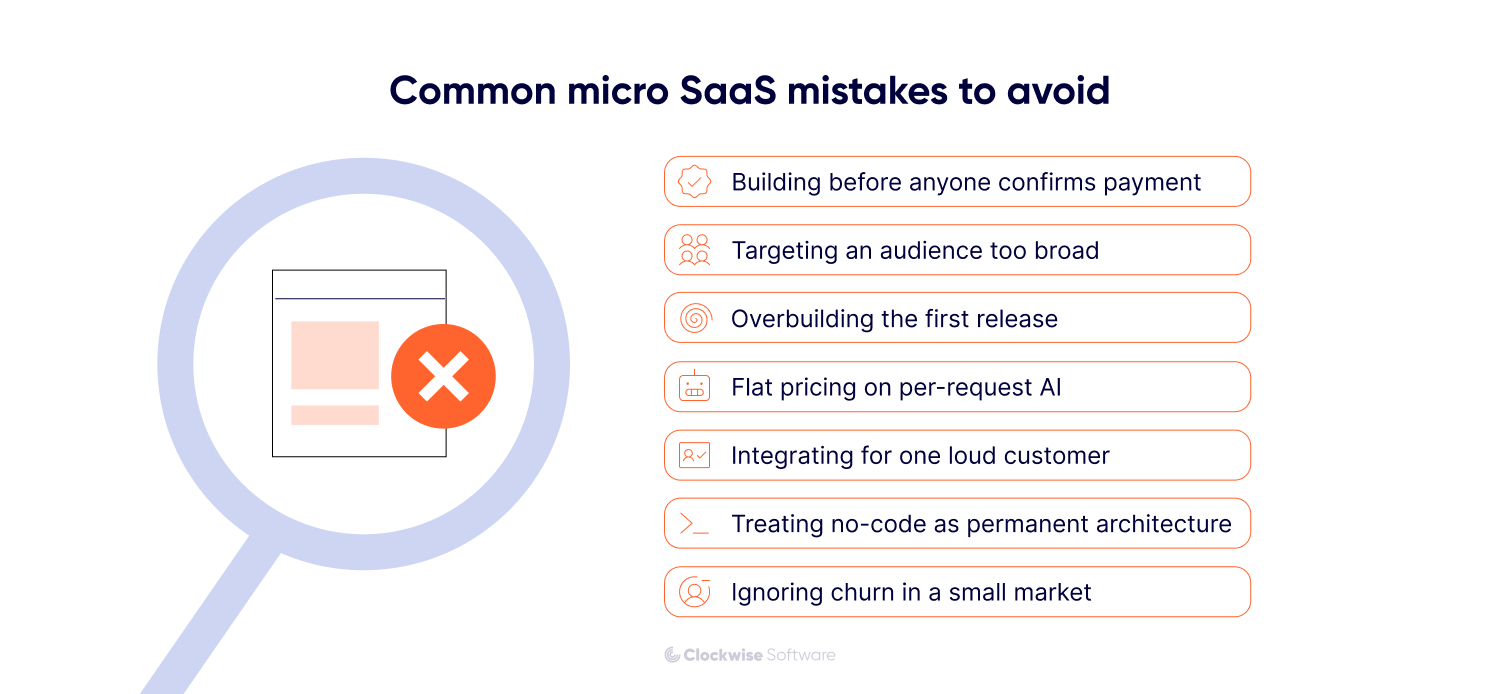
None of these are unusual, and most of them cost money at the point where you have the least of it.
Building a micro SaaS works when the problem is narrow, the people who have it are easy to find, and the price covers what it costs to run. Everything else follows from those 3 things.
If you have an idea and nothing else yet, start with the cheapest step available. Read the complaints about tools your target users already pay for, then put up a page with your price on it and see who leaves an email. That week tells you more than a month of planning.
If demand is already confirmed, the decisions that matter are scope, build approach, and pricing. All 3 are cheap to decide now and costly to change once the product is built on top of them.