AI solutions
What we do
Services
Experts in
How we work


















Cut manual work, reduce routing errors, and keep labor hours in check. We build algorithms to automate paperwork and invoicing, routine tasks in dispatching, and rerouting based on traffic and delays. Your team gets less repetitive work and can focus more on high-impact tasks that require human judgment.
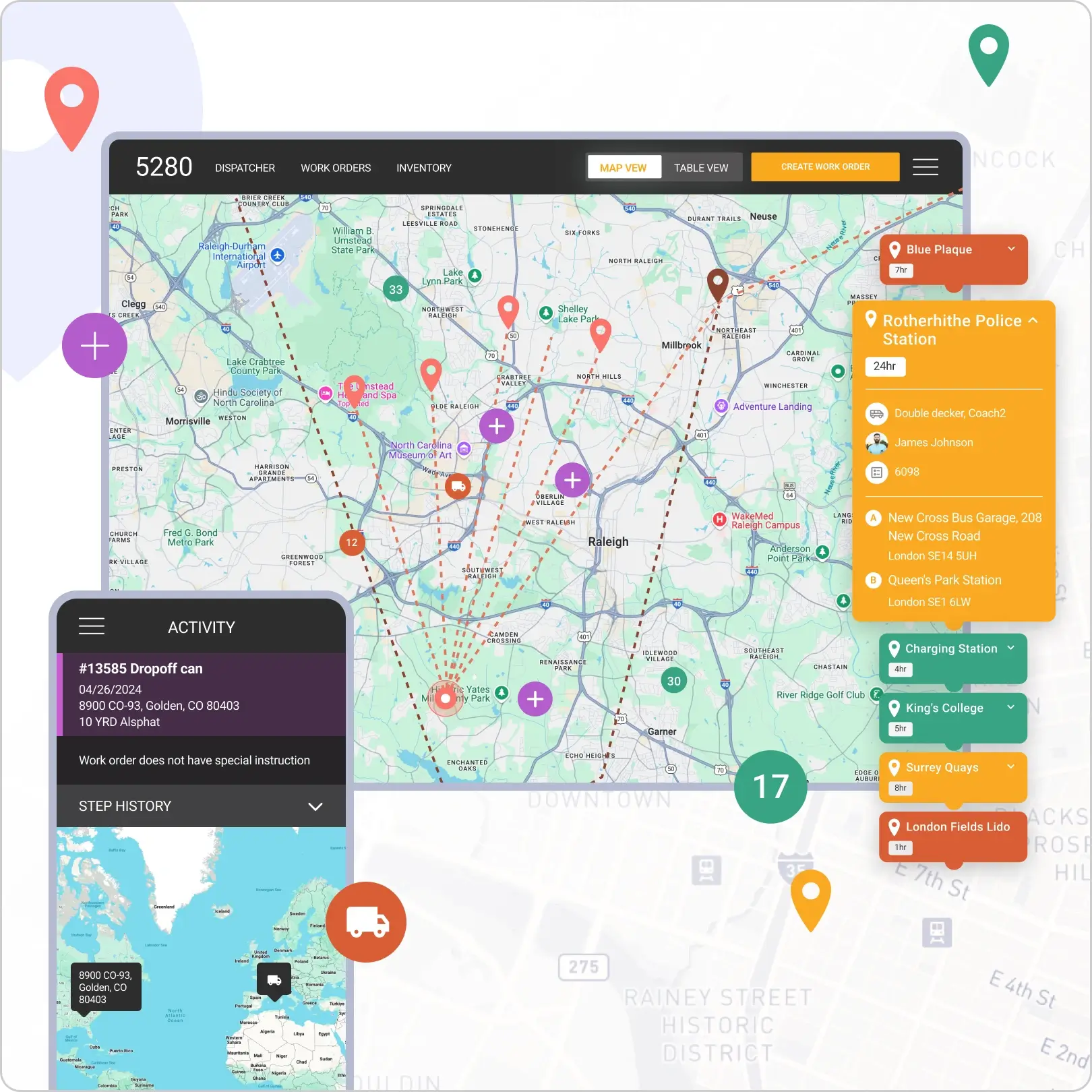
See what’s happening across your network the moment it happens. Delays, bottlenecks, ETA shifts —everything is visible in one place. Telematics data, GPS signals, and sensor inputs feed the system in real time, helping your team spot issues early and respond before they escalate.
Drivers, dispatchers, warehouse teams, managers — everyone gets tools built around their daily work. Intuitive mobile interfaces for drivers, unified functionality for dispatch, and structured dashboards for managers and leaders. Each role gets the tools it needs, tuned to simplify its workflows.
Make your data a driver of your decisions. Add functionality to analyze past delivery patterns, traffic, delivery loads, and drivers’ performance to spot risks and mitigate them faster, plan better, and optimize fleet usage.
We build your platform based on your workflows, roles, and logistics routines. Routing rules, task flows, feature placement on a screen, everything is made to fit how your team operates. Our business analyst will help translate your needs into clear system requirements, and we will anchor development to them.
Our coding standards, efficient CI/CD pipelines, and QA with 95-100% test coverage result in stable, reliable software.
From sprint one to release, you have full visibility into code and progress, with regular updates, budget reports, and demos.
Our projects run with <10% CPI/SPI variance, giving predictability to plan budgets, roadmap, and scaling around.
We connect to your ERPs, TMS, WMS, and telematics with a clean integration layer. Your operations won’t be disrupted.











Our clients seen $100K savings in the first year using a platform we delivered. Well-thought-out functionality, solid infrastructure, and great interoperability result in tangible gains.
We worked on integrations in 90% of our projects, connecting ERP, CRM, telematics, maps, and more. Whether it’s a well-documented Azure Maps API or a custom tool, we will assess them at the start and choose an optimal integration approach to match your needs.
Building 10+ platforms taught us to spot hidden gaps others miss. We close them with functionality that reduces handoffs by 80% and makes processes up to 3 times simpler.
From 50+ interfaces built for drivers, operators, and dispatchers, we bring proven patterns that drive 94.12% user satisfaction and minimize support needs: some clients reported they got just 1 support ticket in 6 months.
Want to offer your solution to multiple clients under their own branding? We design the architecture that will unlock this opportunity for you: multi-tenancy, subscription logic, rebranding capabilities, and customer management features.
Yes. We integrate custom logistics platforms with GPS trackers, telematics providers, ERP, WMS, TMS, payment gateways, and partner systems. In 90% of our projects, we’ve connected third-party services, from well-documented solutions like Azure Maps to clients’ custom internal tools. During discovery, we identify the required integrations and design reliable data flows so the platform works smoothly with your existing ecosystem and can support new providers as your operations grow.
Our logistics software development company builds cross-platform solutions with shared business logic so the core system works consistently on both Android and iOS, while still supporting device-specific capabilities where needed, such as background GPS tracking, camera access for proof of delivery, or push notifications for dispatch alerts.
Across our logistics software development services projects, we've built 50+ role-specific interfaces for drivers, operators, and dispatchers. This focus on usability is a key reason our logistics platforms maintain 94.12% user satisfaction, with some clients reporting as few as 1 support ticket over 6 months after launch.
Head of delivery

We’ve launched 10+ logistics apps with less than 10% CPI/SPI variance, from fleet tracking dashboards to full-scale warehouse platforms.

Most of the complexity we deal with comes from things that aren't in any API documentation. Vehicle profiles, loading dock hardware, sync delays from GPS providers. We spend time early on mapping those constraints so development doesn't stall halfway through when someone discovers the route planner doesn't know about a weight limit.
Most of the complexity we deal with comes from things that aren't in any API documentation. Vehicle profiles, loading dock hardware, sync delays from GPS providers. We spend time early on mapping those constraints so development doesn't stall halfway through when someone discovers the route planner doesn't know about a weight limit.
Most of the complexity we deal with comes from things that aren't in any API documentation. Vehicle profiles, loading dock hardware, sync delays from GPS providers. We spend time early on mapping those constraints so development doesn't stall halfway through when someone discovers the route planner doesn't know about a weight limit.
Most of the complexity we deal with comes from things that aren't in any API documentation. Vehicle profiles, loading dock hardware, sync delays from GPS providers. We spend time early on mapping those constraints so development doesn't stall halfway through when someone discovers the route planner doesn't know about a weight limit.
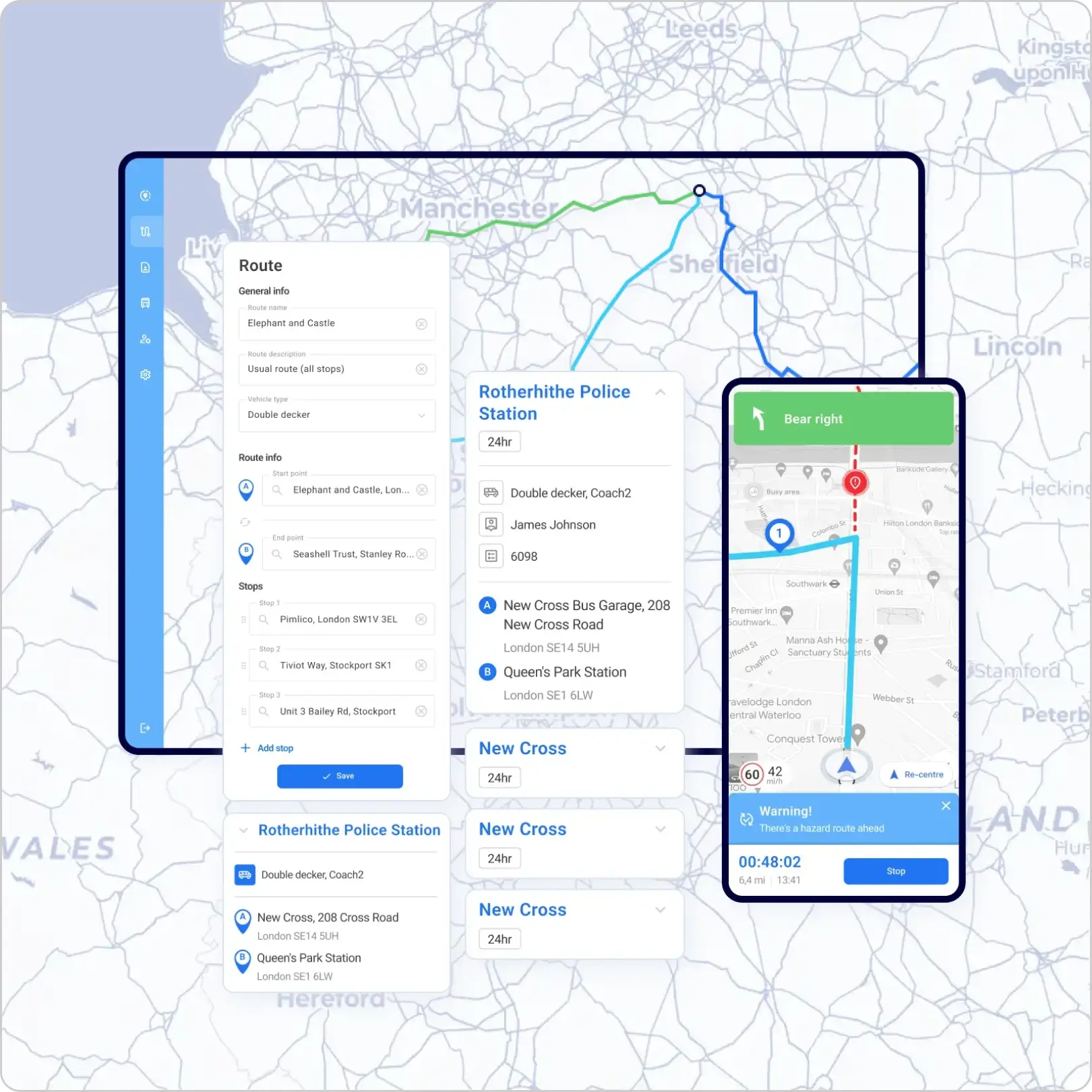
Our logistics software development company builds routing engines that go beyond standard point-to-point navigation. Using advanced mapping services and GIS databases, we calculate paths based on specific vehicle profiles, like height, weight, length, axle load, and factor in road-level constraints like low bridges, weight limits, and HAZMAT restrictions.
The system recalculates routes dynamically as conditions change, helping prevent accidents, costly delays, and unrealistic ETAs. AI-assisted custom logistics software development workflows help our engineers cover more edge cases in routing logic by accelerating API research and test scenario generation before the platform goes live.
Most of the complexity we deal with comes from things that aren't in any API documentation. Vehicle profiles, loading dock hardware, sync delays from GPS providers. We spend time early on mapping those constraints so development doesn't stall halfway through when someone discovers the route planner doesn't know about a weight limit.
We build event-driven ingestion pipelines that process continuous streams of GPS coordinates, speed logs, and engine diagnostics without overwhelming the database or creating tracking blind spots. Using lightweight communication protocols and managed data queues such as Redis and Amazon SQS, our logistics software development company keeps fleet data flowing reliably even under high load.
Plus, we can configure backend geofencing that triggers instant alerts when a vehicle deviates from its assigned corridor or enters an unauthorized zone. On a fleet management platform serving London’s #1 bus operator, this architecture supported near-zero-latency tracking, instant alerts, and 99.9% system uptime with minimal infrastructure overhead.
Most of the complexity we deal with comes from things that aren't in any API documentation. Vehicle profiles, loading dock hardware, sync delays from GPS providers. We spend time early on mapping those constraints so development doesn't stall halfway through when someone discovers the route planner doesn't know about a weight limit.
During custom software development for logistics , we replace manual stock tracking in return and consignment cycles with automated pipelines that follow inventory through every state: shipped, tried, returned, kept. The system integrates with shipping APIs to generate return labels, reconciles warehouse check-in scans with client records, and triggers condition-based billing for unreturned or damaged items automatically.
This eliminates the manual reconciliation that can easily cause inventory discrepancies and revenue leaks in reverse logistics.
Most of the complexity we deal with comes from things that aren't in any API documentation. Vehicle profiles, loading dock hardware, sync delays from GPS providers. We spend time early on mapping those constraints so development doesn't stall halfway through when someone discovers the route planner doesn't know about a weight limit.
We integrate logistics platforms directly with industrial hardware (weighbridge sensors, RFID scanners, barcode readers) to remove manual steps at loading docks and dispatch points. The system captures vehicle weight, validates it against order capacity, generates shipping manifests, and dispatches the driver via mobile app without paper handling.
On platforms where our logistics software development company implemented this approach, truck queue times dropped by up to 75% and weight-based invoicing errors were eliminated.
Most of the complexity we deal with comes from things that aren't in any API documentation. Vehicle profiles, loading dock hardware, sync delays from GPS providers. We spend time early on mapping those constraints so development doesn't stall halfway through when someone discovers the route planner doesn't know about a weight limit.
Track maintenance, fuel usage, and driver schedules. Keep your fleet operating without surprises.
From order in to delivery confirmation, automate the workflow and cut out manual entry.
Track shipments, vehicles, and operations as they happen with telematics. Complete visibility across your supply chain.
Smart routing that factors in traffic, delivery windows, and vehicle constraints. Less fuel, faster deliveries.
Connect your ERP, WMS, TMS, and telematics to avoid data silos and gaps in your operations
Customized maps and turn-by-turn navigation tuned to your fleet’s restrictions, load limits, and delivery windows.
Head of Client Relations

You won’t fight specs or send endless change requests. A 99.89% acceptance proves we deliver what was agreed.
Let AI models recalculate routes instantly when conditions change. Keep deliveries on track despite traffic or delays.
Predict traffic patterns with AI-powered analysis of your delivery routes. Avoid congestion before your drivers hit it.
Let AI flag operational issues early: detect fuel spikes, route deviations, and unusual patterns faster.
Automate invoice matching with AI trained on your data. Cut reconciliation time and reduce billing disputes.
$15,000 to $50,000
Minimize risks and build a small-scale prototype
$50,000 to $100,000
Launch your logistics software with minimal initial investments
$100,000 to $500,000
Launch a monetization-ready app for the transportation industry
$500,000+
Prepare to beat your transportation competitors right away
The two most common logistics software development services models are end-to-end development and dedicated teams. Each supports a different level of involvement and long-term planning.
End-to-end development works well when you need one partner to manage the full cycle, from discovery through launch. We take ownership of coordination, timelines, and quality, keeping CPI/SPI variance under 10% across 10+ logistics platforms delivered this way.
Dedicated teams fit companies that already have product leadership and need consistent engineering capacity. Developers follow your priorities and scale as needs change. Our average engineer tenure on a project is 3.3 years, which means less context loss and faster delivery over time.
Logistics software development services timeline depends on scope, integrations, and operational complexity. A logistics platform covering core workflows, such as dispatching, route planning, and order tracking, with basic integrations can typically be delivered within 6 months.
More advanced logistics software solutions with real-time telematics, multi-fleet management, analytics, and connections to ERP, WMS, or TMS take longer. Discovery helps define the scope, identify technical constraints, and set realistic milestones. During development, AI-assisted workflows can accelerate routine tasks such as API research, test generation, and documentation, allowing engineers to focus on high-value tasks and decisions.
Custom logistics software solutions are built around how your operations actually work. Instead of forcing your team to adapt to generic tools, the system reflects your workflows, roles, and business rules, covering the exact features you need and avoiding unnecessary complexity.
This approach reduces manual work, improves visibility across routes, warehouses, and fleets, and supports automation where it has the biggest operational impact. Because the platform is designed specifically for your setup, it integrates cleanly with existing systems such as ERP, WMS, TMS, and telematics. As operations grow, the software scales with your processes, helping you maintain efficiency, accuracy, and control over the long term.
Logistics software development services usually cover the full delivery cycle, starting with discovery and preparation. During this stage, teams clarify business goals, workflows, data sources, and technical constraints to define a clear scope and avoid issues later in development.
The process then includes system architecture design, development, testing, and deployment. Most vendors also handle integrations with telematics platforms, ERP, WMS, TMS, and third-party APIs to ensure data flows smoothly across systems. After launch, logistics software development services often continue with post-release support, performance tuning, and updates, helping the platform remain stable, secure, and reliable as operational demands grow.
Choose a partner with proven experience in your field and high-load systems. Logistics platforms often involve complex workflows, real-time data, and multiple integrations, so hands-on experience in similar environments makes a real difference.
Look for a logistics software development company with clear delivery processes, strong integration expertise, and a solid understanding of operational risks. A reliable partner explains technical trade-offs upfront, plans architecture with scalability in mind, and shows how they maintain data accuracy and system stability in live logistics environments. Evidence such as case studies, measurable results, and transparent communication practices helps confirm that the team can deliver predictably and at scale.
Yes, as long as scalability is planned from the start. A well-designed logistics system relies on modular architecture, stable data flows, and clear boundaries between services, so growth does not introduce structural problems.
This approach allows the platform to handle more users, vehicles, orders, and data volume without reworking core logic. New features, integrations, or regions can be added incrementally while existing operations keep running. By designing for scale early, the system reduces the risk of downtime, performance issues, or costly architectural changes as logistics operations expand.
You can avoid vendor lock-in by establishing clear ownership and transparency from the start. This includes retaining full rights to the codebase, design assets, documentation, and infrastructure access, so the product never depends on a single vendor’s environment or tools.
Using standard, widely supported technologies also makes the system easier for another team to maintain or extend in the future. A reliable logistics software development company designs systems with clean architecture and clear documentation, and prepares a structured handover process. This ensures the platform can be transferred to another vendor or internal team without disrupting live logistics operations.
Software quality after launch depends on continuous monitoring, regular updates, and structured QA practices. Teams track system performance, data accuracy, and error rates to spot issues early, before they affect daily logistics operations.
Planned updates follow clear validation steps, including automated testing and pre-release checks, to ensure new changes do not introduce regressions. Staged deployments and defined rollback procedures provide additional safety, allowing teams to respond quickly if an issue appears in production. Together, these practices help keep the logistics platform stable, reliable, and ready to support ongoing operational growth.
AI brings the most value to logistics software when it improves everyday operations rather than adding complexity. Common use cases include route optimization that accounts for traffic, delivery windows, and vehicle constraints, as well as demand forecasting that helps plan capacity and reduce last-minute changes.
AI can also support predictive maintenance, automated dispatching, and anomaly detection, such as identifying unusual fuel usage, route deviations, or delivery delays early. When applied to real operational data and existing workflows, these capabilities help reduce costs, improve reliability, and enable faster, data-driven decisions across logistics operations without disrupting established processes.
Yes. Custom logistics software is often designed to consolidate several disconnected tools into one unified platform. Instead of switching between separate systems for routing, tracking, invoicing, reporting, and communication, teams can manage daily operations from a single interface built around their workflows.
By centralizing data and automating handoffs between processes, custom software reduces duplicate data entry, inconsistencies, and manual coordination. This not only simplifies day-to-day work for drivers, dispatchers, and managers, but also improves visibility and control across the entire operation. Over time, replacing multiple tools with one tailored platform helps lower operational costs and makes scaling easier as logistics needs grow.
The main cost drivers in logistics software development services are scope, integrations, and operational complexity. Features such as real-time tracking, route optimization, telematics, analytics, and role-based access require more engineering effort than basic workflow automation.
Integrations also have a significant impact on cost. Connecting ERP, WMS, TMS, telematics providers, payment systems, or custom internal tools increases complexity, especially when data needs to stay synchronized in real time. Other factors include UI requirements for different roles, supported platforms and devices, security standards, and scalability needs.
We help small and mid-sized logistics businesses scale without adding headcount. Automate routing, invoicing, dispatching, and tracking, and get a platform that is ready to grow with you.
Handle complexity at the scale your operation demands. We architect platforms that manage multiple facilities, thousands of daily orders, diverse fleets, and integrate with your existing systems.