
Any questions unanswered?
Let's discuss them


Since 2014, we’ve been providing logistics software development services to businesses with diverse operational needs: route planning, fleet tracking, dispatch operations, and integration with transport management tools.
One of the first questions any team asks before starting a logistics software project is how much development will actually cost. This is a basic and unavoidable part of planning, yet many guides still stop at “it depends,” offering little help for making real budget decisions.
Luckily, we’ve built enough logistics apps to share with you a realistic view of costs.
In this article, we break down the main cost drivers in logistics app development and outline realistic budget ranges for different levels of functionality. We will clarify where the budget goes and why, so project planning can be based on clear assumptions.
Before getting into individual cost drivers, it’s useful to start with a baseline view of logistics app development cost. Based on our experience delivering logistics software, most projects fall into one of three categories depending on scope and functionality.
The ranges below are meant to set realistic expectations. They assume custom development, production-ready quality, and an architecture designed for long-term use and growth.
Approximate cost: $50,000–$200,000
A basic logistics app or MVP focuses on a narrow set of workflows. This might be an internal dispatch tool, a simple order management module, or a pilot version of a logistics product used to test assumptions with real users. At this stage, the goal is to validate the idea with real users and see whether the app actually delivers the results you expect, before committing to a larger system.
Approximate cost: $200,000–$300,000
Most logistics products that are ready for real operational use fall into this range. These platforms usually support several user roles, provide real-time tracking, connect to third-party services, and offer a more complete user experience. They are built to manage daily operational load and to expand as the business grows.
Approximate cost: $300,000+
This category includes logistics platforms that support complex, high-volume operations. They typically involve real-time data processing, advanced routing logic, multiple integrations with systems like TMS, WMS, ERP, or telematics, and stronger security or compliance requirements. Because these systems often support mission-critical workflows, they require careful architecture and long-term support planning.
These numbers reflect how scope translates into real engineering effort across discovery, development, and testing.
Next, let’s look at the key factors that drive logistics app development cost, and how logistics-specific requirements shape the final price.
Logistics software costs are shaped by more than just “number of features” (but it’s still one of the factors). What also drives the budget is how those features behave in real-world logistics operations, where systems must work with live data, multiple stakeholders, and external services.
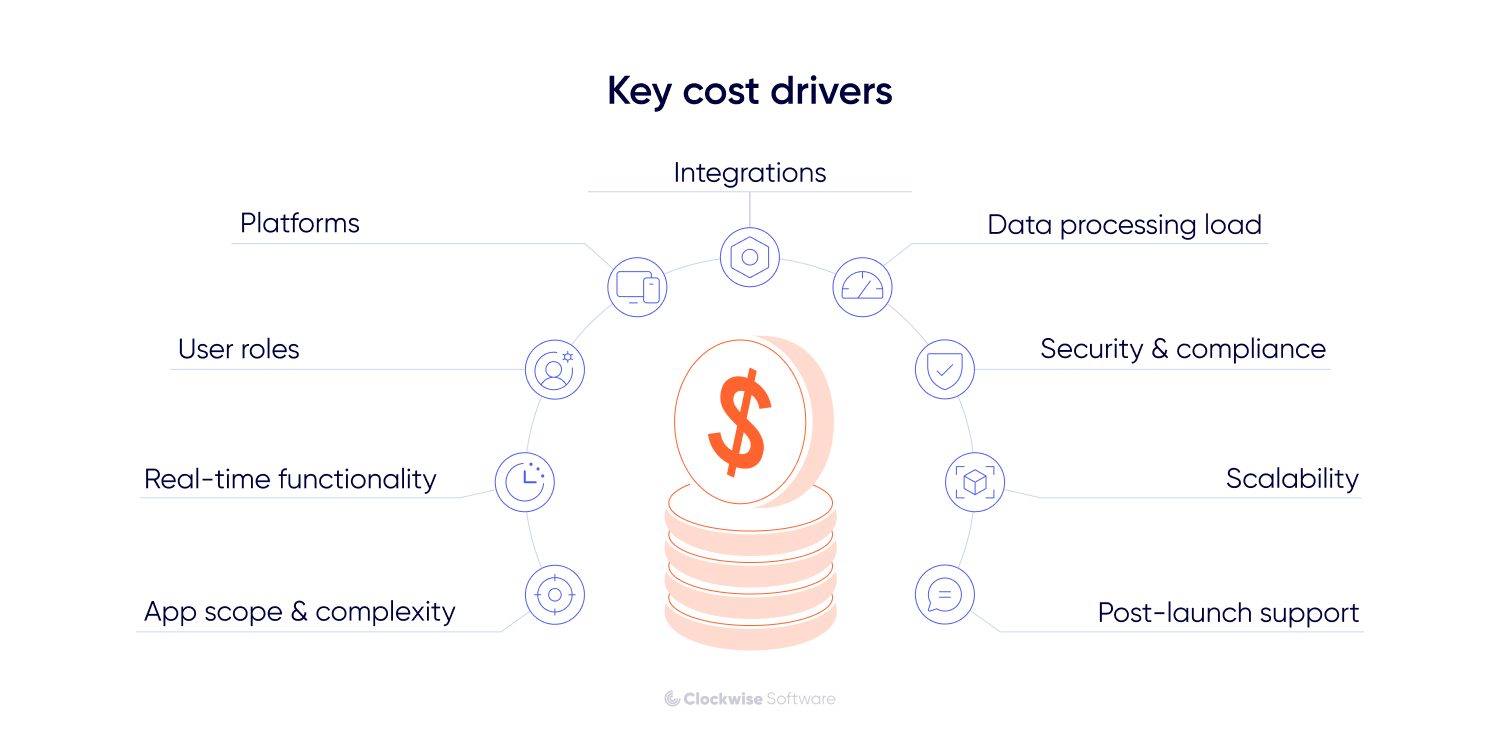
A simple internal logistics tool with a single workflow is very different from a platform that coordinates drivers, dispatchers, warehouses, and customers across the supply chain in real time. Complexity grows quickly as soon as the app must support:
Multiple user roles with different permissions
Real-time updates for orders, vehicles, or routes
Workflows where delays or errors directly affect deliveries, fleet usage, and customer commitments
Adding features like live tracking, dynamic status updates, or exception handling (such as delays, route changes, or failed deliveries) also raises backend complexity compared to a static order management system.
As the scope expands, the demands on architecture, testing, and monitoring grow as well, and those demands become a direct driver of logistics app development cost.
How you choose to deliver the product has a direct impact on the timeline and budget. The main decisions for logistics software development companies involve whether the system is web-only or includes mobile apps, whether mobile development is native or cross-platform, and whether the product is meant for internal teams or for customers.
A dispatcher-facing web dashboard is usually straightforward to build. Adding mobile apps for drivers. especially with offline mode, GPS tracking, and background data sync, introduces significantly more design, development, and testing work. Supporting multiple platforms also increases long-term maintenance, and that needs to be reflected in the logistics mobile app development cost from the start.
Functionality such as live vehicle tracking, traffic-based route updates, real-time order status changes, and inventory management notifications depend on stable data pipelines, background processing, and careful performance tuning. These systems need to operate reliably under load and often process thousands of updates per minute.
Compared to standard CRUD applications, real-time logistics systems require significantly more engineering effort and infrastructure, which affects both development and ongoing operational costs.
Most logistics apps rely on integrations with external services such as:
Maps and routing providers
GPS and telematics providers
TMS, WMS, or ERP systems
Payment and accounting tools
Each integration introduces additional complexity. APIs behave differently, documentation quality varies, and error handling becomes critical when external services fail or respond slowly.
Logistics platforms often handle sensitive operational and commercial data, including customer information, delivery locations, financial details, and contractual documentation. Meeting higher requirements for access control, data encryption, audit logs, and overall system reliability adds to the development and testing effort. Systems supporting large fleets or public transportation need even stronger resilience, which further increases logistics app development cost.
Scalability and future growth also play a role in the overall logistics mobile app development cost. Designing for future growth means allocating more infrastructure resources upfront to handle higher load and data volumes, which raises initial costs but reduces long-term migration risk.
Now that we’ve covered the main drivers behind the cost of the logistics app development, let’s look at the different types of apps and what realistic budgets usually look like for each.
Logistics software can take many forms, from simple route planning tools to platforms that support entire operations. Because of that range, costs differ based on what the product is meant to do and how closely it ties into everyday work.
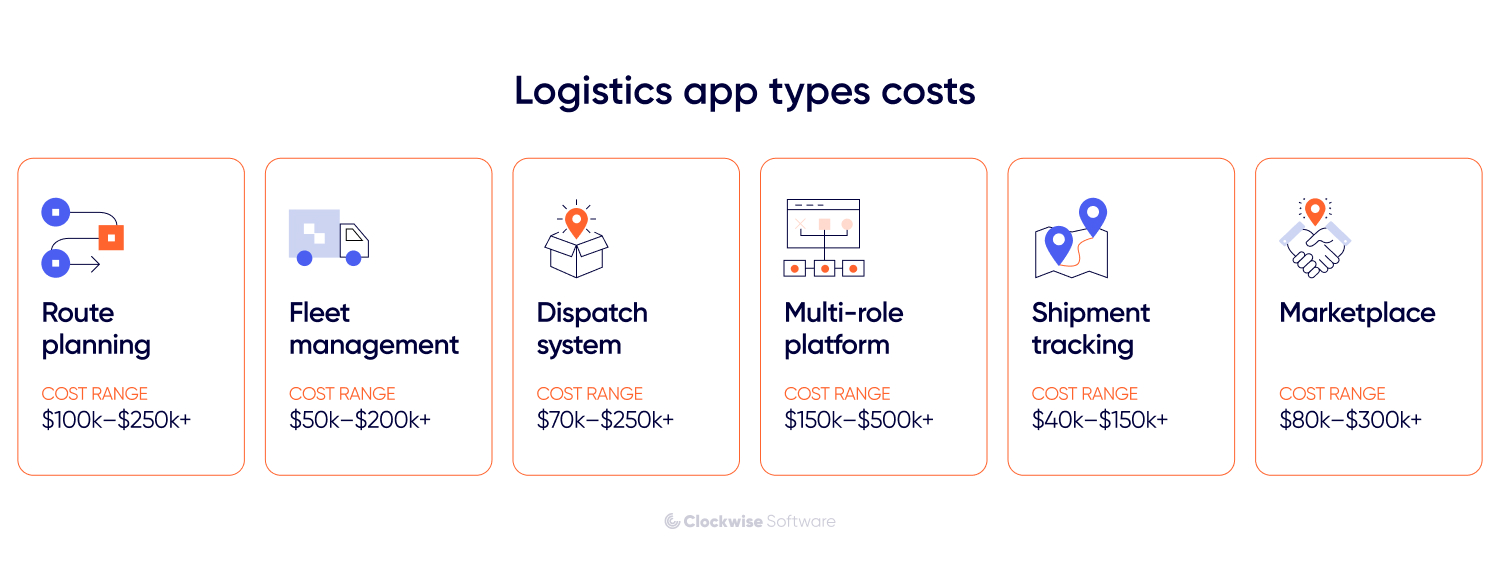
Route optimization apps focus on calculating the most efficient routes based on constraints such as distance, time windows, traffic conditions, vehicle capacity, and delivery priorities. These systems are often used by transportation providers, delivery companies, and public transport operators.
We’ve built route planning solutions with constraint-based routing and real-time updates, and the cost ranges below reflect what similar systems typically require.
Typical MVP scope
Route calculation and visualization
Basic constraint handling
Dispatcher-facing web interface and mobile app for drivers
Integration with map providers
Approximate cost range for MVP: $100,000 – $150,000
Full-featured version may include
Real-time traffic-aware routing
Dynamic route recalculation
Support for large fleets and complex constraints
Analytics and performance reporting
Integrations with fleet or dispatch systems
Approximate cost range for full version: $150,000 – $250,000+
Route optimization software can become expensive quickly because algorithms, real-time data processing, and performance requirements go far beyond standard CRUD functionality.
Fleet management software helps companies monitor vehicles, drivers, and operational metrics in one place. These systems are often the foundation of broader logistics platforms.
Typical MVP scope
Vehicle and driver management
Basic GPS tracking
Status monitoring
Internal dashboards for operations teams
Approximate cost range for MVP: $50,000 – $100,000
Full-featured version may include
Live tracking with frequent updates
Maintenance planning and alerts
Fuel usage and efficiency analytics
Integration with telematics providers
Advanced reporting and access control
Approximate cost range for full version: $100,000 – $200,000+
Logistics app development cost increases as soon as the system must handle real-time data streams, background processing, and integrations with external hardware or APIs.
Dispatch systems sit at the center of logistics operations. They coordinate orders, drivers, routes, and statuses in real time and are often mission-critical for the business.
Typical MVP scope
Order creation and assignment
Dispatcher dashboards
Basic role management
Manual status updates
Approximate cost range for MVP: $70,000 – $120,000
Full-featured version may include
Automated dispatch logic
Real-time order and route updates
Exception handling and alerts
Integrations with ERP, accounting, or warehouse systems
Approximate cost range for full version: $120,000 – $250,000+
These systems cost more because downtime or errors directly affect daily operations and revenue.
At this level, logistics software is no longer a single app. It becomes a platform supporting a wide range of operations and multiple user roles such as drivers, dispatchers, managers, and external partners.
Typical MVP scope
Core workflows for key roles
Shared backend and data model
Admin and operational dashboards
Essential integrations
Approximate cost range for MVP: $150,000 – $200,000
Full-featured version may include
Multiple interconnected modules
Advanced analytics and reporting
Stable performance under high load
Support for multiple regions or business units
Approximate cost range for full version: $300,000 – $500,000+
The cost to develop a logistics management app is higher because these solutions effectively combine several applications into one coordinated system.
Shipment tracking applications focus on providing real-time visibility into deliveries for customers, partners, or internal teams. These apps are often customer-facing and are commonly used by retailers, logistics providers, and manufacturing companies that want to improve transparency without rebuilding their entire operations stack.
Typical MVP scope
Shipment status tracking
Basic location updates
ETA calculation
Customer-facing web or mobile interface
Notification system (email or push)
Single-source integration for shipment data
Approximate cost range for MVP: $40,000 – $70,000
Full-featured version may include
Real-time GPS-based tracking
Proof of delivery (photos, signatures)
Advanced notifications and alerts
Customer portals with shipment history
Multiple system integrations and data synchronization
Approximate cost range for full version: $90,000 – $150,000+
These apps are typically less expensive than core logistics platforms because they focus on visibility rather than operational decision-making. Logistics mobile app development cost increases as soon as real-time data, higher update frequency, or integrations with multiple data sources are required.
Logistics marketplaces connect multiple parties, such as shippers, carriers, and drivers, within a single digital platform. These systems often resemble “Uber-like” models for freight and transportation services.
Typical MVP scope
User registration and authentication for multiple roles
Load posting and search
Basic booking and confirmation flow
Admin panel for moderation and oversight
Basic payments and invoicing flow
Approximate cost range for MVP: $80,000 – $140,000
Full-featured version may include
Real-time matching and availability updates
Dynamic pricing logic
Live tracking and notifications
Advanced payments, invoicing, and settlement flows
Ratings, reviews, and dispute management
Approximate cost range for full version: $200,000 – $300,000+
Marketplace platforms are more expensive than single-purpose apps because they combine multiple user experiences into one system and require complex backend coordination to keep data consistent across all participants. To learn more about these platforms, read our guide on trucking app development.
To avoid mismatches between early estimates and actual costs, it's important for logistics startups to account for the factors that are easiest to overlook and hardest to fix later.
Even seemingly simple connections to external systems can introduce significant complexity. When estimating the cost of the logistics app development, make sure to account for:
Map and routing providers
GPS or telematics platforms
TMS, WMS, or ERP systems
Payment, invoicing, or notification services
Each integration involves more than just API calls. It requires data mapping, error handling, testing, and ongoing support. Ignoring this early leads to unrealistic estimates.
Features such as live tracking, dynamic route updates, and instant status changes rely on background services and continuous data processing. These mechanisms affect backend architecture, infrastructure costs, testing scope, and system monitoring requirements. A logistics app with real-time functionality will always require more effort than a system built around static workflows, and this should be reflected in the estimate.
Most logistics applications support more than one type of user, such as drivers, dispatchers, managers, or customers. Each role adds its own interface, permissions, and workflows. Cost estimation should consider:
Separate user experiences
Role-based access control
Cross-role interactions and dependencies
What starts as a “single app” often becomes several connected interfaces sharing the same backend.
Logistics software usually requires:
Ongoing support and bug fixes
Performance optimization
Infrastructure scaling
Feature iterations based on real usage
Ignoring these factors can lead to budget pressure shortly after release. Post-launch costs are usually estimated separately and not included in the initial digital product development budget, but they’re something you should keep in mind when planning the project.
The most reliable way to approach logistics app development cost is through a structured discovery phase. This is where high-level assumptions are replaced with concrete plans, architecture decisions, and validated scope.
For example, at Clockwise, during the discovery phase we:
Analyze business workflows and edge cases
Define functional and non-functional requirements
Validate technical assumptions
Choose architecture and integration approaches
Break the project into a realistic scope of work
As a result, the estimate shifts from a broad range to a well-grounded budget with clear reasoning behind it.
A well-executed discovery phase helps:
Identify unnecessary features early
Prioritize MVP functionality
Reduce rework during development
Prevent scope creep caused by unclear requirements
This leads to a more predictable development process and fewer surprises later.
For logistics software projects, discovery usually costs $12,000 – $25,000, depending on complexity.
Typical deliverables include:
Product requirements and scope definition
UX flows and wireframes
High-level system architecture
Integration and risk assessment
Phased development plan with cost ranges
In our experience, discovery has been a critical step in complex logistics projects, including route planning solutions, where early validation of algorithms, data sources, and constraints helped define realistic scope and timelines before development began.
Logistics app development cost depends on what the system needs to do, how much real-time functionality it requires, and how directly it supports day-to-day operational workflows. From simple tracking tools to enterprise platforms, each type of solution comes with different technical and budget implications.
The cost to develop logistics apps is driven less by surface-level features and more by the complexity behind them. Real-time processing, multiple user roles, integrations, and scalability all translate directly into engineering effort and long-term support.
Defining the scope early is the most reliable way to plan a budget. A structured discovery phase turns assumptions about how much does it cost to build a logistics app into concrete requirements and produces estimates that hold up during development. If you want realistic numbers for your own logistics project, we can run this discovery process with your team and help you build an estimate you can actually plan around.