
Any questions unanswered?
Let's discuss them


If you want predictable growth, measurable ROI, and scalable customer acquisition, marketing technology solutions are indispensable. Today, your marketing team likely relies on MarTech platforms to run campaigns, track performance in real time, manage leads, and connect data across channels.
But here’s the reality: building a MarTech software that truly scales, integrates cleanly with your existing tools, and delivers measurable business value takes more than connecting APIs. You need clear product thinking, resilient architecture, and engineers who understand how marketing systems behave under pressure.
Since 2014, we’ve built more than 200 digital products from scratch, including over 10 MarTech and AdTech platforms. We’ve developed SMM systems, lead parsing and segmentation engines, PR distribution tools, and full-scale marketing analytics platforms. Some of these products now serve more than 3 million users worldwide.
Over the years, we’ve seen how marketing tech solutions evolve. They start simple. Then the data grows. Integrations multiply. Traffic spikes, AI gets added. If the foundation isn’t strong, the system becomes fragile and expensive to maintain. If it’s built correctly from the beginning, it becomes long-term growth infrastructure.
In this guide, we’ll walk you through what modern marketing technology platforms must include, how we approach architecture and development, what MarTech development services look like step-by-step, and what level of investment you should realistically expect. We’ll help you understand the technical and strategic decisions that determine whether your platform scales or stalls.
Marketing technology solutions are integrated software ecosystems that bring your tools, data, and workflows into a single system, so you can plan, execute, and measure campaigns without switching between platforms.
Today, MarTech goes far beyond automated email service or simple CRM add-ons. If you’re building or scaling a platform today, it typically includes:
Customer data platforms and unified data layers
Multi-channel campaign orchestration
AI-driven personalization engines
Attribution and marketing analytics systems
Lead capture, parsing, enrichment, and routing tools
Social media management and ad optimization platforms
Performance dashboards with predictive insights
The fundamental goal is still the same: to connect marketing activity directly to revenue impact.
What has changed is how marketing technology companies build those platforms. Modern systems are modular, API-first, cloud-native, and increasingly relying on machine learning components to automate decisions and uncover patterns that are hard to spot manually.
When you treat digital marketing tech as infrastructure rather than a collection of tools, you gain control over how your data flows, how campaigns are executed, and how performance is measured.
The global MarTech and AdTech market continues to expand year over year. Recent industry research estimates the marketing technology market at approximately $552 billion in 2025, with projections reaching nearly $2.4 trillion by 2033, growing at an annual rate of around 20 percent. This reflects sustained long-term investment in digital marketing infrastructure.
At the same time, digital channels now account for the majority of marketing spend. Recent industry surveys show that over 60% of total marketing budgets now flow into digital channels, emphasizing how essential technology has become for executing campaigns, tracking performance, and driving customer engagement.
Several larger trends are fueling this shift:
Rising customer acquisition costs require better targeting and analytics
Privacy regulations such as GDPR and CCPA push companies toward first-party data ecosystems
AI capabilities enable automation and personalization at scale
Multi-channel marketing demands centralized data orchestration
Businesses increasingly require real-time performance measurement
Marketing complexity keeps increasing. Technology becomes the only scalable way to manage it.
Whether you're a product founder or an enterprise team, scalable marketing technology is no longer a bet, it's a foundational investment that shapes revenue, efficiency, and your ability to compete long-term.
Modern marketing teams face structural challenges that cannot be solved with disconnected tools. When data, campaigns, and reporting live in separate systems, complexity grows fast.
Marketing tech solutions address these core pain points:
Data fragmentation. Marketing data often lives across CRMs, ad accounts, analytics platforms, email tools, and sales systems. Without consolidation, reporting becomes inconsistent and decision-making slows down. MarTech platforms centralize and normalize this data into a single, reliable source of truth.
Lack of attribution clarity. If you can’t clearly see which channels drive revenue, optimization becomes guesswork. Advanced attribution engines and unified analytics dashboards provide visibility across touchpoints and connect marketing activity to measurable outcomes.
Manual and repetitive processes. Campaign setup, lead routing, audience segmentation, and reporting consume time and create operational overhead. Automation workflows streamline these processes and allow your team to focus on strategy instead of routine tasks.
Scaling personalization. Delivering personalized experiences at scale is difficult without automation. AI-powered engines analyze behavior, segment audiences dynamically, and trigger relevant communication without increasing team size.
Cross-channel coordination. Marketing rarely happens in a single channel. Email, paid ads, social media, PR, and CRM workflows must operate together. A well-designed marketing automation platform synchronizes these channels, so campaigns function as a unified system rather than isolated efforts.
Investing in custom MarTech products provides:
Centralized control over marketing operations
Real-time dashboards and performance visibility
Automated lead lifecycle management
Scalable campaign orchestration
Improved marketing ROI measurement
Reduced dependency on multiple disconnected SaaS tools
Infrastructure that grows with the user base and data volume
In 2026, marketing technology platforms sit at the center of operations, determining how effectively you acquire, nurture, and retain customers.
At this point, you may wonder about the difference between Adtech and MarTech platforms and where each one fits. Let’s figure it out.
Marketing and advertising technology are often grouped together, yet they address different business challenges and support different users. Understanding that difference matters when you’re defining product strategy and building your platform.
MarTech systems focus on owned channels, customer relationships, analytics, and lifecycle management. They are mainly used by marketing teams, growth managers, CRM specialists, and revenue leaders.
They help companies collect and unify first-party data, automate email, content, and CRM workflows, segment audiences, measure performance across channels, and personalize communication.
AdTech platforms, in contrast, are focused on paid media buying, targeting, bidding, and programmatic advertising.
Their users are media buyers, performance marketers, and advertising networks. They help companies purchase and optimize ad inventory, run programmatic campaigns, track impressions, clicks, and conversions, optimize bidding strategies, and manage ad exchanges and real-time auctions.
In reality, most modern platforms blend both layers. Still, MarTech focuses on long-term customer value and owning your data, while AdTech is centered on paid acquisition and optimizing media spend.
| Category | MarTech | AdTech |
| Primary focus | Owned channels, customer relationships, lifecycle management | Paid media buying and programmatic advertising |
| Main users | Marketing teams, growth managers, CRM specialists, revenue leaders | Media buyers, performance marketers, advertising networks |
| Core objective | Long-term customer value and data ownership | Paid acquisition and media optimization |
| Data strategy | Collect and unify first-party data | Track impressions, clicks, and conversions |
| Key capabilities | Email automation, segmentation, personalization, performance measurement | Ad inventory purchasing, bidding optimization, real-time auctions |
| Channel scope | CRM, content, email, owned marketing channels | Ad exchanges, programmatic campaigns, paid media platforms |
| Business impact | Customer lifecycle growth | Efficient paid traffic acquisition |
Modern MarTech products are built around several foundational capability layers. Depending on the strategy, those pieces come together in a unified and scalable architecture.
These MarTech technology platforms consolidate performance data from multiple sources and transform it into actionable insights.
Core functionality typically includes:
API integrations with ad networks, CRMs, and social platforms
Data normalization and aggregation
Real-time dashboards
Custom reports and visualizations
Attribution modeling
In one of our projects, we built Sparrow Charts, a marketing analytics platform that collects data from multiple external APIs, processes it, and generates advanced visual reports. Our focus was on data visualization and usability. As a result, when we delivered the product, our client specifically highlighted the clarity of dashboards and reporting UX as one of the key strengths of the solution.
Social media management platforms help brands and agencies manage publishing, monitoring, and analytics across multiple social channels.
Core functionality of custom social media monitoring tools should include:
Integration with social media APIs
Content scheduling and publishing
Engagement tracking
Multi-account management
Performance analytics and reporting
In one of our SMM projects, we built a scalable platform that centralizes campaign management across Facebook, Instagram, LinkedIn, and Twitter. The system integrates directly with social media APIs and processes engagement and performance data through a high-performance pipeline for real-time monitoring.
We implemented structured data normalization to ensure consistent reporting across platforms and delivered interactive dashboards tailored to marketing teams. This led to a centralized system that automates social activity and expands with traffic growth.
These tools focus on capturing, enriching, scoring, and routing leads across marketing and sales pipelines.
Key functionality:
CRM integrations
Lead parsing and enrichment
Automated segmentation
Scoring algorithms
Workflow automation
At Clockwise, we worked on Segment AI, a lead segmentation tool powered by data science. It integrates with Google Account and Salesforce CRM and includes a Python-based data analysis module. We implemented advanced data visualization using D3.js to display segmentation insights clearly. The system automatically categorizes leads based on demographics, behavioral patterns, and previous interactions. This allows marketing and sales teams to focus on high-value prospects and improve campaign ROI.
Although often part of analytics systems, some products are built primarily around advanced visualization. Data visualization software core functionality:
Interactive dashboards
Graphs and charts
Exportable reports and presentations
Customizable widgets
In our work on the Rainforest Connection platform, data visualization was central to the product experience. The system processed environmental data from distributed sources and presented it through intuitive dashboards that made patterns and anomalies easy to interpret. Clear charting and responsive interfaces allowed stakeholders to act on insights without navigating raw datasets.
Marketing technology platforms built around visualization require reliable data processing on the backend and high-performance frontend components that can render interactive views smoothly. When done correctly, the visualization layer becomes the primary interface between complex data and informed decision-making.
These tools automate content workflows across blogs, newsletters, and social channels.
Essential features are:
Editorial calendars
Automated publishing
Collaboration tools
Performance tracking
Multi-channel distribution
They are typically integrated with analytics and CRM modules to close the loop between content and performance.
PR platforms track media coverage, brand mentions, and campaign performance.
Core functionality:
Media monitoring
Coverage tracking
Sentiment analysis
Automated reporting
Shareable dashboards
For example, our company contributed to Releasd, a PR reporting tool that automates media tracking and reporting workflows. It demonstrates how AI-powered MarTech solutions can streamline traditionally manual PR processes, transforming scattered coverage data into structured performance reports.
One of the first strategic decisions you will face is whether to assemble a stack from existing MarTech SaaS tools or invest in building a custom platform. Both approaches have advantages, but they serve different levels of maturity, scale, and complexity.
Off-the-shelf marketing tech solutions include well-known SaaS products for CRM, automation, email marketing, analytics, and advertising management, such as HubSpot, Salesforce Marketing Cloud, Marketo, ActiveCampaign, and Mailchimp. They are ready to use, subscription-based, and typically require minimal setup.
| Pros | Cons |
| Fast implementation | Limited flexibility |
| Lower upfront investment | Feature overload and unnecessary modules |
| Proven functionality | Growing subscription costs over time |
| Vendor support and regular updates | Vendor lock-in |
| Suitable for early-stage teams | Difficult integration between multiple tools |
| No need for internal development resources | Limited ownership of data architecture |
Many companies start with ready-made tools. However, as the marketing information technology ecosystem becomes more complex, stacks often grow into 8 to 15 disconnected platforms.
Recent industry observations show that many companies end up under-utilizing the marketing information technology tools they license. Surveys of marketing stacks indicate that teams often use fewer than half of the tools and features they subscribe to, with many capabilities remaining unused or redundant — a phenomenon commonly called “shelfware.” In practice, this means marketing organizations may be paying for functionality they never actually leverage, increasing overall technology spend without improving outcomes.
Custom MarTech solutions are built specifically for your workflows, audience, data model, and long-term product strategy. Instead of adapting processes to fit tools, the platform is designed around business logic.
| Pros | Cons |
| Fully aligned with business processes | Higher initial investment |
| Modular architecture tailored to real needs | Longer time to launch |
| No payment for unused features | Requires strong discovery and product strategy |
| Complete control over integrations and data | |
| Scalable infrastructure | |
| Competitive differentiation |
Custom development becomes a logical decision when your marketing operations are complex, multi-channel, and tightly integrated with revenue systems.
There are clear signals that indicate your company is outgrowing off-the-shelf tools:
Multiple tools cannot synchronize data correctly
Marketing and sales attribution lacks clarity
Manual processes consume significant team time
Subscription costs exceed predictable ROI
Unique workflows cannot be replicated inside existing MarTech SaaS
AI-based segmentation or advanced analytics require deeper data control
For example, in the Segment AI project, building a custom segmentation engine allowed precise lead categorization based on behavioral and demographic patterns. Achieving the same level of flexibility using generic CRM automation would have required heavy customization and still imposed structural limitations.
If you’re running straightforward campaigns with limited integrations, pre-made tools may be enough. But as your operations grow, data flows become more complex, and performance expectations increase, custom MarTech software development often turns into a strategic growth driver rather than just a technical upgrade.
Now, it is time to see what a modern MarTech platform really needs under the hood.
A modern digital marketing tech platform has to integrate cleanly with other systems, process large volumes of data in real time, support AI-driven logic, and stay stable when traffic spikes. If any of these layers fail, marketing performance suffers immediately.
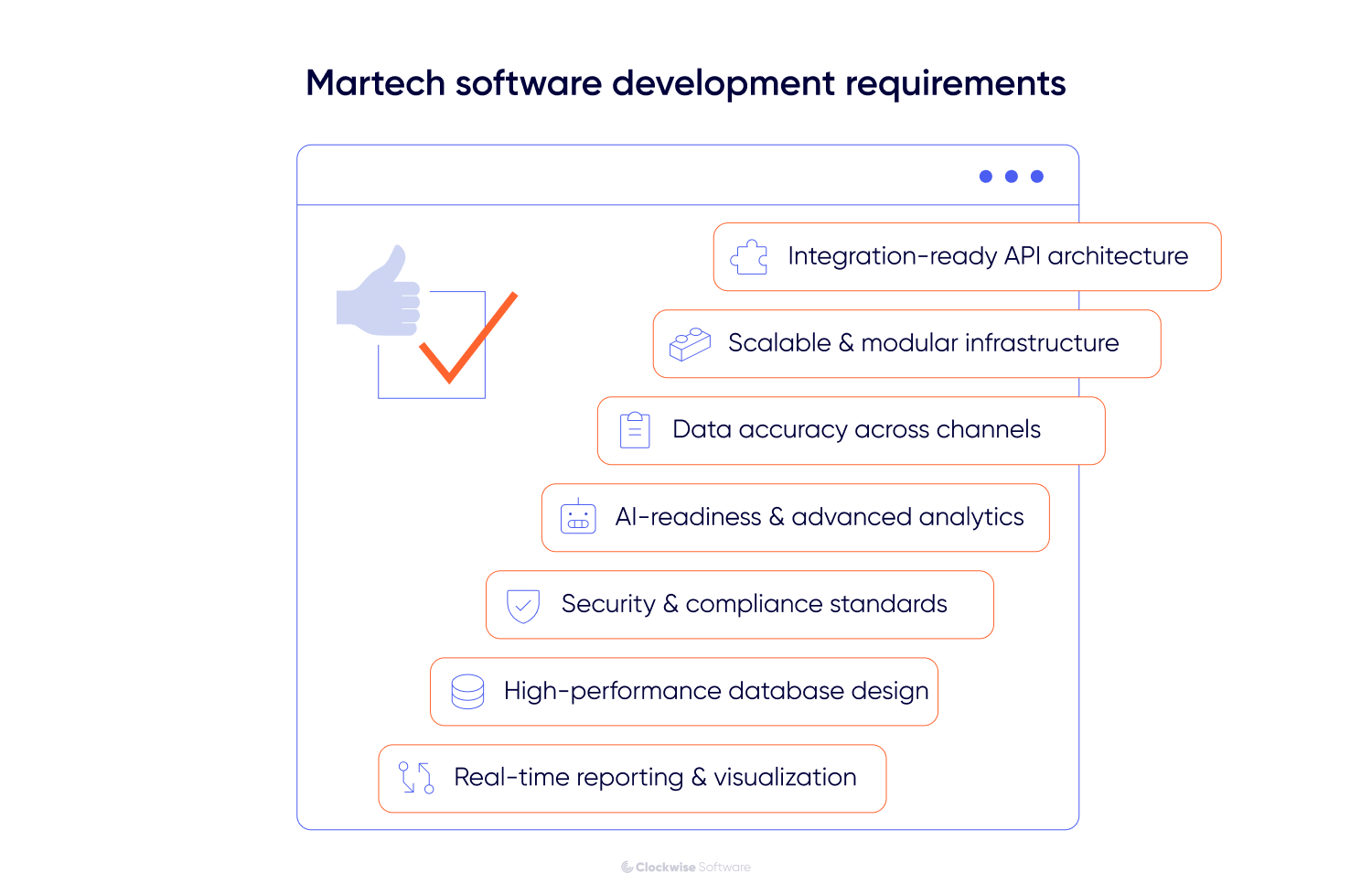
Here are the standards (technical and architectural) that we hold as essential when designing marketing technology platforms built to scale.
Marketing tech solutions rarely operate in isolation. They connect to CRMs, ad networks, analytics systems, email providers, payment gateways, and data warehouses.
A modern MarTech software must include RESTful or GraphQL APIs designed from the ground up, webhooks for real-time event processing, secure OAuth-based authentication, a clear versioning strategy, and well-documented endpoints for third-party integrations.
Without an API-first architecture, long-term scaling and ecosystem growth become limited.
Marketing activity can generate an unpredictable data load. Product launches, viral campaigns, or seasonal promotions often cause sudden spikes in user interactions on tracked platforms, which increases event volume, webhook traffic, and real-time data processing inside the MarTech system.
Today, MarTechmarketing technology platforms must support cloud native deployment, horizontal scaling, containerized environments, load balancing, automated monitoring and alerting, and failover and redundancy mechanisms.
Scalability must be planned from the MVP stage, even if you will need full capacity later.
Marketing decisions depend on reliable data. When data from paid ads, CRM systems, email campaigns, and social platforms is combined, inconsistencies frequently appear.
MarTech systems should include data normalization pipelines, ETL processes for structured transformation, deduplication mechanisms, cross-channel attribution logic, and real-time synchronization.
Accurate reporting depends on correct backend data modeling.
AI integration in MarTechtechnology tools is becoming standard. However, machine learning modules require specific technical preparation.
Key requirements include clean and structured datasets, scalable data storage, Python or similar data science modules, real-time processing pipelines, and visualization layers for AI outputs.
AI shouldn’t be approached as an afterthought. It requires foundational support within your system design.
Marketing tech often handles personal data, behavioral tracking, and payment processing.
Essential security requirements include end-to-end encryption, role-based access control, GDPR and data privacy compliance, secure payment integrations, and audit logging.
As regulations tighten globally, compliance becomes an even more important part of system design.
User profiles, event logs, campaign metrics, attribution models, and behavioral tracking data pile up fast, especially as campaigns grow and customers engage across more channels.
Efficient management of these datasets demands marketing tech solutions with optimized relational or hybrid databases, an indexing strategy aligned with reporting queries, data partitioning, caching mechanisms, and asynchronous processing for heavy tasks.
In high-load systems, efficient performance is often what separates stable growth from failure.
Marketing technology companies expect dashboards that update instantly and present complex data clearly.
Modern requirements include interactive dashboards, customizable widgets, drill-down capabilities, exportable reports, and high-performance front-end frameworks.
Strong visualization is not only a UX enhancement. It directly impacts how quickly marketing teams can make decisions.
Let’s see how we turn this list of requirements into a stable, scalable MarTech marketing technology system.
MarTech platforms follow the same core product development principles as other digital systems. You still start with discovery, define architecture, build an MVP, and iterate.
What makes them demanding is the level of integration, data modeling, and reporting accuracy required from the beginning. Marketing platforms connect multiple systems, process large volumes of data, and support real-time decision-making. That shapes how we approach architecture and validation at every stage.
Let’s take a closer look at how we structure the MarTech development process.
When we begin a MarTech development project, discovery starts with data. Before designing interfaces or automation logic, we need a clear picture of how your marketing team operates and how information moves across systems.
We start with a structured assessment of your current digital marketing technology stack. That includes reviewing platforms, integrations, CRM systems, ad accounts, email tools, and analytics frameworks to pinpoint silos and overlapping functionality.
Next, we map data flows in detail. We define where data originates, how it is stored, where inconsistencies appear, which metrics drive business decisions, and how attribution is calculated. Weak data modeling at this stage leads to unreliable dashboards and reporting problems once the platform goes live.
We then document marketing workflows. Lead lifecycle stages, campaign approval processes, reporting cadence, segmentation logic, and automation triggers all need to be clearly defined before development begins. In projects like Segment AI, the scoring engine could only be designed after segmentation rules and decision criteria were fully clarified.
Compliance is incorporated from the start. If personal data is involved, GDPR requirements, role-based access control, retention policies, and consent management must be built into the architecture. Fixing these later is far more expensive and risky.
A thorough discovery phase lays the groundwork for stable integrations, accurate reporting, and scalable automation.
Once workflows and data models are defined, we design the system architecture.
In MarTech projects, architecture must support:
API-first integrations
Webhooks for real-time updates
Scalable databases
Modular service layers
Analytics pipelines
At this stage of MarTech development services, we also define the hosting model, cloud infrastructure strategy, CI/CD approach, and monitoring architecture. These decisions shape how the system will be deployed, observed, and scaled during implementation and beyond.
The MVP stage centers on one clear marketing value proposition. Instead of trying to build a complete ecosystem from the start, we narrow the scope to what truly matters for initial validation.
We define the core user roles, set up primary data ingestion, build essential dashboards, implement foundational automation logic, and connect the first critical integrations. If it is relevant, we offer custom CMS development to manage campaign content and structured publishing workflows. Our goal as a MarTech developer is to create a functional system that solves a real problem without unnecessary complexity.
At this stage, the focus is on validating the fundamentals of future MarTech application development, ensuring the data flow covers everything needed, the system performs reliably under realistic load, dashboards are intuitive enough to support decision making, and automation delivers measurable value. When these elements are in place, the platform has a solid foundation for expansion.
If your digital marketing technology product includes AI, we integrate those components once the core system is stable. That may involve adding scoring logic, predictive models, or personalization mechanisms that respond to user behavior in real time.
We introduce AI in iterations. First, we connect it to clean and structured data. Then we validate outputs under real conditions and measure impact against concrete metrics such as conversion rates or campaign performance. Based on the results, we expand the model’s role or adjust it.
Rather than adding AI just because it sounds impressive, we use it to strengthen decision-making. It has to run reliably in the current setup and deliver a measurable impact first.
Through testing, we make sure the platform operates exactly as designed under realistic conditions. We concentrate on confirming business rules, identifying edge cases, and addressing problems ahead of release.
Testing typically includes API integration testing, data validation across systems, performance testing under traffic spikes, security testing, automation workflow validation, and real-time webhook validation.
If a webhook fails or data synchronization breaks, marketing decisions may be affected immediately.
Deployment lays the groundwork for consistent performance in production.
At this step, we finalize:
Cloud environments aligned with scalability requirements
Secure separation between staging and production systems
Monitoring dashboards to track system health and performance
Error tracking tools to detect and resolve issues quickly
Webhook configuration to support real-time updates
Before full release, our MarTech development company validates real-time data processing under realistic conditions. Dashboards, automation triggers, and integrations need to behave consistently once live traffic hits the system.
After launch, marketing technology tools continue to evolve. New integrations are added, reporting capabilities expand, database performance is optimized, AI models are refined, and infrastructure scales as the user base grows.
Once your platform is live, the focus moves to running and improving it in real-world conditions. Actual usage exposes patterns, bottlenecks, and edge cases that testing cannot fully replicate. As traffic and data grow, we fine-tune the system to protect performance and reporting accuracy. With strong architecture in place, growth does not require rebuilding the foundation.
Martech apps development is fundamentally about building a reliable marketing infrastructure. The stronger the foundation, the easier it becomes to expand features, integrate new channels, and support millions of users.
A strong base makes scaling possible. But the right capabilities are what make the platform valuable.
When you plan a MarTech apps development project, feature decisions quickly become strategic decisions. No two products are identical, yet some core capabilities repeatedly prove essential when scaling marketing systems.
You probably want to clearly see how campaigns translate into revenue. That requires end-to-end visibility across touchpoints, multi-channel attribution logic, and dashboards that connect spend directly to outcomes. At its core, this demand is about financial clarity. Teams need reliable insight into which channels generate revenue, which campaigns underperform, and where budget should be reallocated.
Demand for AI app development is growing, but not for novelty. Teams want MarTech marketing technology systems that assist with prioritization and forecasting. This often includes:
Predictive lead scoring
Conversion probability modeling
Behavioral signal analysis
Campaign performance forecasting
AI is expected to support decisions, not replace strategy. Its value is measured in improved targeting accuracy and higher conversion efficiency.
In MarTech development services projects like Releasd, AI was integrated to automate media data processing and structure reporting outputs. The goal wasn’t complexity, it was reducing manual effort and improving consistency in performance reporting.
Marketing tech rarely operates in silos. Companies increasingly request centralized control over email, paid media, CRM triggers, and content workflows. The key demand here is coordination. Teams want fewer manual handoffs and more predictable execution across channels.
As organizations scale, reporting requirements shift upward. Executives expect performance dashboards that summarize impact clearly and quickly. The emphasis here is usability. Reports must be interpretable in minutes, not hours.
Manual processes become expensive at scale. High-demand functionality often focuses on workflow automation, lead routing, data synchronization, and repetitive campaign setup tasks. The business objective is straightforward: reduce operational overhead without increasing team size.
Building powerful infrastructure comes with real investment. Let’s break down what that typically looks like.
The cost of building marketing technology solutions depends on scope, integrations, data complexity, AI components, and scalability requirements. Here is a realistic breakdown of what impacts pricing and what businesses should expect today.
Typical investment: $15,000 – $40,000
Timeline: 3–8 weeks
This phase focuses on validating product direction before full development begins. It includes a digital marketing technology stack audit, workflow mapping, technical architecture planning, and risk assessment. In some cases, a proof of concept or clickable prototype is delivered to validate assumptions.
We define scope, confirm feasibility, create a roadmap that prevents architectural mistakes later, and provide a clear, structured cost and timeline estimate for full MarTech software development.
Typical investment: $50,000 – $120,000
Timeline: 3–5 months
At this MarTech services stage, we build the core system that delivers a clear marketing value proposition. That usually includes:
Core user roles
Primary integrations
Initial data ingestion
Essential dashboards
Foundational automation logic
The MVP is designed to validate product-market fit and confirm that the platform performs reliably under realistic conditions.
Typical investment: $120,000 – $250,000
Timeline: 5–9 months
Once the core system proves viable, the next MarTech engineering phase focuses on strengthening scalability, reporting depth, and operational control. This often involves richer analytics, more advanced automation, tighter access management, performance tuning, and stronger security controls. At this stage, the system is ready to support sustained growth and wider adoption.
Typical investment: $250,000 – $500,000+
Timeline: 8–14+ months
At this point, the system is engineered for scale and resilience. It supports large audiences, expanding datasets, and layered integrations. AI enhancements, refined attribution models, and advanced compliance frameworks become part of the core offering, especially for enterprise-oriented solutions.
MarTech apps development works best when you think long-term. Treating it as infrastructure instead of a short-term initiative ensures the system can reliably support revenue, reporting, and workflow automation.
As complexity grows, early decisions start to compound. Clear planning during the discovery and MVP stages directly affects how easily the system scales later. A solid foundation allows the platform to expand without major restructuring or performance trade-offs.
Several factors significantly influence the final investment.
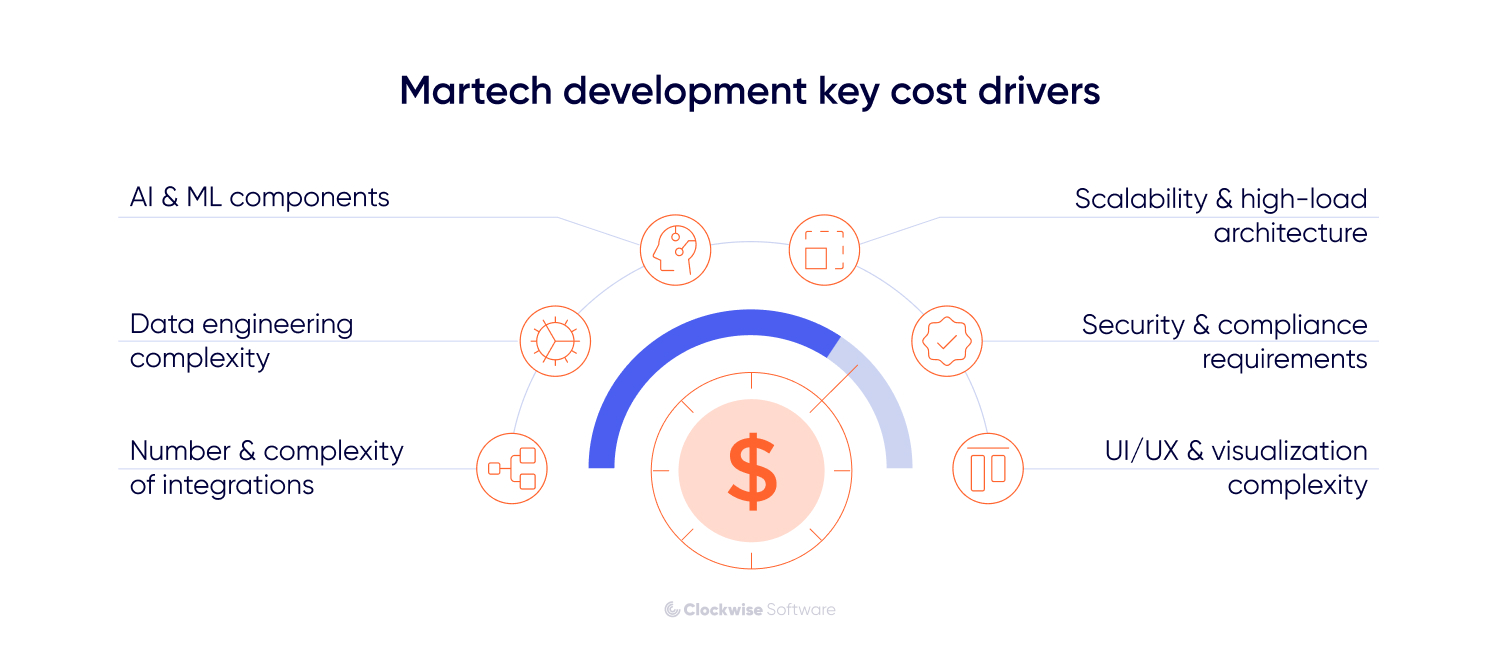
Every additional integration with CRM systems, ad networks, social platforms, payment gateways, audiogram software, or data warehouses increases development time. Each connection requires API configuration, error handling, synchronization logic, and thorough testing to ensure data flows reliably between systems.
If marketing technology solutions aggregate large datasets from multiple sources, such as an influencer relation management database, cost increases due to:
ETL pipeline design
Data normalization
Deduplication logic
Attribution modeling
Real-time synchronization
Each of these layers adds complexity to how data is processed, stored, and queried. The more sources involved, the more carefully the data architecture must be designed to ensure accuracy, consistency, and performance at scale.
AI modules require model training and testing, infrastructure for processing, visualization of AI outputs, and continuous optimization.
Predictive lead scoring, behavioral segmentation, and anomaly detection increase both development and infrastructure costs.
Digital marketing technology platforms expected to handle traffic spikes or serve millions of users require a cloud-native infrastructure designed for scalability. That typically involves load balancing, horizontal scaling strategies, queue management systems, and careful database optimization to maintain performance under pressure. As user numbers and data volumes grow, architectural decisions at this level directly determine whether the platform remains stable or begins to degrade under load.
If the platform processes personal data or payments, additional investment is required for:
GDPR compliance
Encryption
Secure access control
Audit logs
Penetration testing
These safeguards directly affect user trust, regulatory exposure, and long-term platform viability. Addressing them early reduces legal risk and prevents costly remediation once the system is live.
Advanced dashboards with interactive graphs, customizable widgets, real-time updates, and executive-level reporting require specialized frontend engineering and visualization frameworks. Strong UX is especially important in analytics-heavy MarTech platforms.
When comparing custom MarTech development to subscription-based SaaS tools, companies should consider cumulative subscription costs.
Large marketing teams often pay for multiple platforms simultaneously. Over time, annual subscription expenses can exceed the one-time cost of building a tailored internal platform.
Additionally, unused features across multiple marketing technology solutions contribute to inefficient spending. Many companies utilize only a fraction of paid functionality, which reduces overall ROI.
When marketing performance directly influences revenue, owning scalable marketing technology platforms often becomes a strategic advantage rather than a cost center.
Powerful technology platforms sit at the core of marketing operations. They connect systems, handle sensitive data, and influence revenue performance every day. Because of that, the MarTech development services approach you choose has long-term implications.
Companies usually move forward in one of three ways. They build an internal dev team, work with freelancers, or collaborate with a specialized MarTech development company.
Each model has trade-offs. For complex MarTech platforms with multiple integrations and ongoing scaling needs, structured product teams tend to provide more consistency and architectural discipline. Below, we outline how these approaches differ and where each one fits.
Building an internal MarTech engineering team gives you full control over processes and priorities.
Advantages
Direct communication
Deep internal product knowledge
Long-term ownership
Challenges
High hiring and retention costs
Long recruitment cycles
Difficult access to niche expertise, such as data engineering or AI
Risk of limited team scalability during peak workload
For early-stage startups or companies without strong technical leadership, building a full MarTech team internally can slow down time-to-market.
Freelancers may work well for small integrations or isolated tasks.
Advantages
Lower short-term cost
Flexible engagement
Challenges
Limited accountability
Fragmented architecture ownership
Inconsistent code quality
Weak long-term scalability
MarTech platforms require strong architectural consistency, security planning, and coordinated data modeling. This level of cohesion is difficult to achieve through loosely connected MarTech developers.
For complex marketing technology solutions, working with an experienced product development company provides structure, scalability, and technical depth.
Advantages
Cross-functional team from day one
Proven development processes
Access to data engineers, backend architects, frontend developers, DevOps, and QA
Experience with integrations, scalability, and compliance
Clear roadmap and delivery milestones
Challenges
Higher upfront investment compared to freelancers
Requires strong collaboration and communication alignment
When multiple systems, data flows, and automation layers need to evolve together, coordinated engineering becomes critical. Marketing software development services partner with a structured team reduces architectural drift, shortens feedback loops, and keeps the platform aligned with long-term growth rather than short-term fixes.
The MarTech development services model that makes sense for you depends on where your product stands today and what expertise you already have in-house. Based on how MarTech platforms typically evolve, we offer several cooperation models that allow you to choose the level of involvement and ownership that fits your team.
In this model, we take responsibility for the entire product lifecycle. That includes discovery and business analysis, architecture design, UI/UX, backend and frontend development, integrations, testing, deployment, and post-launch support.
This MarTech services approach works well when you need a structured team that can build and scale the platform end-to-end, while maintaining architectural consistency from day one.
This marketing software development services model works when you have a defined product direction and need steady execution over time.
We put together a cross-functional team that focuses only on your platform and works directly with your internal stakeholders. The team becomes part of your working process while we stay responsible for technical consistency and architectural decisions.
The structure is flexible. If you already have MarTech developers in place, we can strengthen your team with specific expertise, such as data engineering, AI development, backend support, or DevOps. If you don’t, we cover the full delivery scope. The setup adapts to your internal capacity rather than forcing a rigid model.
This approach supports long-term scaling and allows priorities to evolve without losing technical coherence.
If you are not ready for full development, starting with a structured discovery phase is often the most strategic first step. Discovery includes:
Audit of current marketing stack
Data source analysis
Workflow mapping
Architecture planning
Compliance assessment
Feature prioritization
Cost and timeline estimation
This phase reduces development risks and prevents costly architectural mistakes later.
Marketing technology tools sit close to revenue operations. They manage customer data, attribution logic, campaign automation, and real-time reporting. When integrations break or the architecture is unstable, the impact is immediate. Marketing decisions start relying on incomplete or inaccurate data.
That’s why technical discipline matters. A well-structured MarTech development company designs API-first systems, plans for scalable infrastructure, treats security as part of the foundation, and tests performance under realistic load.
When a team has experience with different marketing software development services projects, it can recommend efficient architectural patterns, anticipate integration challenges, and choose solutions that have already proven effective in similar scenarios.
If your platform supports large user bases or processes sensitive data, reliability becomes part of the product itself. Stability and data accuracy directly influence how confidently your teams can operate.
Marketing technology platforms shape how marketing teams operate every day. When data is fragmented and workflows rely on manual coordination, performance becomes harder to measure and optimize. A structured MarTech platform brings clarity to data, automation, and reporting, helping your team operate with consistency as you grow.
Building that system requires disciplined product thinking and solid engineering. Architecture, data modeling, integrations, AI components, and compliance all influence how the platform performs under real conditions. Early decisions directly affect how smoothly it scales later.
We’ve been building digital products since 2014, including MarTech and AdTech platforms used at scale. Our work spans discovery, system design, MVP delivery, and long-term platform evolution.
If you’re reassessing your marketing stack or planning a new platform, we can help define the right scope and development approach for your goals.