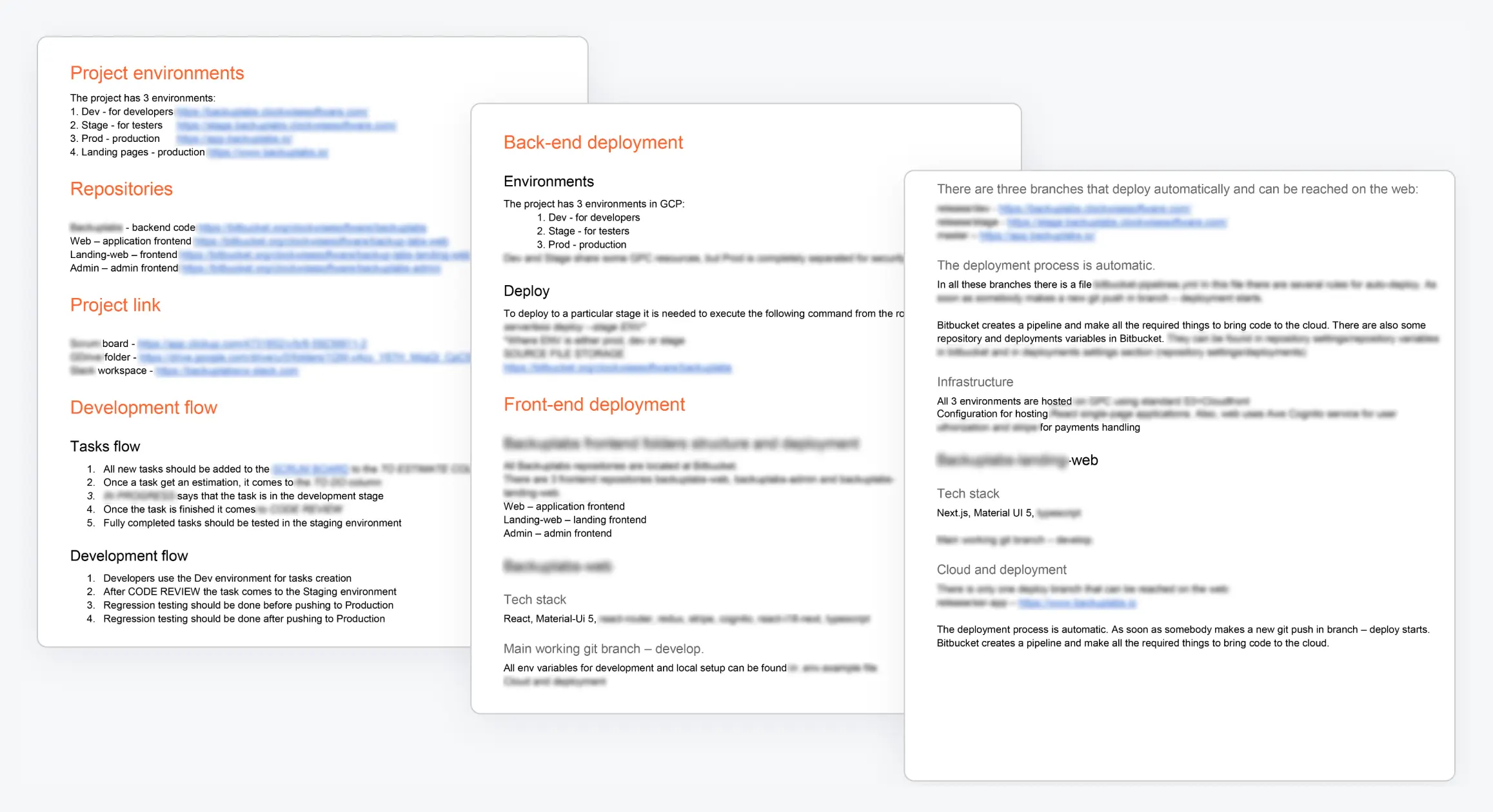
How We Run Development

The scope is approved, the team is in place — what should you expect from the development process?
Here’s the framework we’ve used to achieve 200+ deliveries with CPI/SPI variance under 10%.
Sprint-based work
Regular checkpoints
Built-in flexibility

Our delivery framework

We stick to Agile principles: short iterations, constant feedback, and flexibility for when changes occur.
But we don’t blindly follow a textbook. For each project, we сhoose the approach that fits best:
Scrum when there’s a clear backlog and we need structured sprints.

Great for building an MVP from scratch or moving fast with regular milestones
Kanban when the workflow is constant and priorities shift often.

Ideal for projects where support, bugfix, and feature requests flow in dynamically.
Scrumban when a mix works better.


For example, sprints for new features but Kanban for maintenance tasks in parallel.
No matter our approach, the goal is always the same: keep development predictable while staying flexible enough
to adapt when priorities shift.
Andrii
Andrii
Project Manager
“Most projects land in a Scrumban flow — it has the right balance of structure and flexibility. At the start, we always talk with the client about what they expect, walk through the tradeoffs, and pick the setup that feels right. But nothing’s rigid. If the team feels we need to switch gears, we switch.”

Sprint structure and your involvement in it

A sprint is a short, time-boxed cycle — usually 2 weeks — during which the team commits to completing a set of tasks.

Sprint planning

What happens: We review the backlog, estimate tasks, and decide what’s achievable in the next 2 weeks.

Your role: You (or your product owner) set priorities. We explain tradeoffs (e.g., “if we add this feature, the timeline will shift”), and together, we lock in the sprint scope.

Outcome: A clear, agreed sprint goal + a list of tasks visible on the project board.

Daily syncs

What happens: The team runs short stand-up meetings every day to track progress, reveal blockers, and adjust.

Your role: Optional. We keep you updated asynchronously (via Slack/Teams or a project board). If there’s a blocker on your side (e.g., missing API access), we’ll ping you directly.

Outcome: Continual progress without issues piling up.

Development & QA

What happens: Developers code features while QA tests them in parallel, catching bugs early. Tech leads review code for quality and maintainability.

Your role: Minimal. If needed, we’ll reach out for quick clarifications on requirements. You can also peek at the board anytime to see work in progress.

Outcome: Features built and tested in small, stable increments.

Review & demo

What happens: At the end of the sprint, we present completed features in a live demo. This lets you see the product evolve in real time.

Your role: Join the demo, give feedback, and confirm if what you see matches your expectations. This is where small course corrections happen.

Outcome: Shared understanding of what’s done and what’s next.

Retrospective

What happens: The team reflects on the sprint: what worked, what didn’t, and what we should tweak in the process.

Your role: Optional. If you’ve noticed something about our collaboration (e.g., “weekly reports are too detailed, I’d prefer a one-pager”), we welcome that input.

Outcome: The process constantly improves — every sprint should feel smoother than the last.

Our main communication channels

We mainly use Slack for day-to-day conversations and Google Meet for calls. Alongside these services, we use Google Workspace — Calendar, Drive, Docs, Slides, and other tools — which makes scheduling, file sharing, and collaboration seamless. Everything stays in one place, so it’s easy to access for both sides.

But if your team already runs on something else, we adapt. We can just as easily use Microsoft Teams, Zoom, or email — whatever makes collaboration easier on your side.

Slack
Slack
Google Meet
Google Meet
Zoom
Zoom
Email
Email
Microsoft Teams
Microsoft Teams
Google Workspace
Google Workspace

Your communication with the team

You’ll always know exactly who to talk to.

Business analyst

Project manager

Tech lead or software architect

Developers, QA engineers & designers

Business analyst

The business analyst is often your closest partner in day-to-day work. The BA helps refine requirements, clarify edge cases, and translate your business needs into detailed development tasks. If something is unclear or needs adjustment, the BA is usually your first stop.
Tetiana
Tetiana
Business Analyst

“Most conversations about features or requirements will go through me. My role is to take your ideas, ask the right questions, and turn everything into clear user stories and feature specs — the instructions our developers rely on.”

Transparency on progress

You’ll have direct access to our project board — the same one our team uses every day. This way, you’re not waiting for reports or chasing updates.
If you ever wonder, What’s happening with my project right now? — the board already has the answer.
See everything in real time
Every task, bug, and feature is logged on the board. You can check progress anytime: what’s planned, what’s in progress, what’s done.
Stay in control of priorities
The backlog is visible too. You’ll see what’s coming up next and can reshuffle priorities whenever your business needs change.
Track accountability
Each task is assigned to a specific developer, with status updates along the way. You’ll always know who’s working on what.

Tools we use for tracking progress

Jira

The industry standard for Agile projects. Great for Scrum/Kanban boards, backlog management, and reporting.
Jira

Notion

Gives us a highly customizable workspace, with direct access to meeting notes, documentation, and more, all in one place.
Notion

Trello

Simple Kanban boards, often used for smaller projects or as a visual layer for clients.
Trello

ClickUp / Asana

Sometimes used if the client already has them in place.
ClickUp / Asana/ClickUp / Asana
At Clockwise, Jira and Notion are the most commonly used tools, but we can adapt to whatever you’re comfortable with.

Change & risk management:
Adapting without losing control

Andrii
Andrii
Project Manager
“In a perfect world, we’d map out the whole project once and just follow the plan until release. But let’s be honest — that almost never happens. Priorities shift, new ideas come up, and sometimes technology throws in surprises. That’s why our process is built to adapt.”

Shifting business priorities

Maybe your users ask for a new feature, or the market changes and you want to react quickly.

New insights during development

Once we start building, you might see the product differently and refine requirements.

Third-party dependencies

APIs, integrations, or external tools sometimes change their rules or limits.

Technical discoveries

Occasionally, we uncover hidden complexity that necessitates a different approach.

Deadlines or budget adjustments

If something changes on your side, we’ll re-plan to match the new reality.

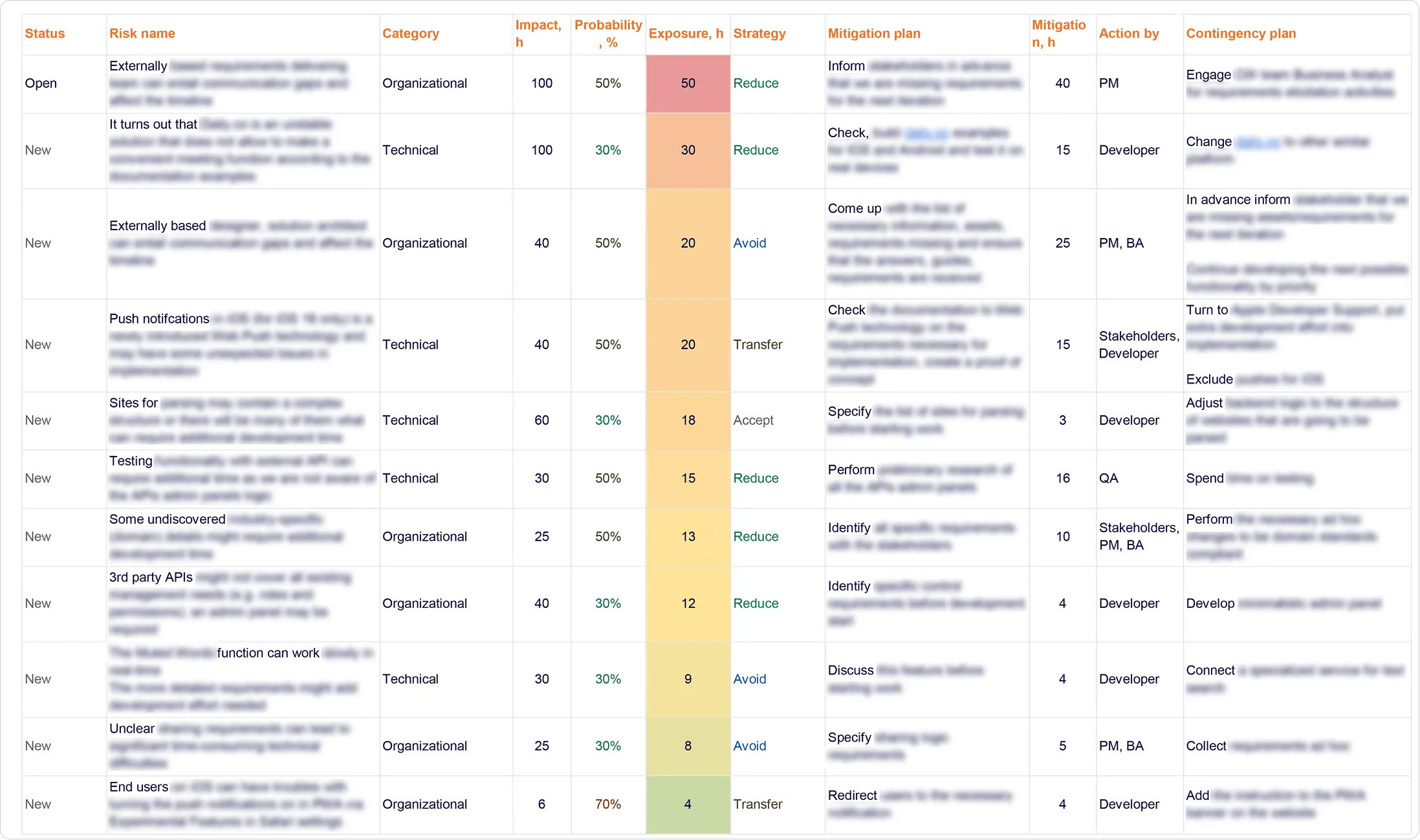
How do we work with risks?

We build the initial risk register during the discovery phase and regularly update it throughout development. Each potential risk gets a defined strategy, so the register becomes a working guide the team can rely on.
That way, when challenges appear — and they always do — the response has already been thought out and doesn’t need to be improvised on the spot.
Risks Table

How do we manage changes?

What if unexpected changes do happen? In this case, our team’s response will depend on the methodology we’re working with.
Scenario 1:
Scrumban / Kanban
Scenario 2:
Pure Scrum
🗒️Planning horizon
1 sprint ahead (typically 2 weeks)
🗒️Planning horizon
Several months ahead.
🌱️How changes work
  • Changes in the middle of a sprint are rare — the team stays focused on the agreed scope.
  • At the end of each sprint, we re-prioritize tasks and add new items.
🌱️How changes work
  • New requirements, market shifts, or stakeholder decisions often lead to changes mid-project.
  • Each change is logged, clarified, and assessed for impact on deadlines, budget, and scope.
💫Impact
  • Easy to adjust priorities every 2 weeks.
  • Predictable cadence without disrupting delivery.
💫Impact
  • Changes may require re-planning the roadmap, updating estimates, and shifting feature priorities.
  • Still controlled: nothing is introduced without your approval.
🗒️Planning horizon
1 sprint ahead (typically 2 weeks)
🗒️Planning horizon
Several months ahead.
🌱️How changes work
  • Changes in the middle of a sprint are rare — the team stays focused on the agreed scope.
  • At the end of each sprint, we re-prioritize tasks and add new items.
🌱️How changes work
  • New requirements, market shifts, or stakeholder decisions often lead to changes mid-project.
  • Each change is logged, clarified, and assessed for impact on deadlines, budget, and scope.
💫Impact
  • Easy to adjust priorities every 2 weeks.
  • Predictable cadence without disrupting delivery.
💫Impact
  • Changes may require re-planning the roadmap, updating estimates, and shifting feature priorities.
  • Still controlled: nothing is introduced without your approval.
Andrii
Andrii
Project Manager
“The best thing about Scrumban is that it gives you space to adjust without slowing the team down. We keep our focus on the sprint at hand, but if you bring new ideas or priorities, we’ll work them into the plan at the right moment. That way, you don’t have to worry about losing momentum while your product keeps evolving in the right direction.”
Andrii
Andrii
Project Manager
“Scrum needs a bit more discipline. If we treat every new idea as urgent, the process breaks. That’s why each change is treated as a tradeoff: it may affect the budget, the timeline, or other features. We always estimate the impact and walk you through the options before anything is approved.”

SPI/CPI reporting: keeping stakeholders on track

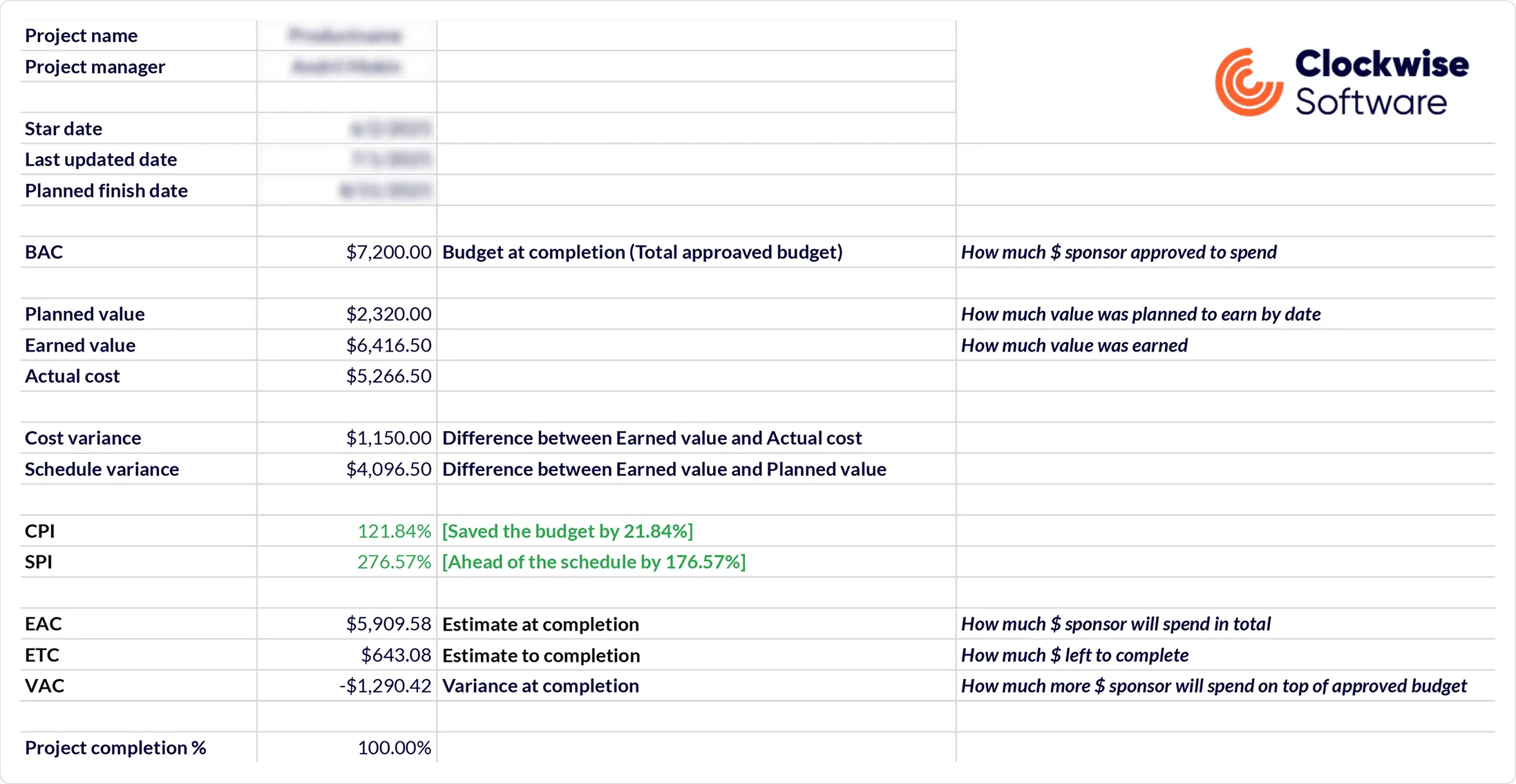
Shifting priorities and moving deadlines happen in every project. The challenge is keeping delivery predictable while adapting to those changes. That’s why we rely on SPI (Schedule Performance Index) and CPI (Cost Performance Index) metrics to track and communicate progress.

The good news: over the last 4 years, the majority of our projects have stayed within a 10% variance on CPI/SPI.

How it works

  • SPI measures schedule health: Are we ahead, behind, or right on track compared to the plan?
  • CPI measures budget health: Are we burning resources efficiently, or is the cost higher than planned?
  • Together, SPI and CPI give an honest picture of how the project is running — in numbers and charts.

How we share it with you

  • We calculate SPI and CPI regularly based on planned vs. completed work.
  • Results are included in your weekly or biweekly progress reports.
  • Instead of vague updates, you see clear metrics and visual charts that show whether the project is progressing as expected.

How we adapt when things shift

  • If priorities change, we re-plan the backlog and update SPI/CPI to reflect the new reality.
  • If deadlines move, we model different scenarios from adjusting the scope to changing the team capacity and show how each option affects the schedule and budget.
  • You can always see the tradeoffs clearly before making a decision.
Performance Reporting Table

Handover with nothing left behind

Serhii
Serhii
Head of Client Relations
“A lot of companies fear vendor lock-in — being forced to stick with one partner, paying constantly just to keep their software up to date. We work another way. Our process is built so you can continue with us, take support in-house, or move to another vendor without friction.”

What we do to make handover seamless

🤝
Transfer source code and GitHub/GitLab/Bitbucket repo ownership — the code is fully yours.
👤
Assign admin rights for cloud services (AWS/Azure/GCP), containers, databases, storage, CDN, DNS, email/domain sending, etc.
📝
Provide admin rights for third-party services (payment services, chat, analytics, data providers, maps, etc.).
🖍️
Help you replace sensitive credentials (such as API keys, database passwords, or access tokens) with new, freshly generated ones.
📑
Share documentation (system architecture, API specs, setup and deployment guides, known limitations, and the reasoning behind key decisions).
🔗
Provide recorded knowledge transfer sessions with our PM, BA, and tech leads so your new team can review the context whenever they need.
Performance Reporting Table

What our clients say

Does our approach match what you’re looking for?

Let’s connect and use this framework to build your product.
Serhii
Serhii
Head of Client Relations
Kateryna
Kateryna
Senior Account Executive
By submitting this form, you agree to Clockwise Software Privacy Policy.
2014
Building products since
5
Clutch rating
98%
NPS score
5.5%
Annual employee churn rate
100%
Pleasure when working with us
6+ years
Retention of top specialists