AI solutions
What we do
Services
Experts in
How we work



Fortune #40 Global Health Leader
1886-founded | 131K employees | $16B in R&D

NYSE: EB
850k creators | 300M tickets sold in 2023

8th GPS App in the US
3M+ in 2023 | 10M+ Google Play downloads

Cultural Exchange Led by 2K+ Team
Est. 1980 | 500K+ Alumni | 100+ Countries

$12M Revenue Tech Co.
MBE Certified by NMSDC

Trusted Logistics Co. Since 1979
ISO9001 Certified Systems Integrator

3rd in Retail Inc. 5000
$6M+ raised | #1 ranked company in CT

UCSF-Trusted Health App
with 50K+ users in 60+ countries

Google-Funded Green Tech
144K Ha Monitored | Featured by Reuters

Telecom Experts Est. 2005
Google, Proximus & Orange partners

NASA-Trusted Workflows Builder
Est. in 2007 | PCI, GDPR & HIPAA certified

Top Swiss Agency
Awarded #1 Swiss App in 2025

#2 SMM Agency in Australia
Serves 1k+ Australian B2B across 20+ domains

Google Cloud Partner
Trusted by Fortune 5 UHG

F&B Startup with 25K+ Guests/Y
4.5 on TripAdvisor | 600+ Dining Partners
Fortune #40 Global Health Leader
1886-founded | 131K employees | $16B in R&D
NYSE: EB
850k creators | 300M tickets sold in 2023
8th GPS App in the US
3M+ in 2023 | 10M+ Google Play downloads
Cultural Exchange Led by 2K+ Team
Est. 1980 | 500K+ Alumni | 100+ Countries
$12M Revenue Tech Co.
MBE Certified by NMSDC
Trusted Logistics Co. Since 1979
ISO9001 Certified Systems Integrator
F&B Startup with 25K+ Guests/Y
4.5 on TripAdvisor | 600+ Dining Partners
Google Cloud Partner
Trusted by Fortune 5 UHG
#2 SMM Agency in Australia
Serves 1k+ Australian B2B across 20+ domains
Top Swiss Agency
Awarded #1 Swiss App in 2025
NASA-Trusted Workflows Builder
Est. in 2007 | PCI, GDPR & HIPAA certified
Telecom Experts Est. 2005
Google, Proximus & Orange partners
Google-Funded Green Tech
144K Ha Monitored | Featured by Reuters
UCSF-Trusted Health App
with 50K+ users in 60+ countries
3rd in Retail Inc. 5000
$6M+ raised | #1 ranked company in CT
Trusted Logistics Co. Since 1979
ISO9001 Certified Systems Integrator
$12M Revenue Tech Co.
MBE Certified by NMSDC
Cultural Exchange Led by 2K+ Team
Est. 1980 | 500K+ Alumni | 100+ Countries
8th GPS App in the US
3M+ in 2023 | 10M+ Google Play downloads
NYSE: EB
850k creators | 300M tickets sold in 2023
Fortune #40 Global Health Leader
1886-founded | 131K employees | $16B in R&D
F&B Startup with 25K+ Guests/Y
4.5 on TripAdvisor | 600+ Dining Partners
Google Cloud Partner
Trusted by Fortune 5 UHG
#2 SMM Agency in Australia
Serves 1k+ Australian B2B across 20+ domains
Top Swiss Agency
Awarded #1 Swiss App in 2025
NASA-Trusted Workflows Builder
Est. in 2007 | PCI, GDPR & HIPAA certified
Telecom Experts Est. 2005
Google, Proximus & Orange partners
5 AI projects delivered in the last year showed a user engagement boost, improved reporting, and increased average revenue per customer.
20% of our engineers specialize in LLMs and keep learning as tech evolves. You get stable AI features built by a team that’s done it before.
We bring a decade of experience building integrations, so adding LLM features feels stable, predictable, and low-stress for your team.
We’ve delivered 200+ projects since 2014, giving us the experience to keep delivery predictable, estimates accurate, and quality on point.
AI powers our own workflows, so we know what works in practice and apply the same approach when building features for you.
We use proven enterprise models like GPT, Claude, and Llama, ensuring stable APIs, high uptime, and reliable performance in production.










We build AI tools and data-heavy platforms that run fast even under serious load. AI functionality we built is trusted by Aston Martin, WHO, Dyson, Oracle, and Unilever — teams that depend on stable, predictable performance when processing large volumes of data at scale. If your product needs to handle high loads, we know how to ensure it.
We delivered LLM-driven analytics that opened access to an $11.6B market. The new features now support global brands like BBC and Renault. This is the kind of AI work that doesn’t just “add functionality”— it expands what the business can sell and who it can sell to.
We’ve delivered 100+ dashboards for data-heavy products, so visualizing AI-generated insights becomes the least of your worries. From standard metrics to complex LLM outputs, we turn raw data into clear, actionable visuals and reports that help users understand what’s going on at a glance.
We built a GPT-powered assistant that boosted CRO and lead capture while keeping support teams lean. Fully integrated with HubSpot, it qualified leads on its own and cut operational overhead. The client got measurable funnel lift without adding headcount or slowing down the team.
AI can turn slow onboarding into a guided, adaptive flow that gets users to value sooner — which is the fastest way to strengthen retention. We replaced a slow, multi-step onboarding flow with an AI-driven experience that adapts to each user. The result: faster sign-up, fewer drop-offs, and a smoother first-touch experience.
Our AI software development services cover both a strong backend integration and an intuitive UX/UI. Your users get an AI tool that performs well, feels like a natural part of your product, and makes it easy to explore model outputs, helping them make smarter decisions without extra effort.

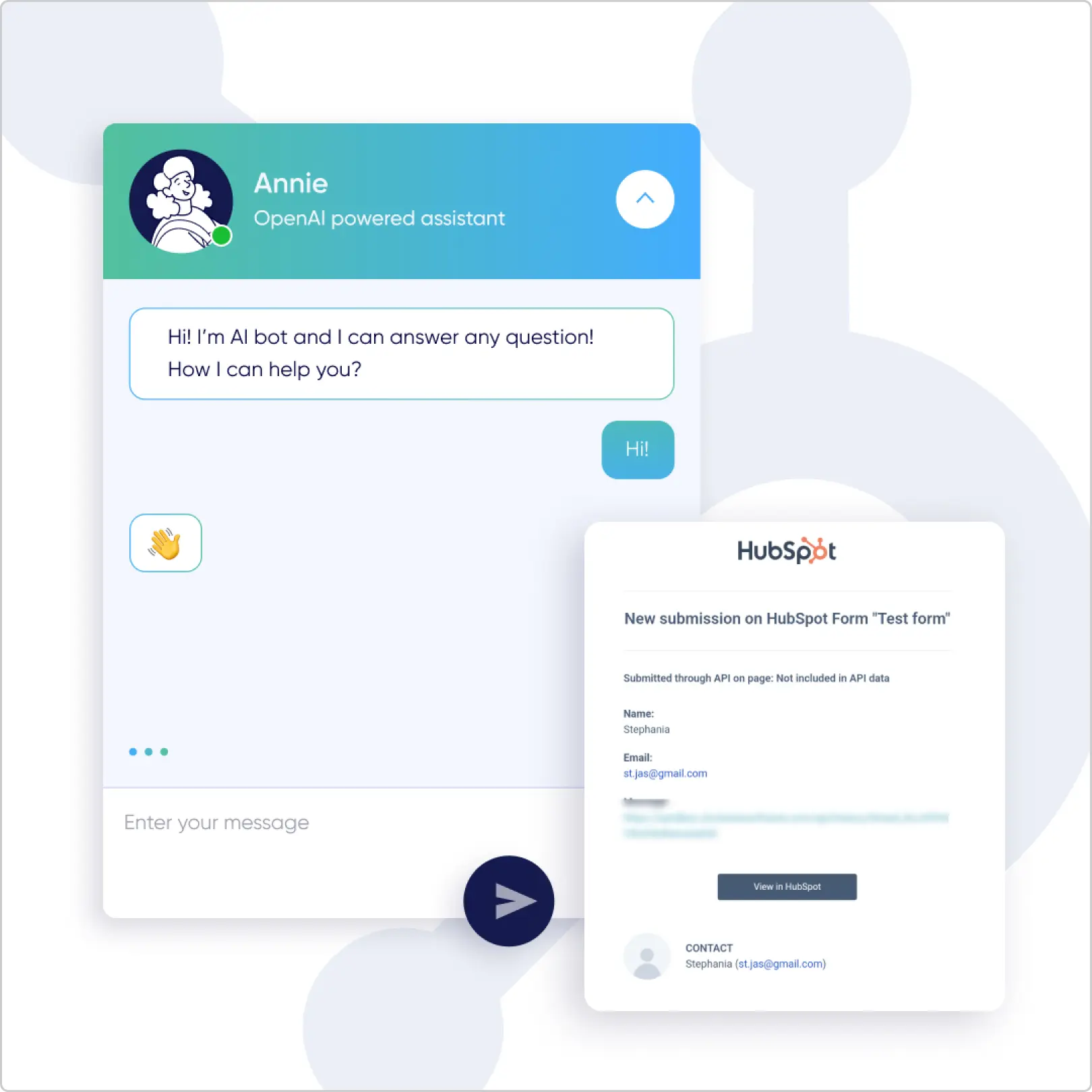
Added a GPT-4–powered assistant to the client's website to improve CRO and capture leads — fully integrated with HubSpot to streamline lead management.
1.5
months delivery
95%+
answer accuracy
500+
leads captured in 1 month

Added AI-powered feature that turned slow, multi-step user onboarding into an automated flow, resulting in enhanced UX and strengthened retention.
3
weeks delivery
67%
faster onboarding
We help you automate the parts of your workflow that drain time and budget: data entry, document processing, routing decisions, content generation, customer communication, internal approvals, and more.
We pick the right AI models, shape the logic around your operations, customize the model with your data, and handle the integration, so AI feels like an integral part of your system.
We turn your historical and real-time data into forecasts that help you plan better: demand shifts, workload peaks, inventory levels, risks, and performance trends.
We fine-tune models to your specific analytics needs and create custom UI to visualize insights in a convenient format, right in the tools your team already uses.
If you collect valuable operational data but aren’t turning it into revenue yet, we help you do that with AI. From building internal analytics products to packaging insights for partners, suppliers, or clients, we help you use AI models to extract patterns from your data and provide them in a digestible way, and wrap everything into a product or reports you can sell or embed in your platform.
We step in when your codebase feels like it was rushed, patched together, or partially written by AI, and now slows everything down. We review architecture, clean up unstable logic, remove accidental complexity, rewrite weak parts, and bring everything to a level your team can grow with, without constantly fighting unpredictable behavior.
We build AI matching engines for cases where rule-based logic isn’t enough to provide the desired experience. Make search results driven by behavioral data, historical outcomes, and operational constraints, so users find what they need faster. We combine pretrained models with custom scoring logic, embeddings, or lightweight fine-tuning, choosing only what’s needed to reach those outcomes.
Reduce operational load with AI chatbots configured to domain-specific workflows. Whether you want to automate onboarding, customer support, or internal assistance, we customize API-based models to your use case with prompt logic or RAG setups connected to internal knowledge, with clear boundaries around data access and escalation.









AI that predicts loading needs, speeds up rerouting, and automates dispatch decisions to cut delays and reduce operating costs.
AI that detects early-risk patterns in users’ health metrics and keeps engagement high with smart, personalized insights.
AI features to provide tailored property recommendations, predict property value, automate lead scoring, and streamline listing generation.
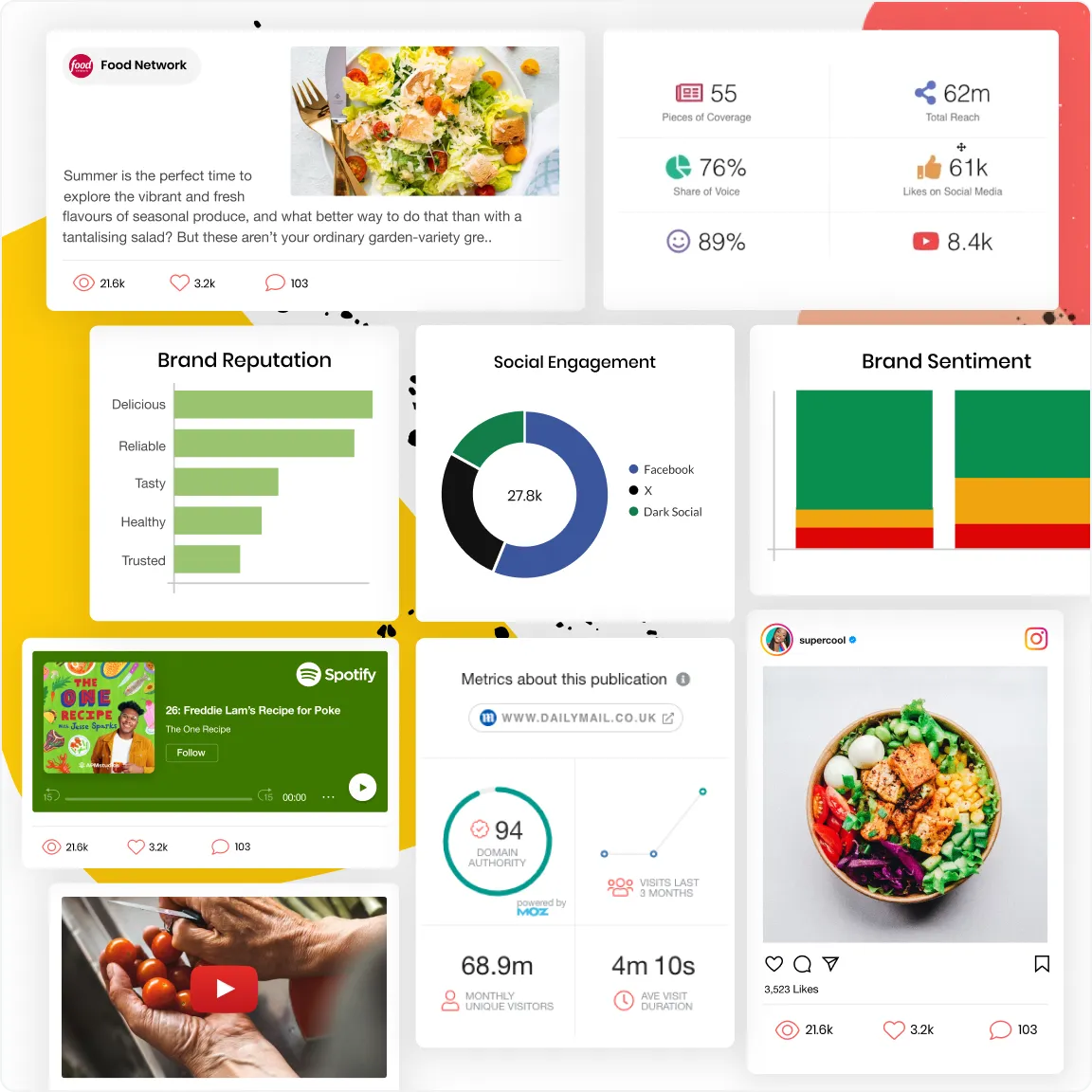
LLM-powered PR reports, predictive analytics, and auto-segmentation — get features for your team to run campaigns with less effort.
Solution architect

Our team covers all the tech steps: selecting the best model, customizing it, and ensuring it fits your system.
Our collaboration kicks off with a call where we dive into your business goals and the specific problems you’re aiming to solve with AI. It’s a chance to get aligned, ask questions, and make sure we’re heading in the right direction from the start. If needed, we’ll gladly sign an NDA to keep your ideas and business details safe.
Next, our AI software development company digs into your operations and builds on what we learned during the consultation. Our goal here is to pinpoint AI opportunities that align with your business priorities, are technically feasible, and bring real value. Whether it’s streamlining internal processes or creating better customer experiences, we focus on what will move the needle.
We assess your current tech stack, infrastructure, and data quality to make sure the AI solution we recommend fits your ecosystem, budget, and goals. This step helps surface any potential blockers early, minimize risks, and confirm that your AI plans are realistic and achievable.
Once our custom AI development company confirms the solution is a good fit, we map out a clear implementation plan. You’ll get full visibility into timelines, milestones, integration needs, costs, and deliverables, all defined and agreed on up front. This keeps everyone aligned and helps avoid surprises down the road.
Now it’s time to bring the solution to life. We take care of both the technical implementation and project coordination, so you get results on time, on budget, and at the level of quality you expect.
The AI solution is configured to match your workflows and business goals. By building on proven, pre-built components, we keep the process efficient and reduce risks without sacrificing quality. Once integrated, we run thorough testing to ensure everything works as intended and meets the agreed requirements.
After integration, we make sure your team is ready to use the new AI tools with confidence. Our hands-on training is tailored to your workflows, so your team learns what’s most relevant to their day-to-day tasks. We also provide clear, practical documentation, giving your team the support they need to maintain and evolve the solution on their own.
We stay involved after delivering AI application development services to make sure the system performs reliably in real-world conditions. Our team monitors system performance to catch and resolve any issues that may only surface during real-world use. We also gather feedback from your end users; this input is key to fine-tuning the AI solution so it delivers real value where it matters most.
As your business changes, your AI solution should grow with it. Whether you need to fine-tune models, add new features, solve unexpected issues, or scale the system, we’re here to support you. With long-term help from our team, you’ll have a reliable tech partner to keep your AI working (and evolving) in step with your goals.
$10,000 to $15,000
Confirm feasibility early and map the smartest path forward
$15,000 to $30,000
AI chatbot development, automation of simple workflows, etc.
$30,000+
Tools for automating predictive analytics and other complex operations
Yes. In most cases, AI is integrated into existing products rather than built as a standalone system. This typically involves connecting prebuilt or customized models to current databases, APIs, backend services, workflows, and user interfaces, so AI becomes part of the product’s core logic.
A solid integration approach takes into account data flows, system performance, security requirements, and access control from the start. By embedding AI at the API or service layer, teams can introduce new functionality without large rewrites, avoid disruptions to live operations, and keep existing infrastructure, integrations, and business processes intact while the product evolves.
Yes, and this step is critical for successful AI implementation. A reliable AI development company helps translate business goals into concrete AI use cases, clear data requirements, and realistic technical constraints before development begins.
This work usually includes validating data availability and quality, selecting appropriate models or customization approaches, building a small proof of concept, and defining measurable success criteria early. Clear requirements reduce unnecessary experimentation, prevent scope drift, and help teams avoid investing time and budget into AI features that cannot deliver meaningful results in production.
Post-release support usually includes monitoring model performance, addressing issues, and improving accuracy as real production data becomes available. AI development solutions often require ongoing tuning, logic adjustments, or periodic retraining to stay aligned with changing inputs and usage patterns.
Support also covers validating outputs, refining prompts or retrieval logic, and ensuring integrations remain stable as surrounding systems evolve. This ongoing involvement helps keep the AI solution reliable in real conditions and ensures it continues delivering measurable business value well after the initial launch.
AI project success is evaluated against business and technical metrics defined at the start of the project. These metrics may include model accuracy, response time, automation coverage, cost savings, error reduction, or user adoption, depending on the use case.
Regular reviews compare real-world performance to the original goals and assumptions. This allows teams to confirm whether the AI solution delivers practical outcomes in production and identify where adjustments are needed to improve reliability, efficiency, or overall impact.
AI software development services usually require a cross-functional team with clearly defined roles. This typically includes data engineers who prepare, clean, and structure datasets, and ML engineers when the solution requires custom modeling, fine-tuning, or embeddings-based personalization beyond prebuilt models.
Backend developers handle model integration, orchestration logic, APIs, and connections to existing systems. QA specialists validate outputs, edge cases, performance, and failure scenarios in real conditions. In addition, a project manager oversees scope, timelines, and coordination, while a business analyst aligns AI functionality, data assumptions, and success criteria with real business workflows and goals.
Not always. Many AI solutions work well with limited or structured datasets, especially when built on pre-trained models or combined with rule-based logic. In these cases, data relevance, consistency, and structure matter far more than raw volume.
A reliable AI development company evaluates your available data early, checking its quality, coverage, and suitability for different implementation approaches. Based on this assessment, they can choose methods such as prompt engineering, retrieval-based setups, or lightweight fine-tuning that fit your current data maturity, timeline, and budget constraints.
Uncertain data quality does not have to block AI development. Early data assessment is usually part of AI development services and helps identify gaps, inconsistencies, missing fields, or noisy inputs before implementation begins.
In many cases, data can be cleaned, normalized, enriched, or supplemented with alternative sources or proxy signals. When risks are identified early, teams can adjust the technical approach, choose suitable models, or limit scope where needed. This prevents late surprises, reduces rework, and keeps AI development moving in a predictable and controlled way.
Yes, when reliability is designed into the solution from the start. This includes defining confidence thresholds, monitoring outputs in production, and combining AI-driven decisions with validation logic or human oversight where accuracy is critical.
Reliability is reinforced through continuous testing, structured output reviews, and post-launch monitoring as real data flows through the system. Teams track model behavior over time to detect edge cases, data drift, or performance degradation early. When needed, prompts, retrieval logic, or model parameters are adjusted to keep outputs stable. This approach ensures AI functionality remains dependable as usage patterns, data sources, and business requirements evolve.
AI development services usually follow either an end-to-end delivery model or a dedicated team model. End-to-end delivery fits companies that want one partner to handle the entire process, from discovery and data assessment to model selection, development, integration, and rollout.
Dedicated teams work well when you already have a clear product direction and internal ownership, but need AI specialists to execute specific tasks. In this model, AI engineers integrate into your workflow, follow your priorities, and scale their involvement as requirements change.
AI development services usually span the full lifecycle of building and integrating AI into a product. This starts with defining concrete use cases, assessing and preparing data, and selecting or adapting AI models that fit technical and business constraints.
The scope also includes building backend logic and integrations, validating outputs, and aligning AI behavior with existing workflows and UI. Testing, deployment, performance monitoring, and ongoing adjustments are part of the process as well. The goal is not just a working model, but AI functionality that fits the product, scales reliably, and delivers measurable value in real usage.
Data privacy and security are addressed at every stage of artificial intelligence development services, from early design and data assessment to deployment and ongoing operation. This includes controlled data access, encryption in transit and at rest, secure storage, and compliance with relevant regulations and internal security policies.
AI solutions are designed to limit exposure of sensitive data by carefully controlling what information is sent to models, how prompts are constructed, and how outputs are stored or logged. Security reviews, access audits, and monitoring are built into the delivery process to ensure AI features operate safely within existing infrastructure and continue meeting security requirements as the system evolves.
The main risks in AI development usually relate to unclear goals, data limitations, and unrealistic expectations. If business objectives are not clearly defined, teams may build AI features that work technically but do not deliver real value in production.
Other common risks include poor data quality, underestimated integration complexity, and lack of planning for post-launch monitoring and adjustments. These risks are reduced through early discovery, data assessment, and a proof-of-concept phase that validates feasibility before full development begins. Clear scope, measurable success criteria, and ongoing oversight help keep AI projects predictable and aligned with business needs.
The timeline for seeing business impact from AI features depends on the use case, data readiness, and how deeply the functionality is integrated into existing workflows. In many cases, teams start seeing measurable results within a few weeks or months after release, especially for automation, analytics, or decision-support features.
Clear success metrics defined upfront make it easier to track impact early. When AI is embedded into daily operations rather than added as an isolated feature, improvements such as time savings, cost reduction, or faster decision-making tend to appear sooner and compound as usage grows.
Companies decide between pre-trained and custom AI models based on how specific, critical, and differentiating the use case is. Pre-trained models are usually the default choice when teams want faster delivery, lower cost, and proven performance. They work well for many tasks when combined with prompt engineering, retrieval, or fine-tuning.
Building a custom AI model from scratch makes sense only when existing models can’t meet functional, performance, or compliance requirements. This typically requires large, well-labeled datasets, specialized ML expertise, and significant investment in training and infrastructure. Because of the cost and risk involved, most teams evaluate custom models only after confirming that pre-trained options can’t solve the problem effectively.
We help add AI-driven features that increase user value. From smarter workflows to actionable insights, we make your product more engaging and set it up to scale with your first users.
We enable you to harness AI for both product and operations. From boosting B2B product value for users to automating routine tasks, our AI development services help you build solutions that increase engagement, improve efficiency, and let teams focus on strategic growth.